
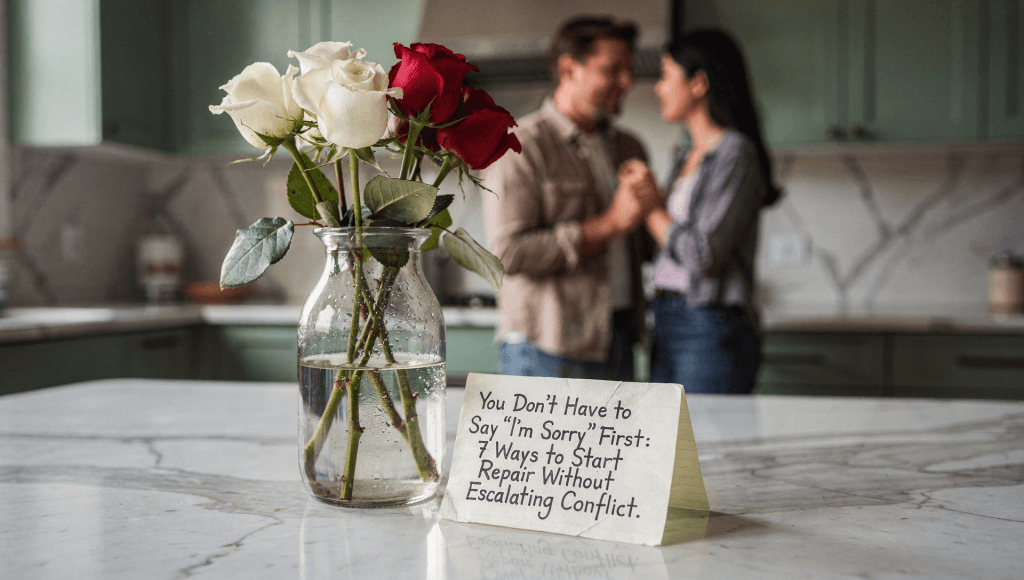
You Don’t Have to Say “I’m Sorry” First: 7 Ways to Start Repair Without Escalating Conflict
In This Article
- Repair Without Saying Sorry: Why “I’m Sorry” Can Feel Hard
- Repair Without Saying Sorry Starts With One Key Shift
- Repair Without Saying Sorry: 7 Ways to Start Repair Without Escalating Conflict
- Repair Without Saying Sorry Way 1: “Can We Pause and Come Back-”
- Repair Without Saying Sorry Way 2: “I Don’t Want Us to Fight Like This”
- Repair Without Saying Sorry Way 3: “Let Me Try That Again”
- Repair Without Saying Sorry Way 4: “I’m Not Against You”
- Repair Without Saying Sorry Way 5: “Help Me Understand What You Mean”
- Repair Without Saying Sorry Way 6: “I Can See How That Landed on You”
- Repair Without Saying Sorry Way 7: “Can We Solve This Together-”
- Repair Without Saying Sorry: Why These Phrases Work So Well
- Repair Without Saying Sorry: A Simple Plan for Your Next Conflict
- Repair Without Saying Sorry: What If Your Spouse Doesn’t Respond Well-
- Repair Without Saying Sorry: When to Move From Repair to Apology
- Closing: Reconciliation Begins With Intention, Not Perfection
For some people, “I’m sorry” feels vulnerable, forced, or overwhelming – especially in the heat of conflict. This post offers practical alternatives that still move the relationship toward repair, proving that reconciliation begins with intention, not perfection.
If you’ve ever been in an argument where you knew you needed to move toward your spouse – but the words “I’m sorry” felt stuck in your throat – you’re not alone.
Sometimes “I’m sorry” feels too big.
Too final.
Too exposed.
Too much like admitting total guilt.
Too much like surrendering your dignity.
Too much like “you were right and I was wrong.”
And when “I’m sorry” feels impossible, couples tend to do one of two things:
They escalate to protect pride.
Or they withdraw to protect themselves.
Both paths lead to distance.
At Live Your Best Marriage, we want you to have a third option: repair without escalating – even when you can’t say “I’m sorry” yet.
 Because here’s the truth: reconciliation rarely starts with perfect words. It usually starts with a small move toward connection – a repair attempt.
That’s why the cornerstone post for this mini-series is so important: Repair Attempts: The Most Underrated Skill in Strong Marriages at https://blog.liveyourbestmarriage.com/connection/repair-attempts-marriage explains how tiny repair moves keep conflict from turning into emotional distance.
This post is your practical toolbox:
7 ways to start repair without saying “I’m sorry” first – so you can stop the spiral, lower the temperature, and come back to the issue with more safety.
Before we go further, an important note on safety and scope.
This post is intended for healthy, non-abusive marriages navigating everyday conflict and communication challenges. It does not apply to situations involving physical abuse, emotional abuse, coercive control, intimidation, manipulation, or untreated severe mental health conditions. If you are experiencing fear, harm, threats, or ongoing emotional damage in your relationship, taking responsibility or initiating repair attempts is not the solution. In those cases, we strongly encourage you to seek help from a licensed therapist, counselor, pastor, or a trusted professional trained in abuse dynamics. Growth requires safety. Repair only works where mutual respect exists.
Now let’s build your repair language – so you’re not trapped between pride and silence.
Ready to identify your next best step?
The United Front Audit gives you a personalized picture of what needs work - and a clear path forward as a couple.
Take the Audit - It's Free →Repair Without Saying Sorry: Why “I’m Sorry” Can Feel Hard
Let’s normalize what’s happening.
“I’m sorry” can feel hard for a lot of reasons, including:
You associate apology with blame
You grew up in a home where apologies were used against you
You fear being the only one who repairs
You feel wronged and don’t want to “let them off the hook”
You’re emotionally flooded and can’t access soft words
You feel shame, and shame makes you defensive
You’re trying to protect your dignity
None of this means you don’t love your spouse.
It means you need a better pathway into repair.
Because the goal isn’t to force words you don’t mean. The goal is to move toward connection in a way that doesn’t escalate conflict.
Repair Without Saying Sorry Starts With One Key Shift
 Here’s the shift:
You’re not trying to declare guilt.
You’re trying to restore safety.
When safety returns, apology becomes easier.
When safety returns, truth can be discussed without attacking.
This is why “repair without saying sorry” is so powerful: it gives you a bridge back to safety without requiring you to jump straight into a full apology.
If you and your spouse tend to get stuck waiting for each other to go first, it’s worth revisiting the cornerstone that started this series: Who Should Apologize First in Marriage- Why the Question Itself Keeps You Stuck at https://blog.liveyourbestmarriage.com/communication/who-should-apologize-first.
Now let’s get to the 7 repair starters.
Repair Without Saying Sorry: 7 Ways to Start Repair Without Escalating Conflict
Each of these repair starters can be spoken in under 10 seconds. That’s intentional.
Long speeches often sound like arguments. Short repair attempts sound like peace.
Choose one that fits your personality and the moment.
Repair Without Saying Sorry Way 1: “Can We Pause and Come Back-”
 This is one of the most powerful phrases in marriage conflict because it acknowledges the heat without blaming.
Try:
“Can we pause and come back-”
“I need a short break so I don’t say something I regret.”
“I’m getting flooded. Can we take 20 minutes and return-”
Why it works:
It stops escalation without turning into withdrawal. It communicates, “I’m still committed to the conversation – I just need regulation first.”
Important tip:
Give a time frame. “Let’s come back at 7:30” is better than “I need space.” A pause without return becomes avoidance.
This tool is especially helpful if your marriage tends to spiral into power struggles or standoffs. If that’s you, read The Scorekeeping Trap: How Waiting for an Apology Turns Conflict Into a Power Struggle at https://blog.liveyourbestmarriage.com/conflict/scorekeeping-apologies.
Repair Without Saying Sorry Way 2: “I Don’t Want Us to Fight Like This”
This is a relationship-focused repair attempt. You’re not debating who’s right – you’re naming what you want.
Try:
“I don’t want us to fight like this.”
“I don’t want this to turn into distance between us.”
“I don’t want to hurt each other.”
Why it works:
It pulls the conversation out of the courtroom mindset and puts the relationship back at the center.
This is the opposite of “who started it.” It’s “where are we going-”
Discover what's fueling tension in your marriage
It's rarely just one thing. The United Front Audit maps the pressure points so you know exactly where to focus.
See Your Results →Repair Without Saying Sorry Way 3: “Let Me Try That Again”
 This is a restart phrase. It acknowledges you came in wrong – without making a full apology statement.
Try:
“Let me try that again.”
“Okay, that came out harsh. Restart.”
“I want to say that differently.”
Why it works:
It immediately lowers defensiveness because you’re taking ownership of delivery – not arguing the content.
It also aligns with the principle from 100% Responsibility Doesn’t Mean 100% Blame: A Healthier Way to Show Up After Conflict at https://blog.liveyourbestmarriage.com/mindset/100-percent-responsibility-marriage: you can own your part without taking all the blame.
Repair Without Saying Sorry Way 4: “I’m Not Against You”
 This one is emotional medicine. It’s especially helpful when conflict starts feeling like enemies.
Try:
“I’m not against you.”
“I’m on your side.”
“I don’t want to win. I want to understand.”
“We’re a team, even when we disagree.”
Why it works:
It calms the nervous system. It reduces the sense of threat. It reminds both of you that conflict is a moment – not an identity.
If you often find yourself thinking “I didn’t do anything wrong, so why should I soften-” you’ll want to read “But I Didn’t Do Anything Wrong”: Why That Belief Blocks Emotional Maturity at https://blog.liveyourbestmarriage.com/emotional-growth/i-did-nothing-wrong, because this phrase is the antidote to moral certainty.
Repair Without Saying Sorry Way 5: “Help Me Understand What You Mean”
This repair attempt shifts the conversation from accusation to curiosity.
Try:
“Help me understand what you mean.”
“Can you say that again slower-”
“What’s the main thing you need me to hear-”
Why it works:
When you ask for understanding, you communicate safety. You stop trying to win and start trying to connect.
This is especially powerful when your spouse feels unheard – because being heard is often the first step toward calm.
Important tip:
Only use this if you truly plan to listen. If you ask this as a tactic while preparing your rebuttal, it will backfire.
Repair Without Saying Sorry Way 6: “I Can See How That Landed on You”
 This one is about impact – without immediately admitting intent.
Try:
“I can see how that landed on you.”
“I get why that felt hurtful.”
“I can see how that sounded dismissive.”
Why it works:
Many arguments escalate because someone feels invalidated. Naming impact lowers emotional intensity quickly.
This is not saying “you’re right about everything.” It’s saying “your experience matters.”
For couples who struggle to apologize when hurt, this phrase often becomes the first bridge. And it leads naturally into the deeper message of Why Healthy Couples Apologize Even When They Feel Wronged at https://blog.liveyourbestmarriage.com/connection/apologizing-when-hurt.
Repair Without Saying Sorry Way 7: “Can We Solve This Together-”
This is a future-focused repair attempt. It invites teamwork.
Try:
“Can we solve this together-”
“I want us to figure this out, not fight.”
“What would help us prevent this next time-”
Why it works:
It turns conflict into collaboration. It shifts from blame to building.
It also helps couples who get stuck in repeating arguments because it aims at patterns and solutions, not just the latest incident.
Not sure what's really going wrong?
The United Front Audit helps you pinpoint exactly where your marriage unity is breaking down - in just 3 minutes.
Take the Free Audit →Repair Without Saying Sorry: Why These Phrases Work So Well
All seven repair starters do something important:
They interrupt escalation without demanding a verdict.
They help you avoid the “scorekeeping trap” of waiting for a confession first. They help you avoid the “courtroom mindset” that turns marriage into prosecution. And they help you step into emotional maturity – where you can stay connected while still being honest.
If your marriage struggles with the “who goes first” dynamic, remember: repair attempts are how you go first without feeling like you’re losing.
Repair Without Saying Sorry: A Simple Plan for Your Next Conflict
 Try this three-step plan the next time things start heating up.
Step 1: Choose one repair starter
Pick one phrase from the list and practice it until it feels natural.
Step 2: Pair it with a regulation action
Lower your voice
Relax your shoulders
Take a breath
Sit down
Turn toward your spouse
Slow down your pace
Step 3: Make a return plan
If you pause, schedule the return: “Let’s talk again in 20 minutes.”
This is what keeps “pause” from becoming avoidance.
Repair Without Saying Sorry: What If Your Spouse Doesn’t Respond Well-
Sometimes your spouse won’t receive your repair attempt right away.
They might stay cold.
They might say, “Whatever.”
They might accuse you of manipulating.
Don’t panic.
Remember: repair attempts are skills, and your marriage may not be used to them yet.
Try this steady response:
“I hear you. I’m not trying to get out of the issue. I’m trying to lower the heat so we can talk better.”
Then stay consistent over time. Many marriages soften when they see that repair attempts are genuine – not tactics.
Repair Without Saying Sorry: When to Move From Repair to Apology
Repair isn’t a substitute for apology forever.
Repair is the bridge that makes apology possible.
Once the temperature lowers, then you can move to ownership:
“I’m sorry for my tone.”
“I’m sorry I interrupted.”
“I’m sorry I shut down.”
This is exactly what we teach in the cornerstone Repair Attempts post at https://blog.liveyourbestmarriage.com/connection/repair-attempts-marriage: reconnection first, then deeper repair.
Closing: Reconciliation Begins With Intention, Not Perfection
If you’ve been waiting to say “I’m sorry” until you feel calm, until you feel justified, until your spouse goes first, or until the moment is perfect – this is your permission to start smaller.
Repair without saying sorry is still repair.
It’s still movement toward love.
It’s still emotional maturity.
It’s still leadership.
Choose one phrase. Practice it. Use it this week.
Because strong marriages aren’t built by never fighting.
They’re built by coming back – quickly, gently, and consistently.


Keep Reading

Who Should Apologize First in Marriage- Why the Question Itself Keeps You Stuck
“Who should apologize first-” sounds like a practical marriage question. It feels fair. It feels logical. It feels…

The Criticism Trap: Why Your Words Are Costing You Connection
Every marriage has moments when one spouse feels the urge to “fix” the other. It often starts with…

From Blame to Curiosity: Listening for the Real Story Beneath the Conflict
Every couple knows the feeling of getting trapped in a familiar argument-one that feels more like a courtroom…