
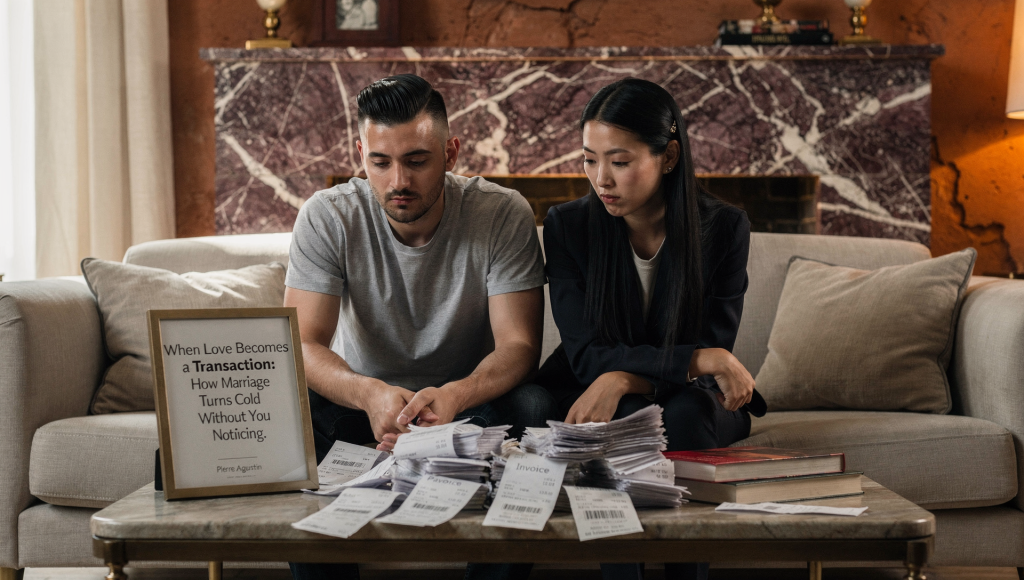
When Love Becomes a Transaction: How Marriage Turns Cold Without You Noticing
In This Article
- Transactional Marriage: The Hidden Agreement You Never Meant to Make
- Signs Your Marriage Is Turning Transactional
- How Transactional Thinking Creeps In Without You Realizing It
- Scorekeeping in Transactional Marriage: The Relationship Tax That Kills Generosity
- Why Transactional Marriage Drains Emotional Safety
- Conditional Affection: The Moment Love Starts Feeling Like Leverage
- Negotiation Conversations: When Curiosity Gets Replaced by Strategy
- The Real Root: Transactional Marriage Often Comes from Pain, Not Greed
- How to Warm Up a Transactional Marriage Without Becoming a Doormat
- Replacing Transactional Marriage with a Culture of Generosity
- A Simple Transactional Marriage Audit: 10 Questions That Reveal the Coldness
- What If One Spouse Is More Transactional Than the Other-
- Bringing Back Warmth: The Small Courtesies That Make Love Feel Safe Again
- Conclusion: Love Was Never Meant to Feel Like a Contract
You don’t wake up one day and decide, “From now on, I’m going to treat my spouse like a means to an end.”
That’s not how transactional marriage happens.
It happens gradually, quietly, and almost always under pressure. Pressure to get through the week. Pressure to keep the house functioning. Pressure to manage kids, bills, schedules, work stress, health, family obligations, and emotional exhaustion.
And in that pressure, something shifts.
You stop relating to your spouse as a person and start relating to your spouse as a provider of outcomes.
You start tracking who’s giving more. You start noticing what you’re not getting. You start withholding what you used to give freely. You start negotiating instead of connecting. You start protecting yourself instead of pursuing closeness.
 That’s when love begins to turn into a transaction.
Not because you stopped caring, but because you stopped feeling safe.
Not because you hate each other, but because you’re trying to survive.
Not because your marriage is doomed, but because your habits changed.
This post will help you recognize the subtle signs that love has become a transaction, why transactional thinking makes marriages feel cold, and how to restore warmth, generosity, and emotional safety before the distance becomes permanent.
Ready to identify your next best step?
The United Front Audit gives you a personalized picture of what needs work - and a clear path forward as a couple.
Take the Audit - It's Free →Transactional Marriage: The Hidden Agreement You Never Meant to Make
 A transactional marriage is not always obvious. It’s not always “If you do this, I’ll do that” spoken out loud.
It’s often a silent agreement that forms when both spouses feel disappointed.
It sounds like:
I’ll be kind when you’re kind. I’ll be affectionate when you’re affectionate. I’ll help when you notice my help. I’ll listen when you finally listen to me. I’ll respect you when you earn it. I’ll give emotionally when I’m sure you won’t hurt me.
This is the relationship version of emotional commerce.
You exchange good behavior for good behavior. You exchange attention for attention. You exchange effort for effort. You exchange affection for affection.
And if you feel like your “payment” isn’t being matched, you stop giving.
At first, that feels reasonable. Even mature.
But over time, transactional marriage doesn’t create fairness. It creates distance.
Because love is not meant to be a bargaining chip. Love is meant to be the environment where bargaining becomes unnecessary.
If you want the bigger picture framework for why this happens, the cornerstone post in this series explains it through the “goose and the golden eggs” metaphor and how chasing outcomes makes the relationship itself sick. It connects directly to what you’re seeing here: https://blog.liveyourbestmarriage.com/connection/goose-and-golden-eggs-marriage
Signs Your Marriage Is Turning Transactional
 Many couples don’t notice the shift because it feels normal. It feels like adulthood. It feels like “this is just marriage after kids” or “this is just what happens after years together.”
Here are some signs that transactional marriage has taken root.
You give affection only when things are going well. You keep mental tabs on who has done more. You feel resentful doing basic kindness. You interpret requests as demands. You ask, “Why should I-” more than “How can I help-” You feel like conversations are negotiations. You avoid vulnerability because it feels unsafe. You feel like you have to earn warmth. You feel like your spouse withholds until they get what they want. You do “nice things” with an expectation of payoff.
Transactional marriage often shows up as a subtle emotional chill. The marriage still functions, but it doesn’t feel alive.
You might still do family events. Still coordinate life. Still pay bills. Still show up.
But the warmth is missing.
The spontaneous affection is missing. The playful tone is missing. The “I’m on your side” feeling is missing.
And that missing warmth is not random. It’s the natural consequence of a relationship becoming conditional.
How Transactional Thinking Creeps In Without You Realizing It
 Transactional marriage rarely begins with selfishness. It often begins with disappointment.
One spouse feels unseen. The other feels criticized. One feels overworked. The other feels controlled. One feels lonely. The other feels rejected. One feels like they’re always giving. The other feels like nothing they do is enough.
So both spouses start protecting themselves.
Protection often looks like withdrawal.
And withdrawal often looks like this:
You stop doing the extra kind thing. You stop initiating affection. You stop sharing your inner world. You stop giving the benefit of the doubt. You stop being generous in interpretation.
At first, you might tell yourself: I’m just not going to try so hard. I’m just not going to let myself get hurt. I’m just matching their energy. I’m just setting boundaries.
But if what you call “boundaries” is actually withholding designed to make your spouse feel the loss, you’re not protecting yourself. You’re pulling the marriage into a transaction.
This is why it creeps in so quietly. Most couples do not see it as transactional. They see it as survival.
And that’s what makes it dangerous. Because you can feel justified while your marriage grows colder.
Scorekeeping in Transactional Marriage: The Relationship Tax That Kills Generosity
 Scorekeeping is one of the strongest fuel sources for transactional marriage.
Scorekeeping is not just remembering what happened. It’s tracking to justify withholding.
I did the dishes three times, you only did it once. I initiated last time, you didn’t. I apologized first, you never do. I’ve been patient, you haven’t. I supported your dreams, you didn’t support mine.
The problem is not memory. The problem is the emotional math.
When you treat marriage like a ledger, you stop being generous.
You stop giving freely. You give cautiously.
You begin to feel that every act of kindness is a “cost” that must be paid back.
This is one of the fastest ways a marriage loses emotional safety. Because generosity is what makes love feel abundant.
When generosity disappears, love feels scarce.
And when love feels scarce, spouses begin competing for it.
That competition creates more coldness.
Why Transactional Marriage Drains Emotional Safety
 Emotional safety is the sense that your spouse is for you, even when you’re imperfect.
Transactional marriage removes that safety.
It communicates:
I’m kind only if you’re kind. I’m close only if you do it right. I’m warm only if I’m satisfied. I’ll be supportive only if I’m getting support. I’ll stay open only if you behave.
When that becomes the emotional atmosphere, both spouses start walking on eggshells.
Not always loudly. Sometimes quietly.
They stop sharing honestly. They stop bringing up needs. They stop risking vulnerability.
Because vulnerability becomes a negotiation tool rather than a gift.
Emotional safety requires something that transactional marriage cannot provide: steadiness.
Not perfection, but steadiness.
A sense that love is not constantly being evaluated.
This is why transactional marriage is not just a habit problem. It’s a safety problem.
And safety is the foundation of intimacy.
When safety goes down, intimacy goes down.
Discover what's fueling tension in your marriage
It's rarely just one thing. The United Front Audit maps the pressure points so you know exactly where to focus.
See Your Results →Conditional Affection: The Moment Love Starts Feeling Like Leverage
 One of the most painful parts of transactional marriage is conditional affection.
Conditional affection is when warmth, touch, kindness, or intimacy is offered as a reward or withheld as a punishment.
It might look like:
You’re only affectionate when your spouse agrees with you. You stop touching when you’re upset. You initiate sex only when you feel appreciated. You withhold sex to “teach a lesson.” You act cold until your spouse apologizes the way you want. You become warm only after you get what you need.
Sometimes it is intentional. Sometimes it is subconscious.
But your spouse experiences it the same way: love feels like leverage.
When love becomes leverage, your spouse stops feeling safe with you.
And when your spouse stops feeling safe, they stop feeling open.
This is why transactional marriage often creates a cycle:
One spouse withholds to protect themselves. The other spouse reacts with more withdrawal. Both feel justified. Both feel lonely.
If you recognize that control and manipulation has become part of the dynamic, the next post in this series is designed to expose those patterns clearly and compassionately: https://blog.liveyourbestmarriage.com/communication/control-levers-marriage
Negotiation Conversations: When Curiosity Gets Replaced by Strategy
 In a connected marriage, conversations feel like partnership.
In transactional marriage, conversations feel like negotiations.
Instead of “Help me understand,” you hear “Here’s why you should.”
Instead of listening, you prepare your argument. Instead of validating feelings, you correct interpretations. Instead of seeking connection, you seek agreement.
Negotiation conversations often include:
Fine, I’ll do it, but you need to do this. I did that last time, so you owe me. If you want me to change, you need to change first. I’ll apologize if you admit you were wrong. I’ll forgive you if you do this to make up for it.
Even when those statements sound fair, they create a subtle tug-of-war energy.
And tug-of-war is exhausting.
Marriage is not meant to feel like bargaining for basic care.
When marriage becomes constant negotiation, both spouses start avoiding conversations. Avoidance then deepens the coldness.
The Real Root: Transactional Marriage Often Comes from Pain, Not Greed
 Here’s the truth that helps couples heal without shame:
Transactional marriage is often built on fear and pain.
People become transactional when they feel unsafe giving freely.
That safety could be missing because of:
Repeated disappointment Harsh criticism Broken trust Emotional neglect Unresolved conflict Feeling like efforts don’t matter Feeling like your needs are invisible Feeling taken for granted Feeling rejected
So the heart starts protecting itself.
Protection looks like conditions.
I won’t give unless I know it’s safe. I won’t risk unless I know you’ll meet me. I won’t open unless you prove you won’t hurt me.
This is understandable.
But here’s the problem: conditions don’t restore safety. They create distance.
So healing requires a different approach.
Not pretending pain didn’t happen. Not ignoring boundaries. Not forcing quick forgiveness.
But shifting the relationship out of extraction mode and back into protection mode.
This is why the cornerstone framework “Protect the Goose” is so important in the overall journey. It gives couples a way to protect the relationship itself without losing truth or boundaries: https://blog.liveyourbestmarriage.com/foundation/protect-the-goose-marriage
How to Warm Up a Transactional Marriage Without Becoming a Doormat
 This is the big question.
If I stop being transactional, won’t I be the only one giving- If I stop withholding, won’t they take advantage- If I soften, won’t they stay the same-
You can warm up transactional marriage without becoming a doormat by doing two things at the same time:
- Offer care without manipulating for a payoff
- Keep clear boundaries about what you will and won’t accept
Those two together are powerful.
Care restores warmth. Boundaries restore dignity.
Here are practical ways to start.
Start with one “free” kindness a day
Do one act of kindness that is not designed to earn anything. This retrains your nervous system to give from love, not leverage.
Use “I miss us” language instead of “you never” language
“I miss feeling close to you” is an invitation. “You never care” is a courtroom statement.
Ask for connection directly
Instead of punishing with coldness, ask: “Can we have 10 minutes together tonight-” Directness reduces games.
Repair quickly when you slip into coldness
A short repair prevents the chill from settling into days.
Protect your tone
Tone is often the first sign you’re becoming transactional. Watch for sharpness, sarcasm, or cold efficiency.
If you need help learning how to lead with care without losing yourself, the post “Emotional Leadership in Marriage: Caring First Without Becoming a Doormat” fits perfectly at this stage of the journey: https://blog.liveyourbestmarriage.com/communication/emotional-leadership-marriage
Replacing Transactional Marriage with a Culture of Generosity
 The opposite of transactional marriage is not being a pushover.
The opposite is generosity.
Generosity in marriage means:
Assuming the best when possible
Being kind without needing immediate reward
Giving appreciation more freely
Choosing warmth even when you feel tension
Seeing your spouse as human, not as a problem
Offering small courtesies consistently
Being quicker to repair than to punish
Generosity creates a culture.
And culture changes everything.
In a culture of generosity, spouses don’t have to earn basic respect. It’s the environment. That environment then makes growth possible.
But generosity doesn’t happen by accident. It happens by intentional replacement.
You replace:
Scorekeeping with appreciation Negotiation with curiosity Withholding with clarity Coldness with repair Strategy with softness
If you want to go deeper on how control gets replaced by care in real conversations, the post “Replacing Control With Care: The Shift That Restores Safety and Trust” expands this into practical steps and phrases: https://blog.liveyourbestmarriage.com/connection/replacing-control-with-care
Not sure what's really going wrong?
The United Front Audit helps you pinpoint exactly where your marriage unity is breaking down - in just 3 minutes.
Take the Free Audit →A Simple Transactional Marriage Audit: 10 Questions That Reveal the Coldness
Take this quick audit. Answer honestly. You don’t need to share it with anyone unless you want to.
- Do I give affection only when I feel pleased with my spouse-
- Do I withhold warmth to make a point-
- Do I keep score in my head-
- Do I do nice things expecting something in return-
- Do I use silence as leverage-
- Do I assume negative intent quickly-
- Do I feel resentful when asked for basic support-
- Do I treat conflict as negotiation rather than connection-
- Do I feel safer being cold than being vulnerable-
- Do I avoid kindness because it feels like “letting them off the hook”-
If you answered yes to several, it doesn’t mean your marriage is broken. It means your marriage has a pattern.
And patterns can be replaced.
What If One Spouse Is More Transactional Than the Other-
 Sometimes one spouse is clearly more transactional. They withdraw faster. They keep score more. They demand more. They withhold more.
If that’s your situation, here’s what matters:
Do not respond with equal coldness.
That is how transactional marriage becomes permanent.
Instead, choose a different posture:
Be clear about what hurts. Stay consistent in your tone. Offer care without performing for approval. Set boundaries when needed. Repair when possible. Invite, don’t corner.
And if you’re stuck in a cycle of proof hunting and constant justification, that’s often the engine behind transactional behavior. The post “Proof Hunting: Why Looking for Evidence You’re Right Is Poisoning Your Marriage” helps dismantle that engine: https://blog.liveyourbestmarriage.com/conflict/proof-hunting-marriage
Bringing Back Warmth: The Small Courtesies That Make Love Feel Safe Again
 When a marriage turns cold, couples often think the solution is something big.
A vacation. A dramatic conversation. A major breakthrough. A grand apology. A new schedule.
Those can help, but warmth usually returns through small courtesies.
A gentle tone. A soft greeting. A brief touch on the shoulder. A sincere thank you. A playful comment. A quick repair. A compassionate question.
These are not small. They are the building blocks of emotional safety.
If you want to build this skill intentionally, the post “Kindness Is Not Weakness: Why Courtesy Is a Marriage Skill, Not a Personality Trait” is one of the most practical steps in this series, especially if kindness feels hard right now: https://blog.liveyourbestmarriage.com/connection/kindness-is-not-weakness
Conclusion: Love Was Never Meant to Feel Like a Contract
A healthy marriage is not a contract where you trade effort for effort like a business partnership.
Marriage is a covenant relationship that thrives on trust, generosity, and emotional safety.
If your marriage has been feeling cold, don’t rush to panic. Don’t rush to label it as hopeless. Often, coldness is a sign that both people have been protecting themselves in ways that created distance.
The good news is that coldness can melt.
Not by forcing outcomes, but by restoring the environment where outcomes become possible.
That environment is warmth. It’s kindness. It’s repair. It’s curiosity. It’s emotional safety. It’s generosity. It’s leadership without control.
And when that environment returns, love stops feeling like a transaction and starts feeling like home again.


Keep Reading

Kindness Is Not Weakness: Why Courtesy Is a Marriage Skill, Not a Personality Trait
Many couples abandon small kindnesses once life gets busy or conflict becomes chronic. They stop saying please. They…

Replacing Control With Care: The Shift That Restores Safety and Trust
Control is often a reaction to fear. Fear of being unheard. Fear of being dismissed. Fear of repeating…

The Goose and the Golden Eggs: Why Chasing Results Is Quietly Killing Your Marriage
Most marriages don’t fall apart because one spouse is cruel. They unravel because the relationship gets put under…