
Vulnerability with Boundaries: Open Up, Don’t Fall Apart

In This Article
- What “Vulnerability with Boundaries” Really Means
- Why Unbounded Vulnerability Backfires (and How to Prevent It)
- The PPPP Framework: Pace • Place • Purpose • Pairing
- Titration: Dose Your Honesty So It Heals, Not Hurts
- Timing Windows: When Honesty Lands Best
- Scripts for Vulnerability with Boundaries (Use, Adapt, Make Yours)
- Guardrails for Both Sides (Speaker and Listener)
- Oversharing vs. Vulnerability vs. Manipulation
- When You’re Ready and Your Spouse Isn’t
- Make Vulnerability Credible Over Time
- Pair Openness with Environmental Help
- Repair After Messy Vulnerability
- A 30/60/90 Plan for Vulnerability with Boundaries
- Case Studies: Bounded Vulnerability in Real Homes
- Safety First: When Vulnerability Is the Wrong Tool
- FAQs About Vulnerability with Boundaries
- Closing: Honesty Plus Pacing Equals Safety
Honesty is oxygen for a marriage-but unfiltered, all-at-once honesty can feel like a fire hose. Vulnerability with Boundaries is the art of sharing motives, fears, and hopes in a way that invites teamwork rather than caretaking. It’s truth with pacing, tenderness with timing, and openness with limits. When you titrate what you share, pick gentle windows, and set kind guardrails, vulnerability nourishes trust instead of flooding the room.
 If you’re trying to make your change credible over time (not just in one emotional download), pairing Vulnerability with Boundaries with the milestone rhythm in The Consistency Clock helps your spouse see and feel your steadiness at 30/60/90 days.
Ready to identify your next best step?
The United Front Audit gives you a personalized picture of what needs work - and a clear path forward as a couple.
Take the Audit - It's Free →What “Vulnerability with Boundaries” Really Means
 Vulnerability with Boundaries is measured openness: you tell the truth about what’s alive inside you and you carry your share of regulation, timing, and responsibility. It has two equal halves:
- Vulnerability: sincerity, specificity, and visibility (naming feelings, motives, and hopes).
- Boundaries: pacing (how much), timing (when), and guardrails (what’s off-limits).
This approach asks: What version of my truth will build connection right now- Sometimes the answer is a brief share and a request to revisit later. Sometimes it’s two minutes and a hug. Sometimes it’s “I want to be honest, and I’m going to catch my breath first.” Boundaries don’t dilute truth; they deliver it safely.
To make your honesty repeatable (not a one-off), practice the micro-rhythms in Say Less, Do More, which turns good intentions into small, scheduled touchpoints your spouse can count on.
Why Unbounded Vulnerability Backfires (and How to Prevent It)
 Raw confession without limits can overload a tired partner or recruit them into a parent role. Classic pitfalls:
- Timing mismatch: you’re ready to process at 10:15 p.m.; your spouse’s brain clocked out at nine.
- Volume overload: a 30-minute monologue where two minutes would have been plenty.
- Responsibility shift: sharing morphs into “please fix my feelings.”
- No landing gear: you open big topics with no plan to slow down or pause.
Vulnerability with Boundaries keeps the benefits of honesty while removing these costs. You scale the dose, choose a calm window, and hold your side of the work. If you know nights are “hot,” try the gentle rooms and routes in New Places, New People-a walk-and-talk or porch reset makes truth easier to carry.
The PPPP Framework: Pace • Place • Purpose • Pairing
 Use this four-part framework to make Vulnerability with Boundaries simple enough to keep:
Pace: How much truth fits today- Start small. Try “one feeling, one need, one next step.”
Place: Where will your bodies stay calm- Swap the kitchen-at-rush-hour for a porch or walk route.
Purpose: What outcome are you after-being seen, a decision, or a debrief- Name it upfront.
Pairing: What support will you bring so your partner isn’t your regulator (water, breath, time limit)-
Example: “Can we do ten on the porch at 7:30- My purpose is to be seen, not to solve it tonight. I’ll bring tea and a timer.”
If you tend to speak fast when anxious, practice the body-first reset from Non-Reactive Strength before you start; it’s the fastest way to keep your share kind and clear.
Titration: Dose Your Honesty So It Heals, Not Hurts
 Medical teams titrate medicines; you can titrate honesty. Think teaspoons, not buckets:
- Titrate by time: two minutes now; schedule fifteen tomorrow.
- Titrate by topic: one slice of the story today (how it felt), the backstory later.
- Titrate by temperature: if voices rise, agree to pause for ten, then return at 8:15.
This is Vulnerability with Boundaries in action. You’re saying, “I’ll handle the dosage.” When you do, trust rises because your spouse can breathe while you’re being real.
If your share stirs defensiveness (yours or theirs), use the quick pause → label → ask routine from Trigger to Teacher to turn that spike into direction: “I’m scared this will overwhelm us. Could we do two minutes now and set a time tomorrow-”
Timing Windows: When Honesty Lands Best
 Good truth at a bad time feels bad. Set windows that make honesty welcome:
- No heavy talks after 9:00 p.m. Tired brains mis-hear.
- Use “Sunday 15.” A short weekly plan (meals, rides, one fun thing, 2-minute money check) from Say Less, Do More.
- Add “Tuesday 3.” A three-minute midweek micro-check-in-“Anything I can lift off you-”
- Protect Recovery Days. Plan low-pressure connection so your body can downshift; the blueprint in Recovery Days turns effort into strength.
When your spouse sees you timing vulnerably (instead of dumping randomly), they stop bracing and start listening.
Scripts for Vulnerability with Boundaries (Use, Adapt, Make Yours)
 To begin with self-regulation:
- “Give me 90 seconds to steady and then I’ll share one thing.”
For a brief share with a clear purpose:
- “Two minutes for me to be seen-not solved-okay-”
- “I’m afraid I’ll disappoint you, and I want to try this anyway. Can you listen and reflect back what you hear-”
To keep responsibility on your side:
- “I’m carrying my feelings. A hug would help, but I’ll still own my next step.”
To set a pause and return:
- “I’m heating up. I’ll take ten and be back at 8:15 to finish gently.”
For quick repair when you overshare:
- “I flooded you-sorry. Can we restart with two minutes and a timer-”
Clean, short repairs are your best friend here; the template in Apologize Right helps you restore connection when your share went long or sharp.
Discover what's fueling tension in your marriage
It's rarely just one thing. The United Front Audit maps the pressure points so you know exactly where to focus.
See Your Results →Guardrails for Both Sides (Speaker and Listener)
 For the speaker:
- Regulate first (longer exhale than inhale).
- Limit to one feeling, one need, one next step.
- Ask for the kind of listening you need (“reflect back,” “hold my hand,” “no fixing yet”).
For the listener:
- Reflect, don’t rebut: “What I hear is ____. Did I get it-”
- Ask permission: “Want ideas or just presence-”
- Honor the timer: when two minutes end, breathe and decide together what’s next.
These guardrails make Vulnerability with Boundaries feel safe for both of you. If you discover patterns of intimidation, control, or humiliation, that’s different-get clear with Friction Isn’t Abuse and prioritize safety over skill-building.
Oversharing vs. Vulnerability vs. Manipulation
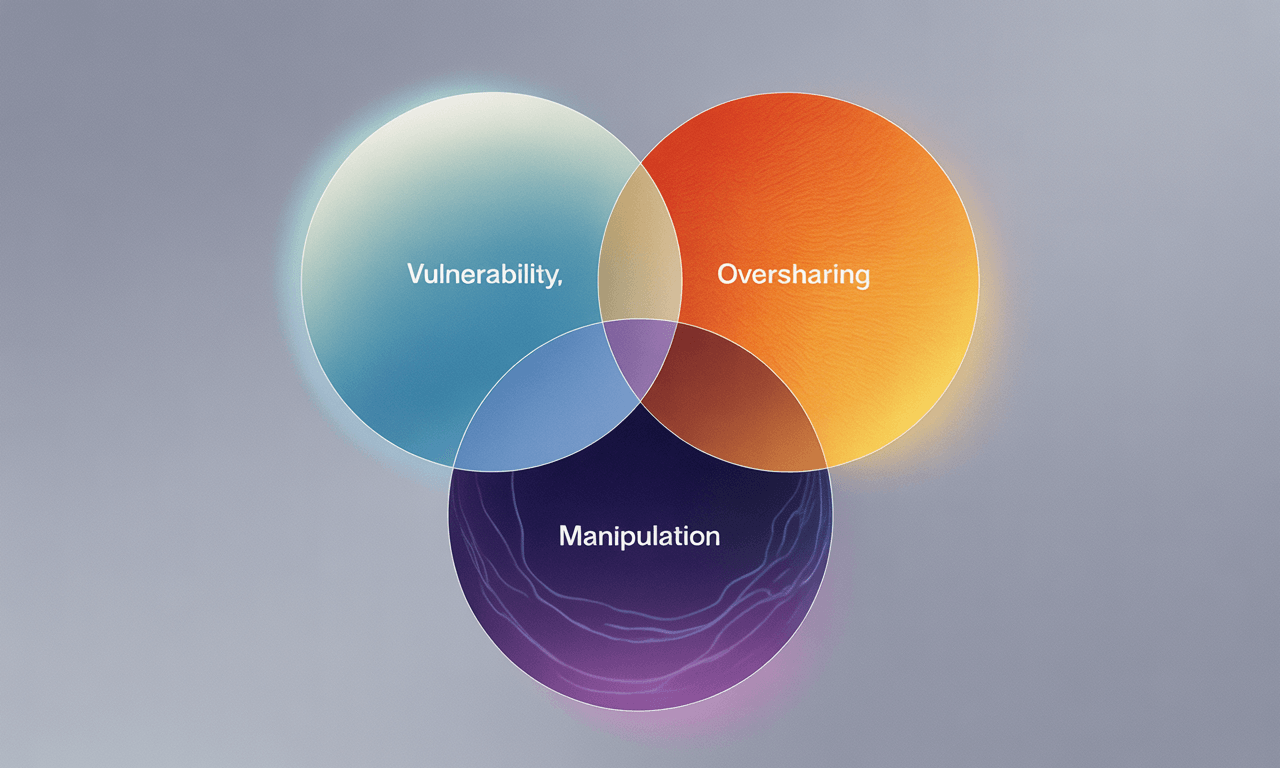
- Vulnerability: “Here’s how I feel and what I’ll do.” (self-responsible)
- Oversharing: “Here’s everything so you’ll carry me.” (flooding)
- Manipulation: “Here’s a story to coerce your choice.” (pressure)
Vulnerability with Boundaries stays self-responsible and low-pressure. You offer your truth and invite a response; you don’t force one. If you’re tempted to overshare, shrink to Minimum Viable Change-a 40-second gratitude text or one-sentence repair from Minimum Viable Change keeps connection alive without dumping.
When You’re Ready and Your Spouse Isn’t
 Coordinating change is harder than personal change. Use bridge habits so your honesty helps now and makes joining easy later. Try:
- Two phone-basket windows per week-less noise, more calm.
- Sunday 15 so planning feels light.
- One-sentence repairs on the same day.
This is classic lead gently; leave the door open. The playbook in Harder with Two shows you exactly how to move first without becoming the household engine, while Invite, Don’t Insist gives you pull-based language that draws your spouse closer.
Make Vulnerability Credible Over Time
 A weepy breakthrough won’t convince a spouse who’s seen big starts and quick fades. Let time certify your growth. Choose two or three visible behaviors and track them with The Consistency Clock:
- Repair speed: apologize within 24 hours.
- Money transparency: a two-minute check inside Sunday 15.
- Tone regulation: use the 90-second reset before hot topics.
At 30/60/90 days, your openness will feel less “new” and more “normal.”
Pair Openness with Environmental Help
 You’re not weak if you need friendlier rooms; you’re wise. Make vulnerable moments easier:
- Move big talks from the bedroom at 10 p.m. to a walk route at 6:30.
- Use a phone basket so pings don’t hijack empathy.
- Curate your feeds with the two-week reset in Retrain Your Feed so sarcasm doesn’t leak into your tone.
Small environmental upgrades make Vulnerability with Boundaries feel natural, not forced.
Repair After Messy Vulnerability
 You’ll overshare sometimes. You’ll cry in a way that asks your spouse to parent you. That’s okay-and repairable.
Use a clean, sub-60-second repair from Apologize Right:
- Name the harm: “I flooded you.”
- Own it: “That was too much to carry.”
- Offer restitution: “Two minutes now, or tomorrow at 7:30-”
- Ask what trust needs: “Anything else I can do differently next time-”
- Plan the guardrail: “I’ll set a timer and regulate first.”
Repair is not groveling; it’s building the bridge back to us.
Not sure what's really going wrong?
The United Front Audit helps you pinpoint exactly where your marriage unity is breaking down - in just 3 minutes.
Take the Free Audit →A 30/60/90 Plan for Vulnerability with Boundaries
 Days 1–7 (Install Guardrails):
- Agree on no heavy talks after 9 p.m.
- Choose a gentle place (porch, walk route).
- Practice the 90-second reset from Non-Reactive Strength before any hard talk.
Days 8–30 (Titrate & Track):
- Use “one feeling • one need • one next step.”
- Start Sunday 15 from Say Less, Do More.
- Track two visible behaviors with The Consistency Clock.
Days 31–60 (Normalize):
- Add a midweek Tuesday 3 check-in.
- Replace one “hot” location with a walk-and-talk from New Places, New People.
- Run one Recovery Day (fun, prayer, quiet) via Recovery Days.
Days 61–90 (Integrate):
- Keep a two-night phone basket routine.
- When you slip, repair fast with Apologize Right.
- If timelines differ, use bridge habits from Harder with Two.
Case Studies: Bounded Vulnerability in Real Homes
 The Midnight Flood
They kept having “state-of-the-union” talks at 10:30 p.m. and waking resentful. They installed no heavy talks after 9, moved serious topics to a walk route, and used “two minutes to be seen, not solved.” Within three weeks, they reported fewer next-day regrets.
The Fix-It Reflex
She shared; he solved. They practiced “reflect before respond” and asked, “Ideas or presence-” Vulnerability landed softer. He learned to say, “What I hear is ____,” and she learned to request, “Presence first, ideas tomorrow.” Repairs shortened and affection returned.
The Overshare Apology
He delivered a 25-minute confession that left her shaky. The next day, he used a clean 45-second repair from Apologize Right and proposed a paced follow-up: two minutes now, a timer, and a clear purpose. She said yes.
Safety First: When Vulnerability Is the Wrong Tool
 If there’s violence, coercion, stalking, or chronic humiliation, you don’t need better vulnerability; you need safety. Get clarity using Friction Isn’t Abuse. In danger, silence and distance are wisdom, not avoidance.
FAQs About Vulnerability with Boundaries
 Isn’t this just being guarded-
No. Guardedness hides; Vulnerability with Boundaries shares wisely. You’re honest-just paced and purposeful.
What if my spouse never opens up-
Lead gently with bridge habits and pull-based invites from Invite, Don’t Insist. Keep your steadiness visible with The Consistency Clock.
How do we keep talks from spiraling-
Pick kind rooms, use timers, and regulate first. If it’s late or loud, pause and return tomorrow. The rhythms in Say Less, Do More keep conversations bite-sized.
What if we backslide-
Normal. Repair fast, shrink the next share, and keep the streak alive with one tiny move from Minimum Viable Change.
Closing: Honesty Plus Pacing Equals Safety
 You don’t need grand speeches to feel close again. You need Vulnerability with Boundaries-truth delivered with timing, titration, and tenderness. Regulate first. Share one feeling, one need, one next step. Use timers and gentle rooms. Repair fast when you overshoot. And let time certify your growth so openness feels trustworthy, not risky.
If you’re ready to make this your reputation, not just your intention, track two or three visible behaviors with The Consistency Clock: 30-60-90 Day Milestones. When vulnerability becomes predictable, connection becomes natural.





Keep Reading

The Consistency Clock: 30-60-90 Day Milestones
Change doesn’t become trust until it becomes consistent. The Consistency Clock is a simple, humane way to track…

Apologize Right: Repair Without Excuses
A clean apology does more than smooth feelings; it rebuilds trust-one honest, specific step at a time. When…

Say Less, Do More: Weekly Proof Your Spouse Can Feel
You’ve said the right things. You’ve meant them, too. But in marriage, trust isn’t built by big speeches-it’s…