
Confidence by Design: Tiny Risks That Teach Your Marriage Who You Are

In This Article
- Why “Confidence by Design” Beats Waiting for Feelings (designed confidence)
- The Identity Engine: Self-Signaling Creates Confidence (self-signaling → Confidence by Design)
- The Tiny-Risk Ladder: A Toolkit for Micro-Bravery (learn fast together)
- The Five-Part Micro-Bravery Script (Confidence by Design in action)
- Design the Room, Reduce the Risk (environmental cues for brave together)
- Confidence by Design in Daily Life (micro-bravery you’ll actually use)
- Communication Firsts: New Conversations, Not New Conflicts (fast-learning marriage skills)
- Confidence by Design Date Nights (brave together without the drama)
- The 30-Day Confidence by Design Plan (learn fast together)
- Metrics That Make Confidence Visible (proof fuels designed confidence)
- What If One Partner Is Hesitant- (safety-first brave together)
- Troubleshooting: When Tiny Risks Feel Silly (fast-learning friction)
- Conversation Scripts for Everyday Micro-Bravery (brave together words)
- From Tiny Risks to Micro-Adventures (your next step)
- Put a Bow on It: Confidence by Design Is a Choice
Confidence isn’t a feeling you wait for; it’s a memory of kept promises. When you and your spouse choose tiny, low-friction risks-new foods, new rooms, new conversations-you teach your relationship to remember, “We do brave things together.” Confidence by Design is the practice of engineering small experiences that are easy to attempt, quick to recover from, and rich in evidence. Over time, those micro-evidences stack into trust: trust in yourself, trust in your spouse, and trust in the “us” you’re building.
Ready to identify your next best step?
The United Front Audit gives you a personalized picture of what needs work - and a clear path forward as a couple.
Take the Audit - It's Free →Why “Confidence by Design” Beats Waiting for Feelings (designed confidence)
 If you wait to feel confident before you try something new, you’ll wait forever. Feelings follow evidence, and evidence follows action. That’s why Confidence by Design starts with small, winnable steps that produce quick proof. When you collect proof-“we tried,” “we recovered,” “we learned”-your nervous system updates its story about what’s possible.
The Identity Engine: Self-Signaling Creates Confidence (self-signaling → Confidence by Design)
 Before we list any tiny risks, understand the engine behind them: self-signaling. The story you repeat about yourselves quietly directs what you notice, attempt, and expect. If your internal narration says, “We’re not adventurous” or “We’re awkward with new people,” your behavior tries to make that true.
The good news: the loop also works in your favor. Act your way into a better story with tiny risks that are almost too small to fail. Each small success broadcasts a new identity signal to your brain: “We keep our promises. We try things. We recover quickly.” For a deeper dive on how identity loops form (and how to interrupt them), see our cornerstone: Who We Think We Are: Self-Signaling and Your Marriage Identity.
The Tiny-Risk Ladder: A Toolkit for Micro-Bravery (learn fast together)
 Think of confidence like a ladder. The first rungs should be so low you can step onto them on your hardest day. Build your own Confidence by Design ladder by choosing micro-actions in three arenas: new foods, new rooms, and new conversations.
Rung 1: Almost Effortless (30–90 seconds)
• Try a new condiment or tea flavor during a meal.
• Sit on the front porch together for two minutes before dinner.
• Ask each other one non-routine question: “What felt easy today-”
• Send a 15-word appreciation text in the afternoon.
Rung 2: Light Lift (5–15 minutes)
• Split a new appetizer at your regular restaurant.
• Rearrange one small corner: a reading chair by the window, a lamp on a timer.
• Ask a friend couple to share a favorite walk route and go once this week.
• Practice a soft start-up: “I’m not upset; I’m curious-can we look at the budget together for five minutes-”
Rung 3: Meaningful, Still Manageable (20–60 minutes)
• Try a new café in a nearby neighborhood and journal a few lines about it together.
• Host a low-effort game or dessert night for one couple.
• Attend a free community class or talk.
• Switch roles for an evening routine (you cook, I do cleanup; you read, I prep tomorrow).
The point isn’t the size of the risk; it’s the signal: we try. Repetition matters more than ambition.
The Five-Part Micro-Bravery Script (Confidence by Design in action)
 Design your tiny risks with this five-part script. It keeps things kind, quick, and concrete.
1) Approach (name one tiny experiment).
“Tonight let’s try the new taco truck and share one dish we’ve never had.”
2) Ask (invite consent and input).
“Would you be up for that- If not tacos, what’s one easy switch you’d enjoy-”
3) Act (keep the promise small).
“Let’s set a 20-minute timer and call it good.”
4) Acknowledge (say what worked).
“I liked seeing that mural on the way and trying the pineapple salsa.”
5) Anchor (preserve the win).
“Want to pin a ‘firsts’ list on the fridge so we remember what to repeat-”
This flow turns novelty into a repeatable ritual. It’s Confidence by Design: small, kind, consistent.
Design the Room, Reduce the Risk (environmental cues for brave together)
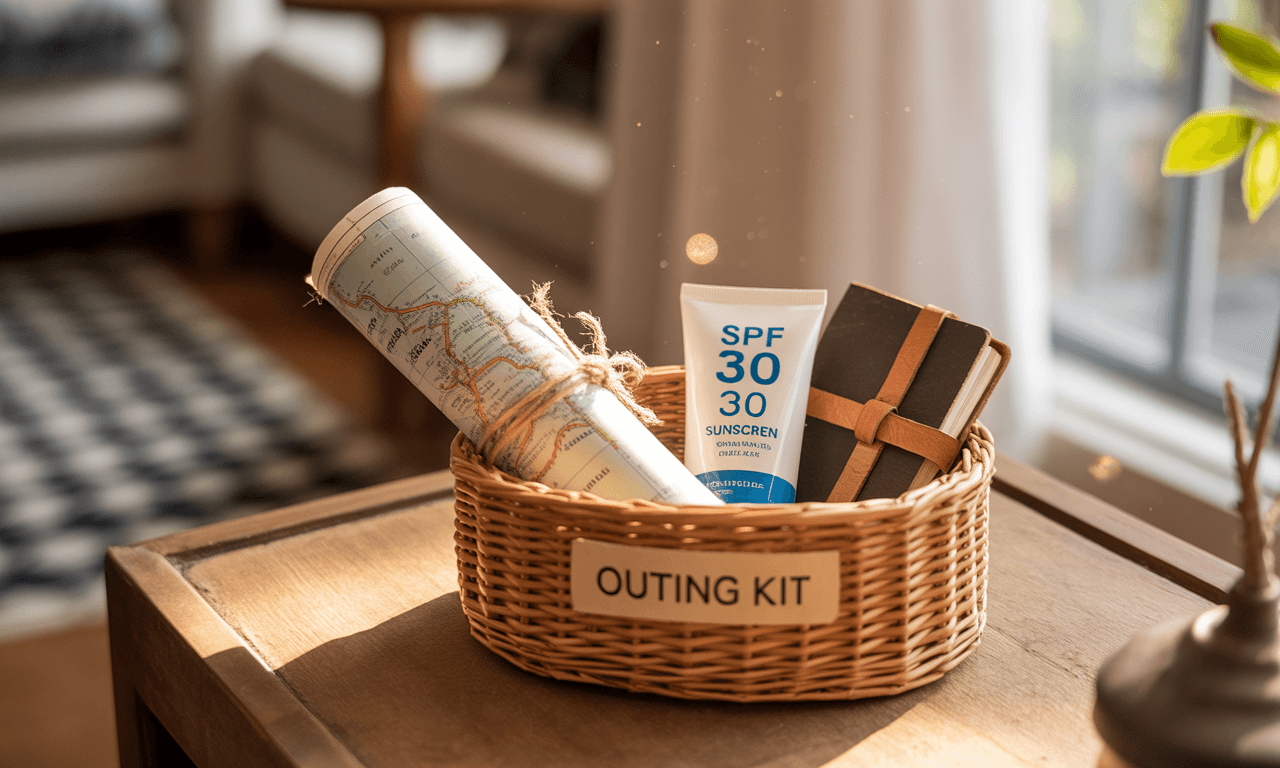 Your space can either argue for comfort or nudge you toward micro-bravery. Make the room do the heavy lifting:
- Put a small basket by the door with “adventure items”: park map, deck of cards, and a picnic blanket.
• Keep a “firsts list” on the fridge-add a new line each week for one tiny novelty.
• Use a visible timer in the kitchen to normalize short experiments (15–20 minutes).
• Create a “distraction-free corner” for five-minute debriefs after trying something new.
Small, visible props make “let’s try” easier to say and simpler to start.
Discover what's fueling tension in your marriage
It's rarely just one thing. The United Front Audit maps the pressure points so you know exactly where to focus.
See Your Results →Confidence by Design in Daily Life (micro-bravery you’ll actually use)
 Meals
Add a single new ingredient to a familiar dish. Talk for two minutes about what you noticed: taste, smell, texture.
Commute & Errands
Pick a different route once a week. Find one thing to appreciate and one thing to repeat.
Evening Wind-Down
Swap 10 minutes of scrolling for a “firsts” brainstorm: “What’s one tiny thing we could try tomorrow-”
Weekends
Visit a new park for 20 minutes. Take a photo, then write a one-sentence caption describing the moment.
Communication Firsts: New Conversations, Not New Conflicts (fast-learning marriage skills)
 You don’t need “deep talk” every night. You need new talk sometimes-questions that open windows instead of rehashing yesterday’s hallway. Try these:
- “What’s a small risk you’re glad you took in the last year-”
• “What could make weekdays feel 10% lighter-”
• “What’s a story we tell about us that feels too small now-”
• “What do you want me to understand about your stress this week-”
After one question, practice the “reflect and ask” loop: reflect a sentence back, ask a follow-up, and stop before advice. That restraint is its own tiny risk-and a big relational payoff.
Confidence by Design Date Nights (brave together without the drama)
 Date nights can slip into autopilot (same place, same talk) or pressure (perfect or bust). Design middle ground:
- The 60-Minute Wander: Pick a block you’ve never walked together. Enter one shop or café you’ve never tried.
• Two-Napkin Night: Each writes one new question on a napkin; swap halfway through.
• $10 Twist: In addition to whatever you do, spend $10 on an unfamiliar item-snack, magazine, postcard-and talk about it.
If you need ideas that scale from 30–120 minutes and cost almost nothing, queue up this follow-up read: Micro-Adventures, Major Signals: New Foods, New Cities, New Us. It’s the natural companion to Confidence by Design.
The 30-Day Confidence by Design Plan (learn fast together)
 Here’s a simple month that stacks tiny risks into real momentum.
Week 1: Start Tiny
• Pick one Rung 1 action daily (new condiment, porch sit, one question).
• End the day with a 30-second appreciation.
• Debrief each tiny risk in 60 seconds: “What did we notice-”
Week 2: Add Rung 2
• Two Rung 2 actions this week (rearrange a corner; try a new walk route).
• One 10-minute “firsts list” brainstorm.
• One soft start-up conversation about the budget, calendar, or chores.
Week 3: One Rung 3 + One Date
• Choose one Rung 3 action (host dessert, one local class, or a new neighborhood café).
• Do a “Two-Napkin Night.”
• Track repair speed if something goes sideways.
Week 4: Consolidate & Celebrate
• Repeat the easiest wins from Weeks 1–3.
• One 10-minute “retro”: What worked- What didn’t- What will we repeat-
• Celebrate with a low-cost treat that marks your progress (photo, postcard, playlist).
Metrics That Make Confidence Visible (proof fuels designed confidence)
 Measuring feelings can be slippery; measuring actions is straightforward. Try these four for a month:
- Firsts count: How many “firsts” did we do this week-
• Repair speed: Minutes from friction to first repair attempt.
• Appreciations: Daily count of specific thank-yous.
• Debriefs done: Number of 60–120 second debriefs after trying something new.
Don’t weaponize the numbers; use them to notice momentum. Every uptick is a vote for the identity you’re building.
Not sure what's really going wrong?
The United Front Audit helps you pinpoint exactly where your marriage unity is breaking down - in just 3 minutes.
Take the Free Audit →What If One Partner Is Hesitant- (safety-first brave together)
 If your spouse is reluctant, design your asks for safety, not spectacle:
- Offer two options and a veto: “Would you prefer trying the new tea or a 10-minute porch sit- ‘Neither’ is fine too.”
• Shrink the risk until it’s a near-guarantee.
• Own your slice of pressure: “I’m excited and can get intense-help me pick a calmer pace.”
• Reinforce consent: “We can stop anytime.”
• Praise attempts, not outcomes: “Thanks for trying-want to keep or tweak-”
If there’s contempt, chronic stonewalling, or any emotional/physical abuse, prioritize safety and seek support. Confidence by Design thrives in an environment of respect, not fear.
Troubleshooting: When Tiny Risks Feel Silly (fast-learning friction)
 It’s normal to think, “This is too small to matter.” Remind yourselves: small is sustainable. On rough days, tiny is all you have-and tiny still counts. If you miss a day or bicker halfway through a new plan, use the fast-learning pivot:
- Name the moment: “We got tense.”
- Own one slice: “I pushed too fast.”
- Shrink the plan: “Two-minute reset on the porch-”
- Try again: “Timer set; afterwards we’ll pick one thing we liked.”
The goal isn’t a perfect plan; it’s a forgiving system.
Conversation Scripts for Everyday Micro-Bravery (brave together words)
 Budget Tension
“I felt anxious when I saw the balance. I grabbed takeout twice too. Could we try a two-minute nightly check-in for three days and see if that helps-”
Bedtime Meltdown
“I snapped when I felt rushed. I’m going to start 10 minutes earlier tonight. If I heat up, I’ll step out for one minute and come back.”
In-Law Stress
“I love your family and get overwhelmed by long visits. Could we try a 90-minute visit plus a 15-minute walk afterward-”
Intimacy Rhythm
“I want closeness and froze yesterday. Could we start with five minutes of cuddling tonight and see where we want to go-”
These scripts are tiny risks too: new words, small plans, repeatable rhythms.
From Tiny Risks to Micro-Adventures (your next step)
 Once you’re comfortable stacking little wins, graduate to micro-adventures-30 to 120-minute firsts that fit real life and real budgets. They’re the natural extension of Confidence by Design, and they supercharge your momentum: Micro-Adventures, Major Signals: New Foods, New Cities, New Us.
Put a Bow on It: Confidence by Design Is a Choice
 Confidence isn’t waiting for you somewhere down the road; it’s built at your kitchen table, in your neighborhood, across tiny promises you keep. Choose one tiny risk today. Ask kindly. Time-box it. Notice what worked. Anchor the win. Repeat tomorrow. That’s Confidence by Design-and it will quietly teach your marriage who you really are.


Keep Reading

Review, Reset, Repeat: A Weekly Debrief That Builds Momentum
Growth sticks when you keep it in view. A 10-minute weekly debrief turns last week’s friction into next…

Align Without Agreement: Set Shared “Good Enough for Now” Standards
You don’t need consensus on everything to move forward today. Instead of arguing ideals, define “good enough for…

The 24-Hour Repair Rule: Come Back Together Before Distance Hardens
Arguments aren’t dangerous; distance is. The 24-Hour Repair Rule keeps little ruptures from becoming long-term stories. You’ll learn…