
Same Story, New Meaning: Choosing How You Remember Your Childhood in Marriage

In This Article
- What “Same Story, New Meaning” Really Means in Marriage
- Your Memory Is Not a Fixed Video: Why That Matters
- The Headline You Put Over Your Childhood
- How Your Old Story Shapes Expectations of Your Spouse
- Gentle Ways to Experiment with Same Story, New Meaning
- Practicing Same Story, New Meaning Together as a Couple
- When Your Story Feels Too Heavy to Reframe
- Living Today Like Same Story, New Meaning Is True
Two siblings can grow up in the same house and tell very different stories about what happened there.
One might say, “Our family was a mess, and now I’m damaged.”
The other might say, “We went through a lot, but it made me more grateful and determined.”
Same fights.
Same parents.
Same house.
Same story, new meaning.
And here’s the part we often miss: those different meanings follow each person into marriage.
- One spouse shows up expecting everything to break.
- The other shows up expecting that hard things can grow them.
Same story, new meaning-completely different marriage experience.
This article is about how to choose Same Story, New Meaning on purpose.
 We’re going to explore:
- Why your memory is not a fixed video, but a story you keep retelling
- How to notice the “headline” you’ve put over your childhood
- How that headline shapes your expectations of your spouse
- Gentle, practical ways to experiment with new interpretations that honor your pain without locking you into permanent victimhood
- How to practice Same Story, New Meaning as a couple, not just alone
For a bigger, anchoring perspective on how to relate to your past in a healthy way, read this together with the cornerstone article The Past Is a Place for Lessons, Not a Life Sentence. That post gives you the foundation; Same Story, New Meaning shows you how to apply it to the way you remember your childhood in marriage.
Ready to identify your next best step?
The United Front Audit gives you a personalized picture of what needs work - and a clear path forward as a couple.
Take the Audit - It's Free →What “Same Story, New Meaning” Really Means in Marriage
 When we say Same Story, New Meaning, we’re not asking you to pretend your childhood was something it wasn’t.
We’re not saying:
- “It wasn’t that bad.”
- “Your parents did their best, so just get over it.”
- “If you just think positive, the pain disappears.”
No.
Same Story, New Meaning means:
- The events stay the same.
- The interpretation is allowed to grow.
- The effect on your marriage can change.
It sounds like this:
- “My dad really did leave. That happened. But instead of believing ‘Everyone leaves,’ I can start exploring, ‘That loss made me extra aware of how much commitment matters in our marriage.’”
- “My mom really did criticize my every move. But instead of living under ‘I’ll never get it right,’ I can experiment with, ‘That experience makes me extra careful about how I speak to my spouse and future kids.’”
The facts don’t change.
The story you tell about those facts does.
That’s where real freedom lives.
When you adopt a Same Story, New Meaning mindset, you move from:
- “My past broke me, and that’s the end of the story”
to - “My past wounded me, but with God’s help and intentional work, I can grow wiser, kinder, and more self-aware-and that changes how I show up in my marriage.”
The cornerstone article The Past Is a Place for Lessons, Not a Life Sentence walks you through this shift at a high level. Same Story, New Meaning zooms in specifically on childhood memories and how you remember them in the context of your relationship today.
Your Memory Is Not a Fixed Video: Why That Matters
 A big reason Same Story, New Meaning is even possible is because of how memory actually works.
Memory is not a perfect recording you can’t change. It’s more like a story file you open, edit, and re-save over time.
You’re not inventing new events, but you are:
- Emphasizing certain details and downplaying others
- Deciding who was the hero, who was the villain, and who was invisible
- Choosing what it all means about you, about love, and about safety
Think about how you remember a conflict:
- One version: “My parents were always angry. Home was a constant war.”
- Another version: “My parents didn’t know how to handle stress, and it spilled into arguments. It was scary, but it also taught me how much emotional skills matter.”
Same Story, New Meaning doesn’t erase what you went through. It gives you room to see more of the picture.
Why does that matter for marriage-
Because the story you’ve been telling about your childhood is quietly shaping:
- How you interpret your spouse’s tone of voice
- How you react when they make a mistake
- How safe you feel expressing your needs
- How quickly you expect things to fall apart
If the unchallenged headline over your past is:
- “We were a mess and I’m damaged,”
then small conflicts in your marriage can feel like confirmation that:
- “See- I’m too broken for this to work.”
But if you slowly begin to shift toward Same Story, New Meaning, you might find yourself thinking:
- “We were a mess, and it hurt. But I’m also more aware, more determined, and more compassionate now-and that’s something I can bring into this relationship.”
The story isn’t lying to you anymore. It’s telling the whole truth.
The Headline You Put Over Your Childhood
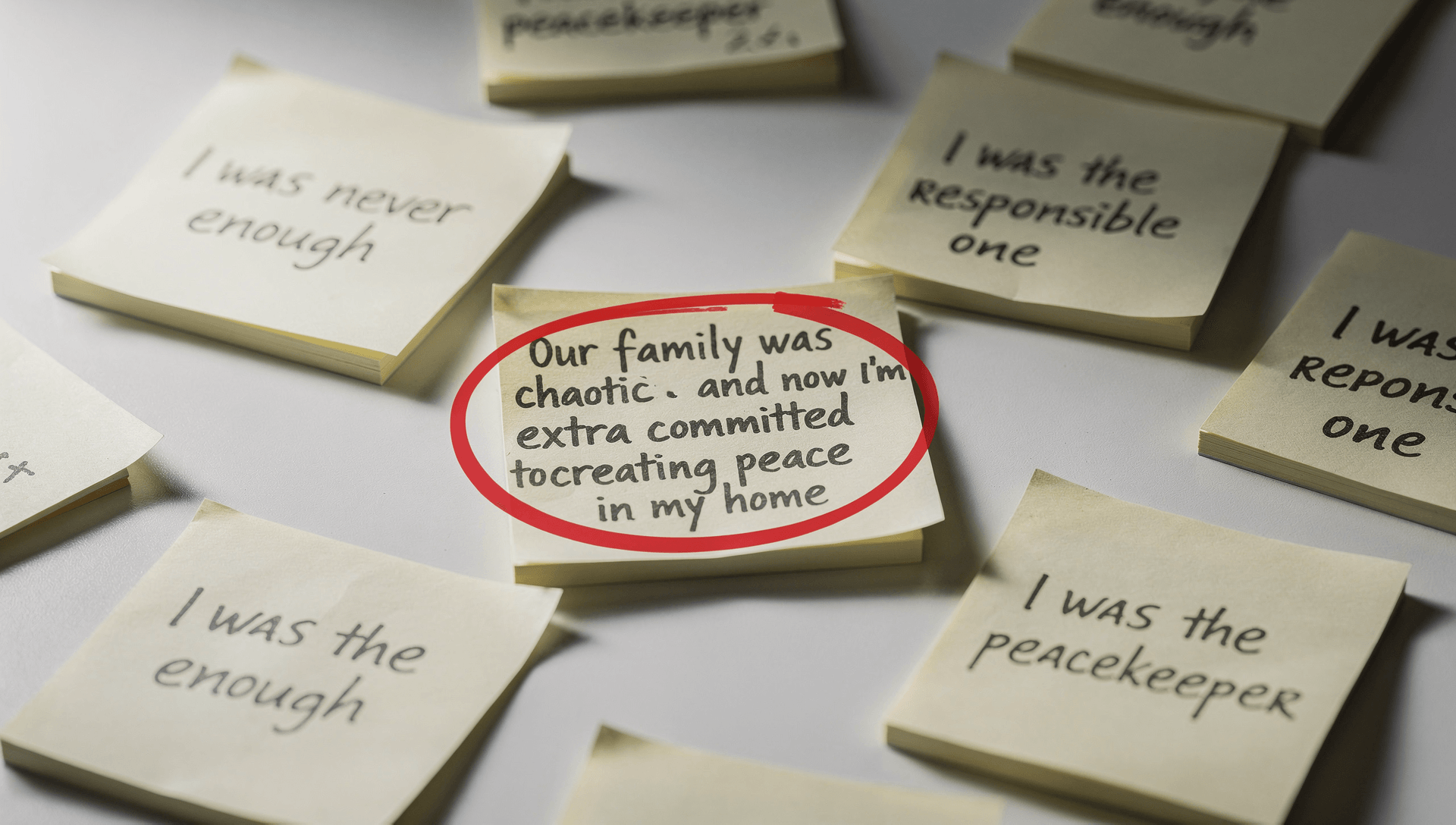 If you had to sum up your childhood in one sentence-your gut-level headline-what would it be-
- “I was never enough.”
- “I was the responsible one.”
- “I was the peacekeeper.”
- “I was the forgotten one.”
- “I was the favorite.”
That headline is the short version of your story. And even if you’ve never said it out loud, it’s influencing how you:
- Read your spouse’s reactions
- Interpret your role in conflict
- Decide what’s “normal” in your home
Same Story, New Meaning starts by simply noticing that headline.
Ask yourself:
- “If my childhood were a news article, what would the title be-”
- “Is that headline the whole truth-or just the most painful or dramatic part-”
- “What other headlines could also be true from the same story-”
For example:
Old headline:
“Our family was a mess, and now I’m damaged.”
Same Story, New Meaning alternatives might include:
“Our family was chaotic, and now I’m extra committed to creating peace in my home.”
“We went through a lot, and now I’m more empathetic when my spouse is overwhelmed.”
“I didn’t get what I needed, and I’m learning how to ask for it now instead of pretending I don’t need anything.”
You’re not denying the mess. You’re refusing to let “damaged” be the only word that follows you into marriage.
This is exactly the move we talk about in The Past Is a Place for Lessons, Not a Life Sentence: your past is real, but it doesn’t have to be the only frame you use. Same Story, New Meaning is what happens when you start experimenting with new, more accurate headlines.
Discover what's fueling tension in your marriage
It's rarely just one thing. The United Front Audit maps the pressure points so you know exactly where to focus.
See Your Results →How Your Old Story Shapes Expectations of Your Spouse
 Once you recognize your original headline, you’ll start to see how it affects the way you relate to your spouse.
Here are some examples of how the “same story” plays out with different meanings in marriage.
“I Was the Responsible One”
Old meaning:
“I always had to take care of everyone. No one took care of me. So now, if my spouse doesn’t anticipate my needs without me asking, it means they don’t love me either.”
Same Story, New Meaning:
“I learned to be responsible very early. That skill helps our home run smoother. But I’m also allowed to be human here. I can say, ‘I’m exhausted-can you help-’ instead of waiting for my spouse to read my mind and then resenting them.”
“I Was Invisible”
Old meaning:
“No one really saw me. I was background. So if my spouse doesn’t notice everything I do, it proves I don’t matter.”
Same Story, New Meaning:
“I felt invisible growing up, so I’m extra sensitive to being overlooked. That’s valid. But instead of assuming my spouse doesn’t care, I can say, ‘I feel really unseen when these things go unacknowledged. Can we work on noticing each other more-’”
“Conflict Meant Danger”
Old meaning:
“When people raised their voices, it was bad. So now, any disagreement means our marriage is in danger, and I either panic or completely shut down.”
Same Story, New Meaning:
“I learned to fear conflict as a kid; that makes sense. But I also know that healthy disagreement can grow us. I can tell my spouse, ‘When voices get loud, my body feels afraid. Can we try talking more calmly- I want to stay present with you.’”
Same Story, New Meaning doesn’t magically erase your reactions, but it does:
- Help you understand them
- Give you words to explain them
- Give your spouse a chance to respond with empathy instead of confusion
Gentle Ways to Experiment with Same Story, New Meaning
 Rewriting the story you’ve lived with for years-or decades-takes time. You don’t have to flip a switch overnight.
Here are some gentle, practical ways to experiment with Same Story, New Meaning:
1. Add “And Also”
When you catch yourself saying something like:
- “My family was a mess and I’m damaged,”
try adding:
- “My family was a mess and I’m damaged-and also, I’m learning new skills and I care deeply about not repeating the same patterns.”
The “and also” makes room for growth without denying the hurt.
2. Ask, “What Else Might Be True-”
Pick a painful memory and gently ask:
- “What else might be true here-”
Example:
- “My dad never came to my events. I felt unimportant. What else might be true- Maybe he didn’t know how to show up. Maybe he was carrying burdens I didn’t see. That doesn’t excuse the hurt, but it reminds me that his failure doesn’t define my worth.”
3. Find a Strength Hidden in the Old Story
Same Story, New Meaning often reveals hidden strengths born from pain:
- Growing up around chaos might make you extra gifted at creating calm and order.
- Being overlooked might make you especially good at noticing the needs of others.
- Learning to navigate tension might make you a wise, steady presence in your spouse’s stress.
Ask:
- “What strengths did I develop because I had to survive that environment-”
- “How can I use those strengths in healthy ways in our marriage-”
4. Practice Compassion for Your Younger Self
Instead of berating your younger self with:
- “Why didn’t you speak up-”
- “Why did you stay quiet-”
practice saying:
- “You did the best you knew how with what you had. Now we know more, and we can do differently.”
Same Story, New Meaning doesn’t just change how you see your parents; it changes how you see yourself.
Practicing Same Story, New Meaning Together as a Couple
 You don’t have to do this alone. In fact, Same Story, New Meaning becomes even more powerful when it’s a shared practice in your marriage.
Here are some ways to make this a “we” journey:
1. Share Your Headlines
Each of you can share:
- “If I had to put a headline over my childhood, it would be: ________.”
Then ask each other:
- “How do you think that headline shows up between us-”
- “What do you wish I understood about that [headline] part of you-”
Take turns listening. No fixing. No debating. Just learning.
2. Create New Shared Meanings
You can literally say:
- “Same story, new meaning moment.”
For example:
- “Same story: my mom always mocked my feelings. New meaning: when you care about my feelings, even if they’re messy, it shows me this marriage is different.”
You’re telling your spouse, “You are part of the new meaning.”
3. Hold Space for Each Other’s Pace
You may not both be ready to shift your story at the same time or in the same way.
So instead of:
- “You should be over this by now,”
aim for:
- “I can see how deep this runs. I’m here for the journey, even if it’s slow.”
Share articles from the series that resonate. For example, if one of you struggles to believe you’re not trapped by your story, reread The Past Is a Place for Lessons, Not a Life Sentence together and talk about what hits hardest.
4. Celebrate “Same Story, New Meaning” Wins
Any time one of you:
- Reacts differently than your family of origin
- Interprets a situation with more nuance
- Apologizes or opens up where you once shut down
acknowledge it.
- “That was a Same Story, New Meaning moment. I see you. That’s different than what you grew up with.”
You’re reinforcing the new story you’re writing together.
Not sure what's really going wrong?
The United Front Audit helps you pinpoint exactly where your marriage unity is breaking down - in just 3 minutes.
Take the Free Audit →When Your Story Feels Too Heavy to Reframe
 Sometimes, the idea of Same Story, New Meaning can feel overwhelming or even offensive if your past includes deep trauma, abuse, or neglect.
If that’s you, hear this:
- You do not have to reframe everything tonight.
- You do not have to force gratitude for what deeply harmed you.
- You are allowed to feel grief, anger, and sadness.
Same Story, New Meaning is not:
- “Find the silver lining in your abuse.”
- “Pretend your wounds are gifts and move on.”
Instead, it’s:
- “Over time, with support, I can allow this story to become one part of my life-not the whole definition.”
- “I can move from ‘This is all I am’ to ‘This is something I lived through, and there’s more to me than that.’”
In heavier situations, it’s wise-and often necessary-to invite professional help into this journey: a trauma-informed therapist, a wise pastor, or a support group.
The companion article Forgive the Past, Take Back the Pen addresses more of this deep work: how forgiveness, boundaries, and healing intersect when your history includes serious harm. Same Story, New Meaning may be a later step in that journey, not the first.
Give yourself permission to go at a pace that’s kind to your nervous system and your heart.
Living Today Like Same Story, New Meaning Is True
 At the end of the day, Same Story, New Meaning is not just a concept; it’s a way of living.
It sounds like:
- “I know where I came from. I don’t pretend it was easy. But I also believe that with God’s help and my choices today, the story doesn’t have to end there.”
- “I can honor my pain without building my identity around it.”
- “I can let my childhood explain some of my triggers without letting it excuse all of my behavior.”
In your marriage, it looks like:
- Owning your reactions without shaming yourself for them
- Giving your spouse context without weaponizing your past
- Asking for what you need now instead of silently reliving old patterns
- Being willing to see new possibilities in yourself and in your partner
Same Story, New Meaning doesn’t make your childhood magically “good.” It makes your adulthood more free.
And when you combine this article with The Past Is a Place for Lessons, Not a Life Sentence, you give your marriage a powerful gift:
You’re no longer two scared kids reenacting old scripts in grown-up bodies.
You’re two intentional adults who know where you came from-and who are choosing, day by day, the kind of story you want to write next.


Keep Reading

Forgive the Past, Take Back the Pen: How to Stop Living as the Victim in Your Own Marriage Story
There is a moment in many marriages when the story changes-quietly, slowly, sometimes without either of you noticing.…

From Broken to Better Boundaries: Letting Your History Shape You Without Defining You
Maybe you grew up in a house where everyone knew everything. Doors were always open, phones were shared,…

The Past Is a Place for Lessons, Not a Life Sentence
Your past is real. The arguments you witnessed, the slammed doors, the long stretches of silence. The way…