You’ve done the hard work of seeing what needs to change.
You’ve started quitting the things that were slowly poisoning the atmosphere in your home-
the rushing, the interrupting, the quiet competition, the sarcastic “jokes” that weren’t really jokes.
That’s huge.
But once you stop doing those things, you’re left with a very real, very important question:
“Now what-”
If you don’t answer that question on purpose, old patterns will quietly slip back in and reclaim their territory. You’ll get tired, life will get busy, and your marriage will drift back to the “before” version-not because you didn’t care, but because empty spaces don’t stay empty for long.
 What You Quit, What You Build is about what happens after you drop harmful habits. This cornerstone article walks you through the transition from subtracting to designing. We’ll explore how to create small, sustainable rhythms that match the new story you want your marriage to tell-rhythms of patience instead of rush, listening instead of control, partnership instead of rivalry.
You’ll learn how to replace old habits with new scripts, micro-practices, and shared rituals that fit your real life, not a fantasy schedule. This post anchors the “What You Quit, What You Build” series and ties together earlier articles like “Quit to Win: Why Stopping the Wrong Things Can Save Your Marriage” at https://blog.liveyourbestmarriage.com/quitting/quit-to-win-save-your-marriage and “Stop Talking Over Each Other: How to Build a Marriage Where Both Voices Matter” at https://blog.liveyourbestmarriage.com/quitting/stop-talking-over-each-other.
Why “What You Quit, What You Build” Matters in Marriage
Most change conversations focus on one side: quit.
Quit being a jerk.
Quit talking over each other.
Quit competing.
Quit the little digs.
Quit the scorekeeping.
That’s the heart behind “Quit to Win: Why Stopping the Wrong Things Can Save Your Marriage.” In that cornerstone, you began to see that subtracting certain behaviors-snapping, rushing, mocking, interrupting-can transform your home faster than adding more date nights ever could.
But quitting is only half a transformation.
- You quit rushing… but what replaces rush on Monday mornings-
- You quit interrupting… but what’s the new rhythm of listening-
- You quit competing… but what does partnership look like on a random Wednesday-
That’s where What You Quit, What You Build comes in.
You’re not just walking away from old habits-you’re walking toward a new story. And that story needs structure: tiny, repeatable choices that quietly become the culture of your marriage.
Think of it like renovating a house:
- Step 1: You tear out what’s rotten or unsafe.
- Step 2: You don’t just stare at the empty space. You rebuild something better.
This article is about Step 2.
From Quit to Design: Why Subtraction Isn’t Enough
You’ve already seen what happens when you only subtract.
You decide to quit snapping. You have a few great days. Then:
- You get stressed.
- The kids melt down.
- Emails pile up.
- You’re exhausted.
And suddenly, the old snap is back.
Not because you wanted it.
Because nothing replaced it.
Here’s a simple truth behind What You Quit, What You Build:
If you don’t design a new rhythm on purpose, your brain will default to the old one.
Your nervous system loves familiarity-even if familiar hasn’t been healthy.
So if you used to:
- rush every conversation
- interrupt with solutions
- roll your eyes and keep score
and now you’ve decided to quit those things, your brain will keep reaching for them when it feels stressed, unless you’ve rehearsed what comes next.
What You Quit, What You Build is about pre-deciding:
- “When I’m tempted to rush, this is what I do instead.”
- “When I want to interrupt, this is the phrase I use to slow myself down.”
- “When I feel competitive, this is how I move back toward team.”
That’s where rhythms, scripts, and micro-practices come in.
What You Quit, What You Build in Everyday Rhythms
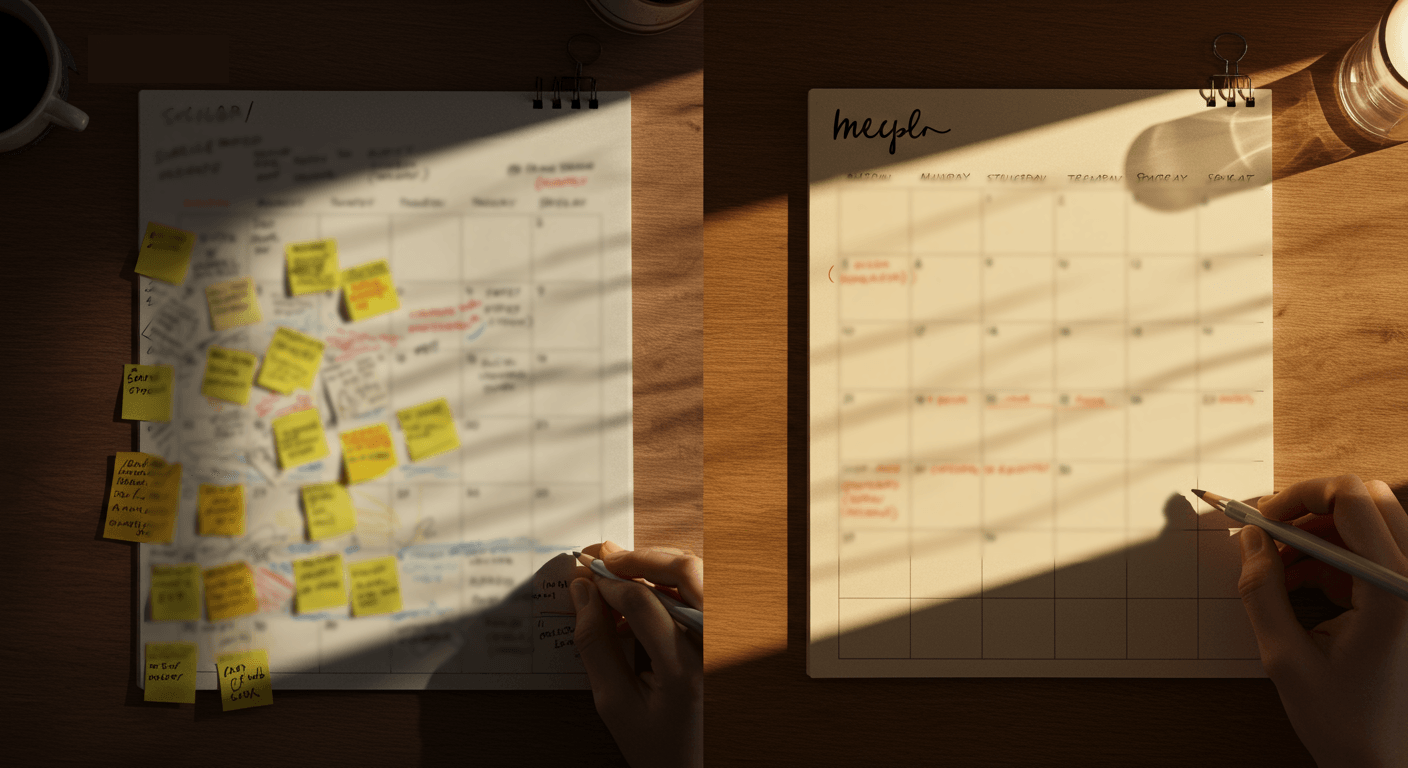 Let’s make this tangible.
Here’s how What You Quit, What You Build plays out across a few of the key areas you’ve already been working on in the quitting series:
- Rush → Presence
From “hurry through everything” to “built-in pockets of unhurried connection.”
(Connected to “From Busy to Present: Quit the Rush and Reclaim Your Home Atmosphere.”) - Interrupting → Listening
From “jumping in with answers” to “letting both voices matter.”
(Built on “Stop Talking Over Each Other” and “Quit Interrupting: Simple Ways to Let Your Spouse Finish a Sentence.”) - Fixing → Curiosity
From “Here’s what you should do” to “Help me understand more.”
(Flowing from “From Fixer to Listener: Quitting the Urge to Tell Your Spouse What to Do.”) - Competition → Partnership
From “who’s right/who does more/who parents better” to “same team.”
(Anchored in “Your Spouse Is Not Your Rival: Quitting the Competition in Marriage” and “Quit Keeping Score: How Letting Go of ‘Who Does More’ Brings You Closer.”) - Disrespect → Honor
From sarcasm and little digs to thoughtful, safer-than-a-punchline humor.
(Rooted in “Drop the Disrespect,” “Quit the Little Digs,” “From Eye-Rolls to Empathy,” and “Safer Than a Punchline: How to Be Playful Without Putting Your Spouse Down.”)
Every one of those shifts is a What You Quit, What You Build moment.
You’re not just taking bricks out of a wall. You’re using those same bricks to build a new room.
What You Quit, What You Build: Replacing Rush with Presence
Let’s start with one of the loudest habits in modern marriages: rush.
In “From Busy to Present: Quit the Rush and Reclaim Your Home Atmosphere,” you saw how constant hurry quietly turns your home into an airport terminal-always moving, never landing. Quitting the rush matters. But what do you build in its place-
What You Quit
- Rushing through breakfast while half-listening
- Rushing your spouse’s story because you “already know where it’s going”
- Rushing transitions: in the door, out the door, into bed, out of bed
What You Build
- Presence Pockets
Instead of promising “hours of connection,” you design tiny, specific presence pockets:
- 5 unrushed minutes when one of you gets home-no phones, no multitasking, just a greeting, a hug, and one real question
- A 10-minute “wind-down chat” in bed where you each share one high and one low from the day
You can borrow from your weekly rhythms you may already be building for check-ins, like in your other series, and simply make sure these presence pockets are protected.
- Transition Rituals
You build small rituals to mark the shift from one part of your day to another:
- Before walking in the door: three deep breaths in the car and a simple prayer-“Help me bring presence, not pressure, into this house.”
- Before screens at night: one brief, face-to-face check-in-“What do you need from me before we zone out-”
- A “No Rush” Phrase
To support your What You Quit, What You Build work around rush, choose a phrase you can say out loud:
- “Let’s not rush this one-tell me the whole story.”
- “I’m tempted to hurry you right now; I want to slow down and actually hear you.”
When you say it, you’re reminding both of you that you’re building something different now.
What You Quit, What You Build: Letting Both Voices Matter
 In “Stop Talking Over Each Other: How to Build a Marriage Where Both Voices Matter,” you started quitting the habit of interrupting, correcting, and finishing each other’s sentences.
To make that last, you need new listening rhythms.
What You Quit
- Cutting them off with “Right, but-”
- Jumping in with solutions before they finish
- Talking over your spouse when they’re slower to find words
What You Build
- The “Finish Line” Rule
You both commit:
“If you’re sharing something important, I won’t respond until you say, ‘Okay, I’m done for now.’”
This builds directly on your work in “Quit Interrupting: Simple Ways to Let Your Spouse Finish a Sentence.” You’re giving each other a clear marker that both voices get space.
- Listening Posture
You design a physical posture as part of your What You Quit, What You Build practice:
- Sitting down
- Turning your body toward them
- Putting your phone face down
Your body becomes a script that says: “I’m here. I’m listening.”
- Reflect Before You Respond
New default:
- “What I hear you saying is…”
- “So the main thing that hurt was…”
This slows you down and helps your spouse feel heard before you share your view. That’s the heart of the move from “fixer” to “listener” that you explored in “From Fixer to Listener: Quitting the Urge to Tell Your Spouse What to Do.”
What You Quit, What You Build: From Competition to Partnership
If you’ve been living in a low-grade competition-over chores, parenting, who’s right, who’s more tired-then Your Spouse Is Not Your Rival: Quitting the Competition in Marriage has already invited you to step off the scoreboard.
Now What You Quit, What You Build helps you design what comes after the rivalry.
What You Quit
- The “secret spreadsheet” of who does more
- Correcting details in front of others to prove you’re right
- Competing over who’s the “better” parent
You’ve also started working through this in “Quit Keeping Score: How Letting Go of ‘Who Does More’ Brings You Closer” and “Smart Together: Quitting the ‘Who’s Right’ Battle So You Can Actually Solve Problems.”
What You Build
- Weekly “Team Huddle”
You intentionally build a once-a-week rhythm (10–20 minutes) where you:
- Look at the week ahead
- Name the heaviest loads each of you is carrying
- Ask, “How can we support each other better this week-”
Instead of tracking who’s losing, you’re planning how to win together.
- Shared Language: “Same Team”
You choose a phrase-“Same team”-to use when you feel competition rising.
- In a disagreement: “Okay, we’re slipping into ‘who’s right.’ Same team-let’s go back to the problem, not each other.”
- In parenting conflict: “We both want what’s best for our kids. Same team. Let’s step back and talk how to combine our strengths.”
- Problem-Solving as Partners
You design a simple Smart Together process:
- Step 1: Each share your view without interruption
- Step 2: Name the shared goal (“We both want evenings to feel less rushed”)
- Step 3: Brainstorm solutions where both of you make reasonable adjustments
That’s What You Quit, What You Build at work: you quit rival energy and build a culture of collaboration.
What You Quit, What You Build: From Disrespect to Honor
 The disrespect work has been deep and wide:
- “Drop the Disrespect: Why Sarcasm and ‘Jokes’ Hurt More Than You Think”
- “Quit the Little Digs: How Micro-Comments Create Macro Distance”
- “From Eye-Rolls to Empathy: Quitting the Habit of Quiet Contempt”
- “Safer Than a Punchline: How to Be Playful Without Putting Your Spouse Down”
- “Quitting Being a Jerk: Why Kindness Matters More Than Roses”
You’ve started to quit the sarcasm, micro-digs, eye-rolls, and cheap shots.
Now, What You Quit, What You Build asks: What goes in their place-
What You Quit
- Sarcastic “jokes” that mask real contempt
- Little digs: “Of course you forgot,” “Why am I not surprised-”
- Quiet contempt: the inner “Here we go again” attitude
What You Build
- Daily Honor Deposits
You design a tiny daily rhythm:
- Once a day, you name something you admire, appreciate, or respect in your spouse. Out loud.
It can be as simple as:
- “Thank you for the way you handled that call today.”
- “I’m really grateful for how steady you were with the kids earlier.”
Over time, this directly counters the contempt that “From Eye-Rolls to Empathy” helped you identify.
- Public Covering
You deliberately build a “no-humiliation” culture in public:
- You decide what’s off-limits for jokes (their body, deep insecurities, past wounds).
- You make it a rhythm to brag on your spouse in front of others-without pretending they’re perfect.
This is how “Safer Than a Punchline” moves from theory into ritual.
- Repair Scripts After You Slip
Because you will slip, you design what you’ll say:
- “Hey, I joked about you being irresponsible with money earlier. That wasn’t fair. You’ve actually grown a lot there, and I don’t want to talk about you like that.”
That’s What You Quit, What You Build: you quit defending your jokes and build quick repair into your normal rhythm.
What You Quit, What You Build: From Little Digs to Daily Deposits
“Quit the Little Digs” helped you see how micro-comments become macro distance. What You Quit, What You Build asks: What do you sprinkle into your day instead-
What You Quit
- Eye rolls, sighs, “Of course you…”
- Exaggerated stories that make your spouse the clown
- Micro-sarcasm that hints at contempt
What You Build
- Micro-Encouragements
You set a quiet personal goal:
- For every correction or complaint, aim for at least one specific encouragement.
This isn’t fake positivity-it’s re-training your eyes to see your spouse as more than their flaws.
- Soft Start-Ups
Instead of letting a little dig slip out, you build a new default:
- From: “You’re always on your phone.”
- To: “I miss you when we’re next to each other but not really together. Could we have 15 minutes tonight with no phones-”
- Gentle Signals for When It Hurts
As a couple, you design a simple phrase that means, “That landed like a little dig”:
- “Ouch.”
- “That stung more than it sounded.”
That phrase helps you course-correct in real time before the distance spreads.
What You Quit, What You Build: From Scorekeeping to Shared Load
 “Quit Keeping Score: How Letting Go of ‘Who Does More’ Brings You Closer” revealed how exhausting the secret spreadsheet can be.
To make that shift real, What You Quit, What You Build leads you into new patterns of support.
What You Quit
- Replaying a mental list of everything you do
- Weaponizing your contributions in arguments
- Constantly looking for ways your spouse is “lagging behind”
What You Build
- Load-Mapping Conversations
Once a week or once a month, you sit down and map the load:
- “Here are the tasks and mental loads I’m carrying.”
- “Here are the ones you’re carrying.”
- “What feels heavy to you- What feels heavy to me-”
Then you ask: “What can we shift, share, or simplify-”
- Gratitude for Invisible Work
You intentionally look for and name things your spouse does that nobody sees:
- Emotional labor with kids
- Scheduling appointments
- Handling extended family drama
These appreciation moments are What You Quit, What You Build embodied-less focus on tallying, more focus on honoring.
- Crisis Rules
You design simple rules for high-stress seasons:
- “If one of us is in a crunch week at work, the other automatically takes more of X task.”
- “We check in Sunday night: who’s in the heavier week, and what can we clear for them-”
That way the load isn’t decided by who complains loudest-it’s decided by the team you’ve committed to be.
Designing Your Own “What You Quit, What You Build” Plan
Now let’s bring this home.
You don’t need a perfect system. You need a living plan-simple enough to remember, specific enough to act on.
Here’s a way to build your own What You Quit, What You Build roadmap.
Step 1: Name 2–3 Things You’ve Quit (or Want to Quit)
Individually or together, list a few:
- “I’ve been quitting interrupting.”
- “I want to quit using sarcasm when I’m angry.”
- “I’m quitting the habit of keeping score in my head.”
You can pull these directly from the series: maybe “From Busy to Present,” “Quit Interrupting,” “Your Spouse Is Not Your Rival,” or “Drop the Disrespect” stood out most to you.
Step 2: For Each, Ask “What Do I Want to Build Instead-”
Example:
- Quit: Interrupting
Build: Reflective listening and “finish line” rule - Quit: Scorekeeping
Build: Weekly load-mapping and regular “thank you for…” moments - Quit: Little digs
Build: Daily honor deposit and “ouch” phrase when something stings
Step 3: Turn Each “Build” into a Tiny, Repeatable Rhythm
Ask:
- “How often-” (daily, weekly, during conflict, etc.)
- “What’s the smallest version of this we can realistically do-”
Write it like this:
- “Every workday, when I get home, 5 minutes of phone-free check-in.”
- “Once a week, ask: ‘What felt heavy for you this week, and how can I support you-’”
- “In hard talks, I will pause and ask one curiosity question before responding.”
Step 4: Share and Adjust Together
Sit down and share your What You Quit, What You Build thoughts with your spouse:
“I’ve been thinking about quitting ____. Here’s what I’d love to build instead. How does that sound to you- What would make it feel more doable for both of us-”
You’re not making a contract. You’re shaping a culture.
Step 5: Revisit and Refine
Once a month-or even once a quarter-ask:
- “Which new rhythms have been helpful-”
- “Which ones felt forced or unrealistic-”
- “What do we want to tweak, strengthen, or let go-”
This keeps What You Quit, What You Build aligned with your actual life, not your fantasy life.
Keeping What You Build Alive When Life Gets Messy
You’re going to have weeks where:
- The presence pockets disappear
- You interrupt more than you listen
- Your jokes get sharper
- The scoreboard quietly opens back up in your mind
That doesn’t mean What You Quit, What You Build has failed.
It means you’re human.
Here are a few ways to protect what you’re building when life gets messy:
- Assume You’ll Drift-and Plan for Reset
Decide now:
- “When we notice old patterns creeping back, we won’t panic. We’ll take it as a cue to pause and reset.”
Maybe that reset is a walk around the block together, a Sunday night chat, or revisiting one of the cornerstone articles like “Quit to Win” or “Stop Talking Over Each Other” as a refresher.
- Measure by Direction, Not Perfection
Ask:
- “Are we drifting closer to the marriage we want, or further away-”
Even if you’re at 60% of the rhythms you dreamed up, that’s different than 0%. Let What You Quit, What You Build be about trajectory, not flawless execution.
- Use Your Language as a Compass
When your words start to sound more like old you-sharp, rushed, competitive-it’s a signal, not a verdict.
You can say:
- “I hear my old tone coming back. Can we pause- I want to respond differently.”
That kind of moment is itself part of the new structure you’re building.
How “What You Quit, What You Build” Ties the Whole Quit Series Together
 This cornerstone sits at the crossroads of everything you’ve been working on:
- “Quit to Win: Why Stopping the Wrong Things Can Save Your Marriage” gave you the courage to subtract harmful habits.
- “From Busy to Present: Quit the Rush and Reclaim Your Home Atmosphere” showed you how hurry changes the air your family breathes.
- “Stop Talking Over Each Other”, “Quit Interrupting”, and “From Fixer to Listener” helped you honor both voices instead of controlling the conversation.
- “Your Spouse Is Not Your Rival,” “Quit Keeping Score,” and “Smart Together” moved you from opposition to collaboration.
- “Drop the Disrespect,” “Quit the Little Digs,” “From Eye-Rolls to Empathy,” “Quitting Being a Jerk,” and “Safer Than a Punchline” invited you to clean up the tone, jokes, and micro-reactions shaping your emotional climate.
- “Parenting Without the Power Struggle” extended this into how you show up as a united front for your kids.
What You Quit, What You Build is where all of that becomes a way of life-where quitting turns into designing, and designing into rhythms, and rhythms into a new normal.
You’re not just trying to “be nicer” or “fight less.”
You’re building a marriage identity:
- The couple that slows down enough to notice each other
- The couple that listens longer than they talk
- The couple that plays as a team instead of keeping score
- The couple that is genuinely safer than a punchline
- The couple who doesn’t just quit what’s harmful, but faithfully builds what’s healing
That’s the long game of What You Quit, What You Build.
Not a single big moment, but a thousand small ones that quietly reshape what it feels like to be married to you.