Tag: marriage rituals

  • The Apron Rule: Using Humor to Signal Grace After Hard Days

    The Apron Rule: Using Humor to Signal Grace After Hard Days

    The Simple Power of a Backward Apron

    Married couple laughing together as a playful gesture signals a need for grace.A husband wore his hat backward when he’d had a rough day. His wife wore her apron backward when she had hers. No words, no long explanations-just a silent signal that said, “Today was heavy. Please be gentle.”

    Before either of them spoke, they were already smiling. The silliness of it broke the ice, replacing tension with tenderness. That’s what makes this little ritual so powerful. Humor like this isn’t childish-it’s strategic tenderness.

    In every marriage, there are days that take more out of you than you expected. You come home tired, reactive, and emotionally thin. A “grace signal” like the apron rule doesn’t fix everything, but it changes the tone. It helps both partners approach each other with softness instead of stress.

    This post will help you design your own version of the apron rule-a lighthearted, loving cue that communicates what words sometimes can’t: “I’m not at my best today, but I still love you.” Because grace, when expressed playfully, becomes unforgettable.


    Humor as a Language of Grace in Marriage

    Married couple showing grace through humor after a stressful day.In Therapeutic Laughter: Why Couples Who Laugh Heal Faster, we saw how laughter softens defensiveness and accelerates healing. The apron rule builds on that idea. It turns laughter into a language-a way of expressing emotional needs safely and without blame.

    Every marriage develops its own shorthand. You might know what your partner’s sighs mean, what their quiet looks communicate, or how their energy changes after a hard day. Humor simply refines that language. It transforms stress signals into grace signals.

    By using humor intentionally, you reframe vulnerability as connection instead of weakness. You’re saying, “I trust you enough to let you see my tired, messy self-and I believe we can still smile about it.”

    Grace in marriage isn’t about ignoring struggles; it’s about remembering that you’re on the same side, even when you’re exhausted. The apron rule turns that truth into something visible, memorable, and kind.


    Why Grace Needs a Signal

    Couple using gentle, humorous gestures to communicate emotional needs.In a perfect world, our partners would always know when to tread softly. But in real life, stress often hides behind silence or snappy comments. Without a clear signal, misunderstanding rushes in.

    That’s where a playful ritual like the apron rule comes in-it externalizes emotion. Instead of saying, “Leave me alone,” it communicates, “I’m struggling, but I still want connection.” The difference is everything.

    A clear, humorous signal disarms tension before it begins. It’s a gentle preemptive strike against resentment. It lets your partner know what’s happening emotionally without turning it into a confrontation.

    Think of it as emotional body language. Just like laughter, these small, intentional acts activate empathy faster than logic. They allow both of you to offer grace before defensiveness kicks in.

    The best part- You don’t have to overthink it. A backward apron, a silly hat, or a dramatic sigh with a wink can all serve the same purpose. What matters isn’t the gesture itself-it’s the agreement behind it.


    Creating Your Own Grace Signal

    Married partners creating their own playful grace signal at home.To build your version of the apron rule, start with two key principles: simplicity and consistency.

    It should be something easy to do, hard to misinterpret, and repeatable enough to become your shared ritual. Here’s a quick framework for designing one together:

    1. Pick something visual. It should make you smile when you see it-like mismatched socks, a goofy mug, or even wearing a hat indoors.
    2. Give it shared meaning. Talk about what it represents. For example, “When I do this, it means I need some softness today.”
    3. Use it sparingly. This isn’t an everyday thing. It’s special precisely because it’s rare and intentional.
    4. Respond with warmth. When you see the signal, don’t joke at your partner-join them in the humor. Say something like, “Looks like it’s a backward-apron kind of day, huh-”

    The magic lies in what happens next: a laugh, a hug, maybe even a light conversation. Suddenly, what could have spiraled into misunderstanding turns into a shared moment of grace.


    The Psychology of Strategic Tenderness

    Married couple practicing emotional safety through gentle humor.Humor works because it lowers physiological arousal-the body’s stress response. When you laugh, your brain releases oxytocin (the bonding hormone) and reduces cortisol. That’s why it feels like warmth spreading through the room.

    Strategic tenderness means using that effect on purpose. It’s not manipulation-it’s emotional intelligence in action. You’re creating micro-moments that say, “This is a safe space.”

    Over time, couples who use lighthearted rituals like this build a stronger sense of trust. Their homes feel calmer, even when life outside is chaotic. And when conflict does arise, they recover faster because safety is already woven into their daily rhythm.

    If you want a marriage that feels emotionally secure, you don’t need grand gestures-you need consistent small ones that anchor grace in humor.


    Why Laughter Works Better Than Logic

    Married couple using humor to soften difficult conversations.You can’t argue your way into emotional safety. Logic may solve problems, but laughter restores perspective. When you’re both tired or irritated, analysis only deepens the divide. Humor, however, bridges it.

    That’s why the apron rule is so effective-it replaces debate with delight. It allows couples to connect emotionally before they even speak logically.

    In moments of stress, the nervous system can’t differentiate between emotional danger and physical danger. That’s why small frustrations feel so big. Laughter interrupts that process by signaling, “We’re okay.”

    The next time you sense tension rising, pause before you explain or defend. Ask yourself, What if we laughed instead- Even a shared smile can redirect the energy faster than a well-worded explanation ever could.

    As couples who practice humor as emotional first aid know, it’s not about avoiding real conversations-it’s about starting them from a softer place.


    Turning Tension into Teamwork

    Married couple turning tension into teamwork through humor and grace.Every marriage has friction-it’s unavoidable. But laughter changes how that friction feels. Instead of seeing each other as opponents, you remember you’re teammates.

    The apron rule helps reinforce that mindset. When one partner wears the signal, the other’s job isn’t to fix-it’s to join. You become collaborators in grace, co-creating a gentler evening.

    For example, if you see your spouse’s signal, you might respond by doing something unexpectedly kind-making tea, lighting a candle, or simply wrapping them in a hug. The humor invites you to show tenderness without pressure.

    Over time, this dynamic rewires how your marriage handles stress. It replaces the old reflex of defensiveness with an instinct toward kindness. The home becomes a soft landing spot instead of another battlefield.

    Couples who master this mindset often find that grace becomes second nature-because they’ve practiced it in light, playful ways before life gets heavy.


    How Grace Signals Prevent Burnout

    Married couple preventing burnout by using laughter to express emotional needs.Emotional burnout in marriage often begins with small, consistent neglects-moments when one or both partners push through exhaustion without communicating their limits. Grace signals act as early warnings.

    By using humor to express emotional fatigue, you prevent resentment before it builds. Instead of snapping, you’re signaling. Instead of shutting down, you’re reaching out.

    This small act of vulnerability keeps the emotional connection alive, even on the hardest days. It reinforces that both of you are allowed to be human-allowed to have limits, moods, and messy moments.

    And when those moments are met with laughter instead of frustration, burnout loses its power.


    Designing Grace Rituals for Real Life

    Married partners designing a playful grace ritual for their home.Not every couple will connect with aprons or hats-and that’s the beauty of it. Your grace ritual can be anything that fits your personality.

    Here are some creative ideas:

    • Wear your slippers on the wrong feet.
    • Send a silly emoji that says, “Grace needed.”
    • Play a “soft day” playlist when you’re overwhelmed.
    • Put a funny magnet on the fridge to signal “low battery.”
    • Leave a doodle or note that makes your partner smile.

    The point isn’t the object; it’s the intention. You’re turning everyday humor into emotional communication.

    In The Window Test: How Shared Tasks Can Turn Arguments into Laughter, we’ll explore more ways to turn ordinary actions into connection rituals. But the foundation begins here-with simple, lighthearted grace.


    Grace, Laughter, and the Long Game of Love

    Married couple reflecting peacefully after reconnecting through grace and laughter.At its core, the apron rule isn’t about aprons at all-it’s about understanding that tenderness doesn’t have to wait for perfect timing.

    When you choose humor over hardness, you create a love that breathes. You stop expecting your spouse to read your mind and instead offer them a map-one that says, “Here’s how to love me well when I’m running on empty.”

    Laughter doesn’t erase the weight of life, but it keeps it from crushing you. Grace doesn’t deny difficulty; it simply refuses to let it define your tone. Together, they form a rhythm of resilience-a way to move through hard days without losing sight of joy.

    Because the truth is, great marriages aren’t built on constant harmony. They’re built on the ability to recover quickly-with softness, with humor, and with grace.

  • Gentle Boundaries: Scripts and Settings That Make Presence Easy (Not Punitive)

    Gentle Boundaries: Scripts and Settings That Make Presence Easy (Not Punitive)

    “Put your phone away” rarely works-because it attacks the person, not the pattern.

    This guide offers kinder, more effective ways to protect attention in your marriage. You’ll get gentle scripts for key moments (meals, reunions, bedtime), notification settings that lower digital noise, and a simple repair plan for when someone slips.

    The goal isn’t perfect behavior-it’s predictable safety.

    Embed these into your shared playbook through The Digital Covenant.
    If subtle disconnects still linger, revisit The Eye-Contact Illusion to see what presence looks like beneath the surface.


    Why Harsh Boundaries Fail in Marriage

    When you say, “Put your phone away,” your spouse doesn’t hear a request-they hear a rebuke. That tone turns connection into correction.

    Harsh boundaries treat presence like compliance. But presence can’t be demanded-it must be invited.

    Gentle boundaries, on the other hand, protect connection without punishing humanity. They say, “I want to feel safe with you,” instead of “You’re doing it wrong.”

    Husband setting phone aside while smiling toward wife, showing gentle digital boundary without tension.Gentle boundaries recognize that both partners live in a world built to hijack attention. The goal isn’t zero distraction-it’s creating calm within it.


    The Heart of Gentle Boundaries: Predictable Safety

    Gentle boundaries aren’t about control-they’re about consistency. Every healthy marriage thrives on predictable safety: knowing when attention is available and how to repair when it slips.

    The opposite of safety isn’t chaos-it’s uncertainty. When one partner never knows whether they’ll get full attention or half-listening, trust erodes quietly.

    Married couple relaxed and present together, representing predictable safety created by gentle boundaries.Predictable safety builds connection because it replaces confusion with confidence: both partners know what to expect.


    Gentle Boundary #1: The Mealtime Pause

    Meals are emotional anchors-but screens can turn them into background noise. Instead of enforcing a harsh “No phones at the table!”, try an invitation that sounds like care, not control.

    Script Example:

    “I love hearing about your day, and I want us to actually taste our food and time together. Let’s pause our phones for dinner-just 30 minutes of us.”

    Why it works: It links the boundary to joy instead of guilt.

    Married couple enjoying dinner device-free, showing a gentle mealtime pause that invites connection.Add a ritual to make it stick-a shared toast, prayer, or “best and worst of the day” check-in. Ritual replaces restriction with rhythm.

    For more small rituals that make connection natural, see Device-Free Rituals That Stick.


    Gentle Boundary #2: The Reconnection Window

    The first 10 minutes after reuniting-whether after work or errands-set the tone for the night. If you both scroll through it, you lose the spark that rebuilds closeness.

    Script Example:

    “When you get home, can we have 10 minutes that’s just us- No devices-just a reset so we feel like a team again.”

    This isn’t a command; it’s a centering invitation.

    Husband and wife hugging at the door, showing digital-free reconnection time that restores presence.Set a shared cue-like placing phones on an entry table-to anchor this habit. These micro-moments of attention matter more than you think.

    For deeper insight, revisit The Eye-Contact Illusion to understand why seeing isn’t always being with.


    Gentle Boundary #3: The Bedtime Buffer

    The blue glow before bed drains rest and replaces intimacy with distraction. But forbidding phones outright can feel controlling. Frame it as a shared benefit instead.

    Script Example:

    “I’d love for our nights to feel like a wind-down instead of a scroll-down. What if we both plug in our phones outside the room and read or talk instead-”

    If your spouse hesitates, lead quietly-model it first.

    Spouses reading side by side device-free, showing a gentle bedtime buffer that promotes peace.When nights become quiet again, connection naturally re-emerges in the stillness.


    The Gentle Way to Handle Slips: The “If/Then” Repair Plan

    Everyone slips. The key is repair speed, not perfection.

    Example Plan:
    If one of us checks our phone mid-conversation,
    Then we gently pause and say, “I lost you for a second.” Spouses reconnecting with warmth after a brief phone slip, showing gentle repair without conflict.Naming the moment without judgment keeps the tone safe. Repairing quickly restores trust faster than arguing ever could.


    Setting Boundaries Through Environment, Not Willpower

    The best boundaries live in the room-not the argument. Adjusting your environment makes connection effortless.

    Try these cues:

    • Placement: Create a “tech drop zone” for charging devices.
    • Lighting: Use warm lamps instead of bright overheads at night.
    • Sound: Replace background TV with music or silence.
    • Objects: Keep photo books, candles, or games where screens used to be.

    Warm living space encouraging connection through environmental design.When the room says “presence,” you don’t have to.


    Rewriting “No” Into “Yes”

    Gentle boundaries work best when they sound like invitation, not restriction.

    • “No screens at dinner” → “Yes to sharing stories we missed today.”
    • “No phones in bed” → “Yes to winding down together.”
    • “No multitasking” → “Yes to finishing this thought with you.”

    Married couple enjoying connection outdoors, showing freedom created by gentle digital boundaries.Reframing boundaries this way changes the emotional tone from control to care.

    For practical modeling techniques, read Leading Without Permission in a Digital Home.


    Notification Settings That Protect Focus

    Attention is often lost through design, not discipline. Adjust your tech so presence becomes the easy choice:

    • Turn on Do Not Disturb during meals and bedtime.
    • Disable social media badges (those red dots trigger urgency).
    • Silence text alerts after 9 PM.
    • Mark your spouse as a priority contact so emergencies still reach you.

    Phone with focus mode enabled, representing smart settings that protect presence.When your devices align with your values, you stop fighting temptation-you flow with intention.


    The Gentle Boundary Mindset

    Gentle boundaries are flexible yet firm. They balance grace with clarity.

    They thrive on three principles:

    • Compassion: Distraction isn’t rebellion-it’s reflex.
    • Clarity: Define agreements clearly so no one feels blamed.
    • Consistency: Model boundaries through action, not lectures.

    Husband and wife using technology together intentionally, showing balance within gentle boundaries.Gentleness isn’t weakness-it’s wisdom wrapped in warmth.


    Making Boundaries Stick Through Shared Rituals

    Rituals remove decision fatigue-they make connection automatic. Embed your boundaries into rhythms like:

    • Morning check-ins: Five minutes of phones-down coffee talk.
    • Weekly adventures: Walks, hikes, or dinners with no devices.
    • Monthly resets: Review what’s working and adjust together.

    Spouses enjoying a walk device-free, demonstrating shared ritual that sustains gentle boundaries.For step-by-step guidance on designing these rhythms, explore Device-Free Rituals That Stick.


    How to Handle Resistance With Grace

    When your spouse resists, softening your approach works better than doubling down.

    Instead of, “We agreed no phones,” try,

    “I miss you right now-can we pause this for a minute-”

    Spouse showing patience and warmth instead of frustration when partner resists boundary.Emotional honesty disarms defensiveness. When your spouse feels your heart, not your frustration, curiosity replaces resistance.


    The Ultimate Goal: Freedom, Not Control

    Boundaries aren’t cages-they’re clarity.

    When distractions lose their grip, freedom returns:

    • Freedom to rest without noise.
    • Freedom to connect without competition.
    • Freedom to be seen, heard, and held fully.

    Married couple walking joyfully device-free, symbolizing freedom created by gentle boundaries.Gentle boundaries don’t eliminate imperfection-they eliminate confusion. Presence becomes the easy choice, not the forced one.

    To turn your boundaries into a shared blueprint, explore The Digital Covenant.


    Conclusion: Gentle Is Stronger

    Gentle boundaries transform digital tension into emotional safety. They replace rules with rhythm, guilt with grace, and control with connection.

    Presence lasts when it’s built through compassion, not compliance.

    When your marriage feels predictable, peaceful, and kind, technology stops being the enemy-and love starts being the environment.

    Embed your boundaries into: The Digital Covenant.
    If subtle disconnection remains, diagnose it through: The Eye-Contact Illusion.

    Because gentle boundaries aren’t walls-they’re doors that lead you home to each other.

  • Busy Doesn’t Mean Distant: Building Connection in the Chaos

    Busy Doesn’t Mean Distant: Building Connection in the Chaos

    Introduction

    Busyness and closeness can coexist-but only if you’re intentional. Many couples assume that being busy means putting love on hold. The truth- Your marriage doesn’t have to suffer just because your calendar is full. In fact, your relationship can grow stronger when you learn to build connection in the chaos. This post explores how to keep your marriage emotionally alive during life’s most demanding seasons. Because being busy doesn’t mean you have to be distant.


    Why Being Busy Feels Like Emotional Disconnection

    Busy couple navigating life without emotional closeness due to constant multitaskingLet’s be honest-when life gets overwhelming, your marriage often gets the scraps. You’re juggling jobs, kids, bills, and a never-ending to-do list. Conversations become transactional. Touch becomes absent. Eye contact becomes rare. And before you know it, you feel like strangers who share a schedule.

    But here’s the truth: Busyness doesn’t have to create emotional distance. It’s not the chaos itself that drives a wedge-it’s the absence of intentional connection inside the chaos.


    Building Connection in the Chaos Starts with Choice

    Moment of intentional connection amidst a busy family dinner sceneConnection doesn’t happen automatically-it’s a choice. A deliberate, daily choice to engage, even in the small moments. You don’t need hours together. You need micro-decisions that say: “You still matter to me.”

    Small daily choices that build connection:

    • Choosing to greet your spouse with a smile
    • Choosing to check in via text midday
    • Choosing to sit together for 10 minutes before bed
    • Choosing to show affection even when you’re tired

    These small decisions disrupt the autopilot and make space for emotional warmth.


    Redefining Closeness: It Doesn’t Have to Be Complicated

    Spontaneous hug during a busy morning showing closeness without needing extra timeMany couples think closeness requires uninterrupted time, deep talks, or romantic gestures. But in a full season, that’s unrealistic. Real closeness is built through simple, repeatable moments of attention and affection.

    Simple ways to feel close:

    • A 30-second hug before leaving for work
    • Making coffee for them without being asked
    • Asking “How can I support you today-”
    • Offering a shoulder rub during their screen time

    Don’t wait for perfect conditions. Create connection in what you already have.


    Use Transitions as Opportunities for Connection

    Daily moment of connection created during a common transition in a busy householdBusy days are full of transitions-waking up, coming home, going to bed. These in-between moments are often wasted, but they’re actually golden opportunities to reconnect emotionally.

    Make transitions count by:

    • Giving a meaningful goodbye in the morning
    • Greeting each other warmly when reuniting
    • Sharing one highlight and one lowlight before sleep
    • Saying “I love you” at the same time each night

    Predictable connection builds emotional security in the midst of unpredictability.


    Talk About Something Besides Logistics

    Married couple reconnecting emotionally through intentional dialogueWhen you’re overwhelmed, most of your communication becomes business-like: “Did you pay the bill-” “What time is soccer practice-” “Can you grab milk-” But connection lives in curiosity, not just coordination.

    Inject intimacy into conversations by asking:

    • “What made you smile today-”
    • “What are you looking forward to this week-”
    • “What’s something you’re dreaming about right now-”

    Let your words nourish the soul, not just manage the household.


    Use Physical Touch as a Shortcut to Connection

    Simple physical touch expressing affection amid daily routinesIn time-starved marriages, words can be few-but touch can still speak volumes. A quick kiss, a gentle hand squeeze, or resting your hand on their back can say: “I’m with you.”

    Ideas for quick touch points:

    • Touch their arm during a conversation
    • Hold hands in the car
    • Cuddle on the couch, even for 5 minutes
    • Massage their shoulders while they cook or work

    Physical affection builds emotional intimacy without needing extra time.


    Stop Waiting for the Perfect Moment

    Ordinary routine turned into a moment of joy and connectionConnection doesn’t require the right music, the right lighting, or a kid-free evening. It requires a willing heart and a readiness to notice. Waiting for ideal moments means connection may never happen.

    Instead of waiting:

    • Take the moment you’re in
    • Lower your expectations
    • Offer love as you are-tired, distracted, imperfect

    Your spouse doesn’t need your best self. They need your real self.


    Build Rituals That Don’t Depend on Time

    Marriage ritual that adds significance to everyday habits Rituals are repeated actions that remind your marriage of its meaning. They don’t have to take long-but they do have to be consistent.

    Examples:

    • Saying “I’m proud of you” before bed
    • A weekly question like, “How can I love you better this week-”
    • Kissing every time you part, no matter what

    These small rituals create an emotional backbone that holds the relationship steady.


    Let Technology Help (Without Letting It Distract)

    Technology used to bridge emotional connection in a busy marriageYour phone can be a source of distance-or closeness. The difference is how you use it.

    Tech-enabled connection ideas:

    • Schedule “check-in” alarms to text something kind
    • Share your calendars so no one feels left out
    • Leave short voice messages when you’re apart
    • Send memes or songs that remind you of each other

    Let your devices serve your marriage, not steal from it.


    Grace Over Guilt

    Graceful reconnection following a stressful day or missed opportunityYou will get this wrong. You’ll forget to check in. You’ll miss their cues. You’ll zone out when they need your presence. And that’s okay. Building connection in the chaos requires grace-for them, and for yourself.

    Grace says:

    • “Let’s try again tomorrow.”
    • “I’m sorry I wasn’t more present today.”
    • “I still choose you-even when life is crazy.”

    Grace creates room for growth. It softens the pressure and reminds both of you that you’re a team.


    End the Day on a Loving Note

    Evening ritual of affection reinforcing connection at the end of a full dayNo matter how hectic your day has been, the way you end it matters. Even two minutes of closeness before sleep can repair disconnection and restore unity.

    Ideas:

    • Share a gratitude moment
    • Pray together
    • Cuddle silently
    • Say, “Thank you for being you. I love you.”

    That final interaction can become your emotional anchor in the chaos.


    Busyness Isn’t the Enemy-Disconnection Is

    Busyness is inevitable. Disconnection is optional. You can build connection in the chaos-not by doing more, but by doing the right things. Eye contact. Kind words. Thoughtful gestures. Shared space. A softened tone.

    Connection isn’t about quantity of time. It’s about quality of presence.

    So don’t let your calendar tell the story of your marriage. Let your intention do that. Because busy doesn’t have to mean distant-not when your love shows up on purpose.

  • Evidence File for Busy Seasons: Collecting Proof That Love Still Shows Up

    Evidence File for Busy Seasons: Collecting Proof That Love Still Shows Up

    Introduction

    Small moments of love being stored as daily reminders in an Evidence File.When stress is constant, you start seeing only the gaps-what’s missing, what didn’t get done, what wasn’t said. The busier you get, the easier it is to forget that love is still showing up in small, quiet ways. The Evidence File is a portable habit that helps you notice, collect, and remember those moments.

    It’s not a journal or a gratitude list-it’s a living archive of small proofs of care: a text your spouse sent, a photo of them laughing mid-chaos, the coffee receipt they bought for you when you were running late. Over time, this file becomes your antidote to distortion-the reminder that even in hard seasons, connection still exists.

    This post will show you how to start one in five minutes, what to store, and how to use it during your weekly reflection or re-entry ritual.


    Why You Need an Evidence File in Busy Seasons

    Partners finding small moments of connection during a busy work week.Busyness has a way of narrowing vision. When stress is high, your brain’s threat system takes over and starts filtering for problems-it looks for what’s wrong, not what’s right. This survival mechanism is useful for getting tasks done, but it’s terrible for relationships.

    In these seasons, even love can start to feel invisible. Your spouse might be doing small acts of care-folding laundry, picking up dinner, sending a check-in text-but your attention is consumed by what’s left undone. The Evidence File breaks that cycle by giving you a visual record of love’s quiet consistency.

    It’s not about pretending everything’s perfect; it’s about remembering that everything’s not absent.


    What an Evidence File Actually Is

    Digital folder collecting small reminders of affection and care in marriage.An Evidence File is simply a place where you collect “proof of love” in real time. It can be:

    • A folder in your phone’s gallery.
    • A physical envelope in your nightstand.
    • A shared note on your phone with your spouse.
    • A small box or journal.

    What matters isn’t the format-it’s the intention. You’re training your brain to record presence, not absence.

    Each item inside should answer this question: How did love show up this week-

    Maybe it was through words, gestures, or even restraint. Maybe your spouse didn’t argue when you were short with them. Maybe they warmed your car or handled dinner without being asked. Every piece counts.


    How to Start Your Evidence File in Five Minutes

    Starter entries inside a personal Evidence File capturing love in daily life.Starting is easy. Here’s your five-minute setup:

    1. Choose your format.
      Decide if you want physical (an envelope, box, or notebook) or digital (phone album, shared note).
    2. Label it clearly.
      Call it “Evidence File” or “Proof Love Still Shows Up.” Naming it gives it purpose.
    3. Add your first three entries.
      Look back at the last few days. Add a photo, a text, or even write one sentence: “He checked on me after my meeting.”
    4. Set a reminder.
      Add a repeating Friday reminder titled “Add to Evidence File.”
    5. Keep it near your rhythm.
      Pair it with your weekly reflection, night check, or re-entry ritual.

    The goal isn’t volume-it’s awareness.

    For structure around when and how to review it, integrate this habit with The Five-Sentence Night Check: A Tiny Ritual That Stops Tomorrow’s Racket Today. Together, they form a powerful micro-rhythm for emotional maintenance.


    What to Store in Your Evidence File

    Tangible items collected as proof of love and partnership during busy seasons.Anything that proves care counts. You don’t need to make it poetic-just tangible. Here are some examples:

    • Texts or DMs: Screenshots of “drive safe,” “proud of you,” or “miss you.”
    • Photos: Moments of shared laughter, cozy mess, or quiet teamwork.
    • Objects: Coffee receipts, notes, ticket stubs, a flower petal, a sticky note.
    • Memories: Write down one-liners like, “He stayed up until I got home,” or “She remembered my appointment.”
    • Spiritual markers: A verse or prayer you shared during stress.

    Every item becomes a breadcrumb trail leading back to gratitude.


    How to Use It During Friday Reflection

    Married partners using weekly reflection to appreciate small moments of love.A reflection habit only works if it includes both honesty and hope. The Evidence File gives you something to hold while you reflect.

    Here’s how to use it:

    1. Sit together for five minutes at the end of the week.
    2. Each pick one piece from your file.
    3. Say, “This reminded me we’re still a team.”
    4. End with one appreciation line: “I see you.”

    That’s it. You’ve just rewired your perspective from scarcity to sufficiency.

    For a full weekly framework, pair this with Raise the Floor: Creating a Reliable Baseline for Your Marriage. It shows how to anchor small rituals like this into a rhythm that holds, even when energy is low.


    The Psychology of Proof and Perspective

    Reminder that love can coexist with chaos and imperfection.In psychology, what you notice becomes what you believe. The brain is biased toward evidence-it builds stories around what it collects.

    If you only collect proof that your spouse forgot, missed, or fell short, your brain will conclude: I’m alone in this. But if you start collecting proof of effort, kindness, and presence, even amid imperfection, your brain learns a different story: We’re still connected, even under strain.

    The Evidence File rewires your internal narrative from neglect to nuance.

    It trains your attention toward truth, not distortion.


    Using the Evidence File in a Re-Entry Ritual

    Spouses using their Evidence File to debrief and reconnect after a difficult season.When a hard season ends, couples often rush back into normal life without stopping to appreciate what held them together.

    The Evidence File becomes your visual anchor in that transition. Pull it out during your Re-Entry Ritual and reflect:

    • “What helped us stay close-”
    • “Which moments felt like care, even when life was hard-”
    • “What can we carry forward into our next season-”

    By naming what worked, you carry lessons forward instead of leaving them behind.


    The Evidence File vs. Gratitude Journal

    Contrast between abstract gratitude and tangible proof of love in practice.Gratitude journals focus on thoughts; the Evidence File focuses on proof. That’s the key difference.

    Gratitude says, “I’m thankful my spouse brought me coffee.”
    Evidence says, “Here’s the coffee receipt-I’ll keep it as a reminder that I’m loved.”

    One is mental, the other is tangible. The Evidence File externalizes your awareness-it’s something you can physically touch when you forget how it feels to be loved.


    How to Involve Your Spouse

    Partners collaborating to record moments of care and connection.The Evidence File can be personal or shared. Both have benefits.

    • Personal version: Helps you regulate perspective quietly. Great for reflective spouses.
    • Shared version: Builds mutual awareness. You both add entries and review them weekly or monthly.

    If you go the shared route, keep it judgment-free. You’re not keeping score-you’re keeping sight.

    Say: “I added something to our file today.” That single sentence can instantly soften tension.


    When You Don’t Feel Like There’s Any Evidence

    Minimal but meaningful reminder that care exists even in subtle ways.Sometimes, you’ll look back and feel like nothing worth saving happened. That’s usually a signal you’re running on emotional empty.

    Start small:

    • Write one neutral fact, not a feeling: “We ate together three nights this week.”
    • Notice restraint as care: “He didn’t snap even though I was short.”
    • Add something you did for them: “I made her lunch.”

    This retrains your focus from absence to presence.

    Over time, the file fills faster than you expect-proof that love was always there, waiting to be noticed.


    Turning the Evidence File into a Memory Ritual

    Married couple reliving shared memories from their Evidence File.Once your file grows, turn it into a monthly or seasonal ritual. Pick a night to go through it together. Spread out your photos, notes, and receipts. Let them remind you of your resilience.

    Ask each other:

    • “Which moment meant the most to you-”
    • “What did this season teach us about love under pressure-”
    • “What do we want to capture next month-”

    This ritual transforms ordinary data into sacred history-the record of a love that kept showing up.


    The Faith Perspective: God’s Evidence File

    Integration of faith and memory through recording God’s faithfulness and love.From a spiritual view, the Evidence File mirrors what God does for us-He asks us to remember. Throughout Scripture, people built altars of remembrance after God showed up.

    Your Evidence File is a modern altar. Each piece says, “Here’s where love held us.”

    When gratitude feels impossible, prayer turns the file into worship:
    “Lord, thank You for showing up in the small things. Help me see them more quickly next time.”

    Faith reframes your collection from nostalgia to testimony.


    How to Keep the Practice Sustainable

    Easy integration of the Evidence File into existing daily routines.The easiest habits are the ones attached to existing rhythms. Don’t create new work-attach the Evidence File to something you already do.

    • Pair it with your weekly planner review.
    • Add one entry before Friday night dinner.
    • Slip one note inside before bed on Sundays.

    The less pressure you attach, the longer it lasts.

    And if you skip a week- Just begin again. Love leaves new evidence daily.


    The Emotional ROI of the Evidence File

    Emotional boost from reviewing tangible reminders of love and connection.This small habit creates massive emotional returns:

    • Increased perspective: You see progress instead of stagnation.
    • Decreased resentment: You remember effort even when it’s imperfect.
    • Faster repair: You have visible reminders that care still exists.
    • Sustained hope: You realize love hasn’t left-it’s just quieter.

    Every time you revisit the file, you deposit calm back into your emotional account.


    Final Thought: Love Leaves Evidence-Pay Attention

    Spouses joyfully rediscovering small proofs of love through their shared Evidence FileBusyness can blur affection. But love always leaves clues-tiny fingerprints of care scattered across your days.

    When you collect them, you change the story your heart tells itself. You stop saying, “We’re disconnected,” and start seeing, “We’re still here.”

    Your Evidence File becomes proof of life: that even in exhaustion, grace still moves, kindness still speaks, and love still shows up.

    Start today. Open a folder, write one note, or tuck away that coffee receipt. Let it remind you that love was never gone-it just needed to be remembered.

  • The Re-Entry Ritual: How to Return to Normal Without Shame or Drift

    The Re-Entry Ritual: How to Return to Normal Without Shame or Drift

    Introduction

    Married couple peacefully reconnecting after a stressful season through a morning ritual.You survived a hard season-but now what- When the storm passes, many couples feel an odd emptiness. You’ve spent weeks or months in survival mode-sickness, burnout, work deadlines, family stress-and suddenly, the urgency is gone. You’re left standing next to each other, unsure how to shift from “just getting through” back to feeling connected again.

    That’s where The Re-Entry Ritual comes in. It’s a short, predictable process that helps couples reorient emotionally after a demanding season. Think of it as your “welcome home” sequence-simple enough to repeat, meaningful enough to reset.

    This post gives you a practical framework (debrief, reconnect, reschedule a meaningful touchpoint), scripts you can actually use, and mindset cues that turn awkward recovery into renewal. Because after hard weeks, you don’t need perfection-you just need rhythm again.


    Why You Need a Re-Entry Ritual

    Symbolic image of smooth emotional landing after a difficult season in marriage.When life finally slows down, your nervous system doesn’t instantly follow. You may still be tense, irritable, or distant. The body remembers the chaos, even after the calendar clears.

    Without an intentional re-entry ritual, couples often drift instead of reuniting. You might both assume things will “go back to normal” on their own-but emotional momentum doesn’t restart automatically.

    Re-entry gives you a soft landing. It allows your marriage to exhale, recalibrate, and remember what connection feels like.

    The ritual isn’t about fixing every issue; it’s about turning survival back into safety.


    Step One: Debrief the Season Together

    Married partners debriefing a challenging week calmly over coffee.After any hard stretch, you need to pause and look back-not to rehash the pain, but to name what happened.

    A debrief isn’t therapy; it’s awareness. It helps you see what worked, what didn’t, and how to avoid drifting into the same patterns again.

    Use these three simple prompts:

    1. “What helped us stay connected-”
    2. “What hurt us or pulled us apart-”
    3. “What do we want to do differently next time-”

    Keep it short-10 to 15 minutes. The goal is clarity, not critique.

    If things got tense or communication broke down during the season, revisit No-Harm Rules: A Minimal Communication Protocol for Crisis Weeks. It gives you the structure to talk honestly without reopening wounds.


    Step Two: Reconnect Through Small Rituals

    Spouses reconnecting emotionally through calm evening walks after stressful weeks.After debriefing, don’t rush into deep talks or grand gestures. Start small. Reconnection grows through gentle rhythms that say, we’re safe again.

    Try one or two of these:

    • A slow morning together with no agenda.
    • A 15-minute walk where you hold hands in silence.
    • Cooking dinner side by side without multitasking.
    • A short prayer together at bedtime.

    These are small, sensory ways to remind your body that closeness is safe again.

    If you need a simple daily rhythm, use The Five-Sentence Night Check. It takes two minutes but resets emotional tone before sleep-no deep analysis required.


    Step Three: Reschedule a Meaningful Touchpoint

    Married couple reviving their weekly coffee date as part of their re-entry ritual.During hard seasons, important routines-date nights, shared meals, spiritual connection-usually disappear. The third step of your Re-Entry Ritual is to intentionally reintroduce one meaningful practice that reminds you who you are together.

    Ask yourselves:

    • “What small thing used to make us feel like us-”
    • “What rhythm do we want to bring back first-”

    It might be your weekly coffee date, a Sunday night reflection, or your monthly “mini escape.” Start with one, not all. Consistency matters more than ambition.

    Once the first ritual is back in place, others can follow naturally.


    Why Shame Often Shows Up After Survival

    Moment of forgiveness and mutual comfort between partners after a stressful season.After a crisis, many people quietly feel ashamed. You might think, “I should have handled that better,” or “I was too snappy,” or “We drifted again.” But shame doesn’t rebuild-it paralyzes.

    That’s why grace has to be part of your re-entry. The goal isn’t to prove you’re strong; it’s to acknowledge you’re human.

    Say it out loud: “We did our best with what we had.”

    Then ask, “What does grace look like right now-” It might mean forgiving your spouse for short tempers, or forgiving yourself for shutting down.

    Grace restores curiosity where guilt creates pressure.

    For more on integrating compassion into your communication, read Raise the Floor: Creating a Reliable Baseline for Your Marriage. It explains how small acts of grace form the emotional baseline that carries you through hard times.


    When One Partner Isn’t Ready Yet

    Spouses giving each other emotional space and understanding during re-entry.Sometimes, one of you recovers faster than the other. One wants reconnection, the other still feels raw. That’s normal.

    The slower partner isn’t rejecting you-they’re still decompressing. The key is patience, not pressure.

    You can say:
    “I’m ready to reconnect, but I’ll follow your pace.”
    or
    “I know we both need space to land. I’ll be here when you’re ready.”

    Love isn’t just expressed in closeness-it’s also expressed in calm waiting.


    Building a Shared “Welcome Back” Script

    Partners using gentle conversation to rebuild safety and closeness.When couples use predictable phrases during transitions, the brain learns safety through repetition. A shared script becomes a familiar anchor in emotional chaos.

    Try this short sequence:

    1. “We made it through.”
    2. “I’m glad you’re still my person.”
    3. “What do you need today-space or company-”
    4. “Let’s plan one thing to look forward to.”

    Simple, tender, predictable. That’s what makes it work.


    How to Prevent Drift After Recovery

    Married partners planning connection rituals to stay grounded post-crisis.The hardest part of re-entry isn’t the first few days-it’s what happens after. Once things calm down, it’s easy to slide back into autopilot.

    Here’s how to avoid that:

    1. Keep one low-maintenance ritual. Even if it’s just the Five-Sentence Night Check.
    2. Name your next rest stop. Plan a weekend or slow evening within the next month.
    3. Create a “floor plan.” Review your baseline connection rules from the Emergency Floor Protocols. That way, the next tough week won’t knock you off balance.

    The point isn’t to live on guard-it’s to live prepared.


    How to Debrief Without Blame

    Married couple practicing empathetic listening during their post-season debrief.The re-entry debrief can easily turn into a “You did this” conversation. To keep it constructive, remember these rules:

    • Speak in I statements. (“I felt lonely when we got distant.”)
    • Validate effort before evaluating outcome. (“I know we both tried our best.”)
    • End on appreciation. (“Thanks for showing up even when we were exhausted.”)

    This approach keeps you on the same team.

    If you tend to spiral into repetitive arguments during debriefs, revisit When Arguing Becomes a Racket: How to Stop the Patterns That Keep Repeating. It shows how to identify those hidden emotional scripts and replace reaction with curiosity.


    Turning Recovery Into Celebration

    Partners celebrating recovery and resilience after a difficult period.You don’t have to throw a party every time you make it through a storm-but you should mark it.

    Ritualizing recovery turns endurance into gratitude. Here’s how:

    • Light a candle and pray together for what you learned.
    • Write down three things you’re proud of as a couple.
    • Cook your “recovery meal”-something comforting and familiar.
    • Name your word for this new season: peace, grace, rebuilding.

    By celebrating, you teach your nervous system that struggle can end in closeness, not collapse.


    When Guilt Lingers After Hard Weeks

    Reflection and self-compassion as part of post-stress emotional recovery.You might still feel guilty for how you showed up during stress. Maybe you withdrew, snapped, or went quiet. Remember: behavior under stress is data, not identity.

    Instead of judgment, use reflection:
    “What was that reaction protecting me from-”
    “What did I need that I didn’t know how to ask for-”

    This turns guilt into growth. You can’t rewrite the past, but you can reinterpret it with kindness.


    How the Re-Entry Ritual Restores Rhythm

    Marriage rhythm returning naturally through everyday connection.Without a ritual, you end up oscillating-high stress one week, flat disconnection the next. The Re-Entry Ritual stabilizes that swing. It signals to both nervous systems, We’re safe again. We can soften now.

    And once you feel safe, you can rebuild rhythm-laughter, play, shared dreams.

    The ritual isn’t complicated, but it’s sacred. It’s the quiet bridge between survival and thriving.


    The Faith Perspective: Grace as a Reset

    Married couple finding peace through shared prayer after a difficult season.Spiritually, re-entry is about grace. When you come out of hardship, the temptation is to perform-prove you’re okay, make up for lost time. But grace whispers, just return.

    Return to kindness. Return to presence. Return to prayer.

    You can say, “Lord, thank You for holding us through the storm. Help us rest in Your peace now.”

    Faith reframes re-entry as homecoming-not to each other only, but to God’s sustaining rhythm.


    The Long-Term Payoff of Re-Entry Rituals

    Sense of calm connection and trust rebuilt after practicing re-entry ritual.Couples who practice re-entry regularly experience fewer emotional hangovers after hard weeks. They don’t avoid tension-they recover faster from it.

    The ritual teaches your marriage three lasting lessons:

    1. Hard seasons are survivable.
    2. Love is renewable.
    3. Grace is repeatable.

    You start trusting that every storm will have a landing, and every landing can lead back to closeness.


    Final Thought: Welcome Home, Again and Again

    Couple joyfully reconnecting after returning from a hard season together.Every marriage lives through cycles-storm and calm, loss and repair. The Re-Entry Ritual is your compass for finding home again after each one.

    It’s not dramatic, not glamorous, and not long-but it’s powerful. It’s what keeps love from freezing during hardship and what helps it bloom again in peace.

    So, when you finally come up for air, don’t just move on. Re-enter.

    Welcome each other home-not just once, but every time.

  • The Five-Sentence Night Check: A Tiny Ritual That Stops Tomorrow’s Racket Today

    The Five-Sentence Night Check: A Tiny Ritual That Stops Tomorrow’s Racket Today

    Introduction

    Married couple practicing nightly communication ritual before bedtime.Change doesn’t stick because of grand declarations; it sticks because of rituals. The Five-Sentence Night Check is one of those small, deceptively simple habits that rewires the emotional tone of your marriage over time. It’s a two-minute, five-line conversation you do before bed-short enough to complete, but deep enough to reset connection after long days.

    This practice surfaces resentments before they calcify into patterns, making space for repair before rupture. It’s the daily maintenance that keeps tomorrow’s arguments from starting tonight.

    In this post, you’ll learn the exact five-sentence script, how to keep it tender (not defensive), and how to make it your anchor ritual for emotional safety and alignment. You’ll also see how it connects with other key practices-like When Arguing Becomes a Racket: How to Stop the Patterns That Keep Repeating-to help you interrupt emotional loops before they take over.


    Why the Five-Sentence Night Check Works

    Symbolic representation of daily emotional hygiene for couples.Rituals are the nervous system’s language. Your body learns consistency faster than your mind learns logic. That’s why small, predictable moments-like the night check-build more trust than long, emotional talks.

    During stress, most couples either avoid talking altogether or try to “fix everything” at once. Both lead to exhaustion. The Five-Sentence Night Check splits the difference: it’s short, structured, and emotionally grounding.

    It works because:

    • It limits the time window, preventing spiral conversations.
    • It replaces blame with curiosity.
    • It gives each partner a chance to express both gratitude and accountability.
    • It closes the emotional loop of the day, so nothing festers overnight.

    This ritual is marriage hygiene: like brushing your relational teeth before bed.


    The Five Sentences Explained

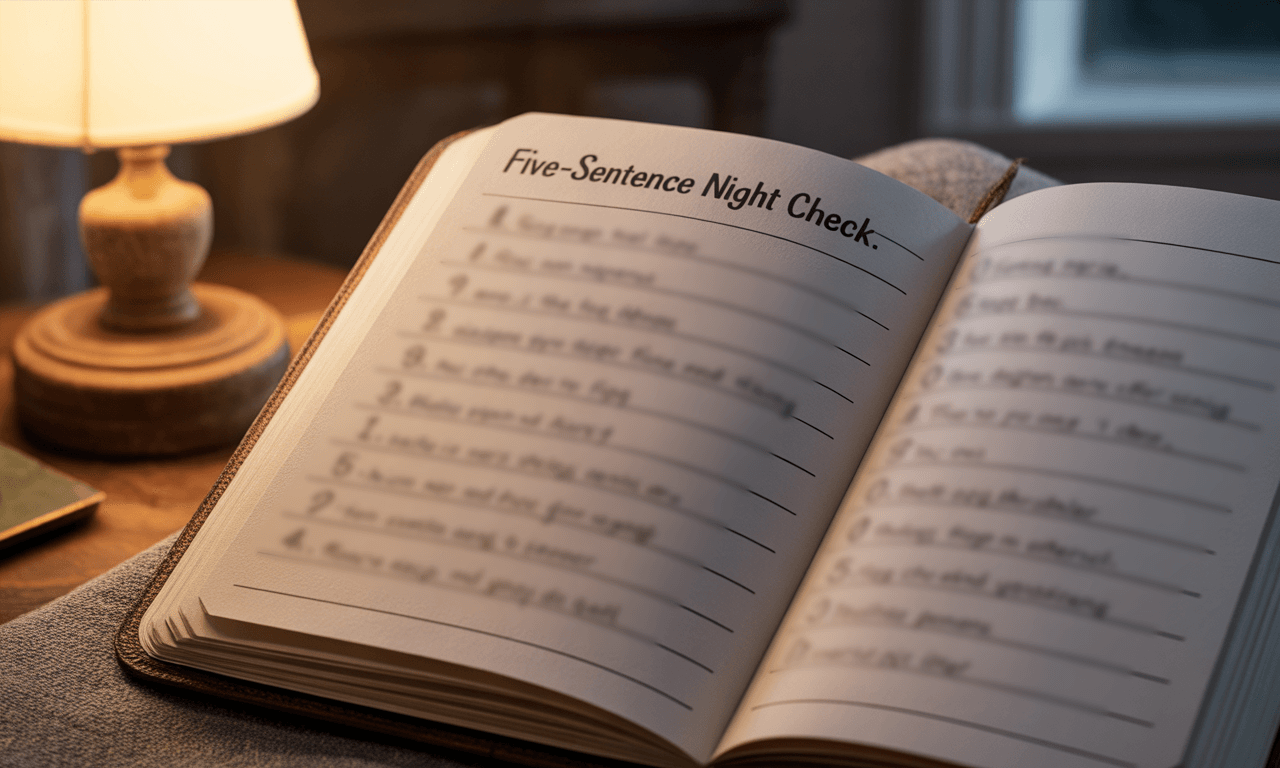
    Outline of the nightly five-sentence communication ritual for couples.Here’s the full script:

    1. One thing I appreciated about you today.
    2. One thing I’m still carrying.
    3. One thing I noticed you did well.
    4. One thing I could do differently tomorrow.
    5. One thing I want to pray (or hope) for us tonight.

    That’s it-five sentences, two minutes. But those two minutes create massive compound interest in your emotional connection. Let’s unpack each one.


    Sentence 1: One Thing I Appreciated About You Today

    Partner sharing genuine gratitude during nightly check-in ritual.Gratitude disarms defensiveness. This first line reminds both of you that you’re on the same team. It doesn’t have to be poetic-just specific.

    Examples:

    • “I appreciated how you handled the grocery run even though you were tired.”
    • “I noticed how patient you were with the kids.”

    Specific appreciation trains your brain to notice positives instead of scanning for faults. It’s the quickest way to reset emotional focus before sleep.


    Sentence 2: One Thing I’m Still Carrying

    Individual expressing lingering feelings to release tension before bedtime.This is your gentle pressure valve. It’s where you name the small frustrations or worries you’re bringing into the night-before they turn into resentment.

    The key is tone: describe without accusation. “I’m still feeling overwhelmed from dinner chaos” works better than “You left me to do everything.”

    This sentence is not for solving, just surfacing. It invites empathy, not defense.

    If tensions rise, apply a technique from No-Harm Rules: A Minimal Communication Protocol for Crisis Weeks. Pause, breathe, and remember-safety first, solutions second.


    Sentence 3: One Thing I Noticed You Did Well

    Couple showing tenderness and recognition through small gestures.

    This is where you strengthen recognition muscles. Couples often assume appreciation is implied, but assumptions don’t heal fatigue.

    Notice the quiet wins:

    • “You handled that call with your mom really gracefully.”
    • “I liked how you made space for me to talk earlier.”

    This simple acknowledgment helps your spouse feel seen-and being seen is the soil of intimacy. It reminds you that goodness still exists, even on weary days.


    Sentence 4: One Thing I Could Do Differently Tomorrow

    Reflection moment focusing on personal growth and emotional accountability.This one builds accountability. It’s not about guilt-it’s about ownership. When both partners model self-awareness, defensiveness dissolves.

    Examples:

    • “I could take a few breaths before reacting next time.”
    • “I want to ask for help earlier instead of stewing.”

    Accountability builds trust faster than apology alone. It says, “I’m paying attention to my part.”

    You’ll find this line particularly powerful after reading From Sarcasm to Signal: Replacing Passive-Aggressive Habits with Clear Requests, which explores how direct honesty creates safety faster than defensiveness ever could.


    Sentence 5: One Thing I Want to Pray (or Hope) for Us Tonight

    Couple closing the day in shared prayer for peace and unity.This closing sentence brings everything back to unity. Whether you pray or simply express intention, you’re reaffirming shared purpose.

    Examples:

    • “I’m praying that tomorrow feels lighter.”
    • “I hope we remember how much we’re for each other.”

    The point isn’t religious formality-it’s alignment. You’re ending the day reminding each other that you’re not enemies, you’re allies.

    Even when nothing is fully resolved, shared prayer or hope invites grace to finish what effort cannot.


    How to Keep It Tender, Not Defensive

    Married couple sharing emotional safety through gentle conversation.Tone is everything. The ritual only works if it feels safe. Keep these three guidelines:

    1. Use calm voices. The goal is to connect, not debate.
    2. Speak only for yourself. No “you should have” language.
    3. End with physical touch. A hand on the arm or kiss goodnight anchors words in warmth.

    If a sentence triggers defensiveness, skip it for the night. The ritual isn’t a test-it’s a tool. Consistency beats perfection.


    Why Two Minutes Can Change Everything

    Symbol of brief but meaningful daily connection through nightly ritual.You don’t need long talks to heal long-term patterns. You just need daily signals of goodwill. The brain learns fastest through repetition-especially when emotion and safety are present.

    By doing the night check regularly, you’re creating micro-corrections before major crashes. Over time, small course adjustments add up to major relational stability.

    This tiny ritual keeps resentment from hardening into rackets-those repetitive argument patterns explored in When Arguing Becomes a Racket.


    When You Miss a Night

    Tired but connected couple maintaining nightly ritual with flexibility.Missed a night- Don’t overanalyze-just restart.

    Like any discipline, it’s not about streaks but restoration. Skipping a day isn’t failure; it’s a reminder that love requires rhythm, not perfection.

    If you’re both too tired, shorten it further: share one appreciation, one burden, one prayer. Even thirty seconds of intentional presence is better than drifting into silence.


    Adapting the Ritual for Your Season

    Partners maintaining connection through digital nightly ritual.Different seasons require different applications.

    • With small kids: Do it right after bedtime routines to anchor the evening.
    • During crisis: Focus only on gratitude and prayer-safety first.
    • During travel: Text your five sentences instead of speaking them.

    The beauty of this ritual lies in its adaptability. However your life shifts, you can always find two minutes to protect what matters most.


    The Science of Emotional Check-Ins

    Graphic showing how nightly gratitude and vulnerability reduce stress.Psychologically, the Five-Sentence Night Check activates three stabilizing mechanisms:

    1. Gratitude lowers cortisol levels and improves sleep.
    2. Vulnerability releases oxytocin, which strengthens bonding.
    3. Consistency retrains the nervous system to expect safety, not conflict.

    In short, the ritual literally rewires your stress response. The more you do it, the easier it becomes to feel connected under pressure.


    Troubleshooting: When It Feels Forced

    Person maintaining emotional ritual even when partner isn’t yet participating.At first, it might feel mechanical. You might think, “We’re just checking boxes.” That’s normal.

    The ritual’s power comes from repetition. Over time, your emotions will catch up to your intentions. Even awkward beginnings create real change.

    If one partner resists, focus on consistency over persuasion. Keep your part of the ritual going quietly. The stability of one heart often invites the other to soften.


    Linking the Five-Sentence Night Check with Your Growth Plan

    Organized marriage rhythm combining daily and weekly connection habits.Use the nightly ritual as part of your larger growth rhythm:

    Together, these practices form a sustainable structure of connection-daily, weekly, monthly-that keeps your marriage emotionally maintained, not reactionary.


    The Faith Connection: Ending the Day With Grace

    Couple practicing nightly prayer as part of faith-driven marriage ritual.Faith adds depth to this practice because it grounds your effort in grace.

    When you pray or reflect together at night, you invite something larger than your willpower into your marriage. You’re saying, “We can’t fix everything, but we can stay soft.”

    Grace turns repetition into renewal. It reminds you that love doesn’t have to be perfect to be powerful-it just has to stay present.


    What Couples Report After 30 Days

    Morning sunlight representing new beginnings after consistent connection.Couples who use the Five-Sentence Night Check for just a month often report:

    • Fewer recurring arguments
    • Better sleep
    • Quicker emotional recovery after tension
    • Deeper sense of being known

    It’s proof that the smallest consistent habits create the biggest relational dividends.

    Love grows not by intensity, but by intention repeated daily.


    Final Thought: Love Is Built in Micro-Moments

    Peaceful ending to the day showing emotional closeness through nightly ritual.Big love is made of small maintenance. The Five-Sentence Night Check is that quiet daily act that reminds you-you’re on the same side.

    It’s how you prevent tomorrow’s argument before it starts, how you soften sharp edges before sleep, and how you say, “We matter,” even when the day’s been hard.

    Because great marriages aren’t built by avoiding conflict; they’re built by staying connected through it-one small ritual, five sentences, two minutes at a time.