Tag: respect

  • The Criticism Trap: Why Your Words Are Costing You Connection

    The Criticism Trap: Why Your Words Are Costing You Connection

    Every marriage has moments when one spouse feels the urge to “fix” the other. It often starts with something small-a tone, a habit, a forgotten task-but ends with distance instead of closeness. That’s the hidden cost of criticism: it promises improvement, but it delivers resentment.

    This cornerstone post unpacks why criticism backfires even when our intentions are good. You’ll learn how it threatens a partner’s sense of dignity, why defensiveness rises instantly, and how restraint can actually deepen respect. We’ll explore simple shifts-from judgment to curiosity, from fault-finding to understanding-that rebuild emotional safety and intimacy.


    The Silent Damage of Constant Criticism

    Couple feeling distant after repeated criticism in marriage.Criticism is often disguised as concern. You might think, “I’m only saying this because I care.” But to your spouse, it can feel like rejection dressed in logic. Over time, those “helpful corrections” begin to sound like disapproval, not love.

    In marriage, repeated criticism chips away at three vital foundations: safety, trust, and respect. When one partner constantly points out flaws, the other begins to anticipate judgment. Every conversation feels like a test to be passed rather than a connection to be enjoyed.

    Even if your spouse stays silent, criticism leaves a mark. It creates invisible walls-the kind that aren’t built overnight but become harder to tear down with each “You should’ve…” or “Why didn’t you…”

    Emotional safety is what allows partners to open up, take risks, and admit mistakes. Criticism turns that safety into surveillance. Instead of asking, “Can I share my heart-” your spouse begins to think, “Will this be used against me-”


    Why Criticism Backfires Even When You Mean Well

    Visual contrast between loving communication and criticism in marriage.At its core, criticism places one partner above the other. It says, “I see your flaw, and I know better.” Even if you don’t mean to sound superior, criticism carries that tone because it points downward rather than reaching across.

    When criticized, most people’s first instinct is self-defense. The brain perceives criticism as a threat to identity and belonging-two of the deepest emotional needs. That’s why even mild complaints can ignite arguments or withdrawal.

    The paradox is painful: the more you criticize, the less your spouse listens. Instead of inspiring change, it inspires protection. Criticism doesn’t correct behavior; it triggers justification.

    That’s why in our article, “When Words Wound”, we explore how “constructive feedback” can often mask deeper frustration or superiority. Learning to spot the difference between correction and condemnation can save couples years of emotional distance.

    If you’ve ever said something “for their own good” and watched it backfire, you’ve already experienced this trap. The goal isn’t to never speak truth-it’s to learn how and when to speak it so that love doesn’t get lost in translation.


    The Pride Beneath the Problem

    Reflection of self-awareness as key to reducing pride and criticism.Criticism often hides behind pride. You might not even realize it’s pride because it feels like “helpfulness” or “high standards.” But when you correct your spouse primarily to prove your own competence or to feel in control, pride has taken the wheel.

    Pride says: “If they would just do things my way, everything would be fine.”
    Humility says: “Maybe there’s more than one way to be right.”

    When pride leads the conversation, empathy disappears. We stop asking questions and start giving orders. But real love is rooted in mutual respect, not moral superiority.

    Before speaking, ask: Am I trying to understand my spouse-or am I trying to win- That one question can shift the entire tone of your marriage.


    The 24-Hour Rule: Learning to Wait Before You Speak

    Taking time to pause and reflect before responding to your spouse.One of the simplest yet hardest disciplines in marriage is waiting. When you’re angry, every word feels urgent. But urgency is the enemy of understanding.

    The 24-hour rule means resisting the urge to criticize or correct until you’ve cooled off for at least a full day. In that time, emotions settle, and perspective returns. Often, what felt like a major offense in the moment becomes something minor-or even forgivable-after rest.

    This practice doesn’t mean ignoring real issues. It means giving your better self time to show up before you speak.

    Our companion post, “Wait Before You Speak”, walks you through practical ways to apply this in daily life-like writing down your frustrations before voicing them, praying for peace, or rehearsing how to phrase concerns with gentleness.

    The most loving words are the ones spoken with wisdom, not impulse.


    How Criticism Creates Emotional Distance

    Emotional distance forming between spouses due to chronic criticism.Criticism doesn’t only hurt in the moment-it rewires how couples perceive each other. The more often criticism shows up, the more likely your spouse is to anticipate it.

    This expectation leads to emotional guarding. You may notice your spouse avoiding conversations, changing subjects, or responding defensively even when you mean well. That’s because criticism teaches the nervous system to prepare for attack.

    Eventually, partners stop sharing altogether. Vulnerability becomes too risky. Intimacy withers-not from lack of love, but from fear of judgment.

    In healthy marriages, both partners feel safe enough to be imperfect. The goal isn’t perfection; it’s partnership. When criticism replaces compassion, the marriage becomes a competition for who’s more “right.”

    That’s why this series continues with “Respond, Don’t React”-a post that retrains how you handle frustration by slowing your emotional reflexes. The shift from reaction to reflection is one of the most mature forms of love.


    Curiosity: The Cure for Quick Judgment

    Choosing to see your spouse through eyes of kindness instead of judgment.Curiosity changes everything. When you feel the urge to criticize, ask instead, “I wonder why that happened-” or “What might they be feeling-” That mental shift turns judgment into inquiry and opens the door to connection.

    Curiosity doesn’t excuse poor behavior-it helps you understand it. And understanding builds compassion, which leads to cooperation.

    Here’s a quick exercise: the next time your spouse forgets something or makes a decision you disagree with, pause and ask one gentle question instead of giving one harsh statement. Watch how the energy shifts from confrontation to collaboration.

    Our article “Seeing with Kind Eyes” dives deeper into this skill-how to notice flaws without shaming, and how empathy often leads to self-correction more effectively than criticism ever could.


    Replacing Criticism with Respectful Communication

    Couple practicing respectful and kind communication.Respectful communication isn’t about staying silent-it’s about speaking life. Every phrase either plants peace or provokes pain. The key is learning to phrase truth in a way your spouse can actually hear it.

    Instead of “You never listen,” try “I feel unheard when I share something important.”
    Instead of “You always mess that up,” try “Can we try a different approach together-”

    These small shifts turn conflict into collaboration. The difference isn’t just in wording-it’s in posture. You move from an accuser’s stance to a partner’s stance.

    You can find more practical language shifts in “Speak to Build, Not to Break”, which expands on how respect transforms both the tone and outcome of every marital conversation.


    Gratitude: The Antidote to Fault-Finding

    Simple daily gratitude note showing appreciation in marriage.You can’t criticize and appreciate at the same time. The human mind is wired to focus on one frame at a time-fault or gratitude. If you want to weaken the power of criticism, strengthen the habit of gratitude.

    Start small. Compliment your spouse’s effort even when the result isn’t perfect. Say thank you for the ordinary. Express appreciation aloud for what they did right.

    When gratitude becomes your default, the entire emotional climate of your home changes. You begin to notice how much good is quietly present in your marriage.

    In “Praise Over Criticism”, you’ll find a step-by-step routine for building a daily gratitude practice that rewires how you both perceive each other. It’s one of the simplest and most powerful ways to reset connection.


    The Emotional Maturity of Withholding Words

    Couple walking peacefully after resolving conflict with maturity.It takes real maturity to stay quiet when you could be right. Silence, in the right moment, is not avoidance-it’s protection.

    Choosing restraint doesn’t mean you don’t care. It means you care too much to let anger choose your words. Emotional maturity means thinking beyond the momentary satisfaction of being right and focusing on the long-term health of the relationship.

    This kind of maturity grows with practice. Each time you hold back criticism and replace it with prayer, patience, or perspective, you’re building self-control-the foundation of lasting love.

    “The Maturity Move” explores how emotional restraint can become your greatest act of strength, not weakness.


    Healing After Years of Criticism

    Rebuilding trust and safety in marriage after years of criticism.If you’ve spent years in a cycle of criticism, don’t despair. Healing is possible-but it starts with awareness. Acknowledging that your tone, not just your words, has hurt your partner is an act of humility that begins to rebuild trust.

    Start by apologizing sincerely-not for what your spouse did wrong, but for how you’ve contributed to disconnection. Replace defensiveness with ownership. Then, commit to practicing empathy and restraint.

    Over time, your spouse will notice the shift. They may even mirror it. Safety rebuilds slowly but powerfully when one person leads with gentleness instead of judgment.

    You might revisit “Respond, Don’t React” and “Wait Before You Speak” together as a couple. Use them as conversation starters about how to handle conflict differently going forward.


    Why The Criticism Trap Is a Choice-And So Is Freedom

    Couple reconnecting emotionally after replacing criticism with compassion.Every word you speak either reinforces fear or builds love. The choice to criticize or to connect is one you make hundreds of times a day. But with awareness, you can catch yourself before falling into the same old patterns.

    Freedom begins with noticing your triggers-the moments when you feel superior, frustrated, or disappointed-and choosing curiosity instead of condemnation. It’s about becoming intentional with tone, timing, and tenderness.

    In healthy marriages, partners become one another’s safe mirrors-reflecting truth with gentleness and grace. That’s how love matures.

    The good news- Every couple can step out of the criticism trap and into compassion, starting today. It begins with the next sentence you speak.

  • Mixed Beliefs, Shared Love: Navigating Faith Differences with Grandparents

    Mixed Beliefs, Shared Love: Navigating Faith Differences with Grandparents

    Maybe a second marriage changed the spiritual landscape. Maybe you came to faith later. Either way, you can honor grandparents while staying faithful to your convictions. This piece offers a gentle framework: affirm shared loves, name your non-negotiables, propose safe alternatives, and keep the door open for questions-not indoctrination. You’ll also get “what if” scenarios (books, services, rituals) and how to respond without shaming or surrendering.

    amily praying at dinner table while grandparents watch lovingly, symbolizing faith respect across generations


    When Faith Becomes the Elephant at the Table

    grandparents and parents holding hands over Bible and storybook symbolizing love across faith differencesFaith is often the invisible thread holding families together-or the quiet wedge pulling them apart. When parents and grandparents believe differently, every bedtime prayer, church service, or holiday meal can become a subtle negotiation.

    Maybe your parents once taught you to pray, and now you’re raising your children in a faith they no longer follow. Or maybe they found a new path that feels foreign to you. Either way, the question remains: how do you stay rooted in your convictions without dishonoring theirs-

    The goal isn’t conversion; it’s clarity. A family’s peace depends on knowing how to love across difference.

    For context on setting relational foundations before spiritual ones, start with The Grandparent Boundary Playbook at https://blog.liveyourbestmarriage.com/Grandparents-Boundaries/boundary-playbook. That cornerstone defines authority, compassion, and repair-the same principles that make interfaith respect possible.


    Why Faith Differences Feel So Personal

    parent and grandparent having gentle porch conversation to understand faith differences respectfullyFaith isn’t just belief-it’s identity, memory, and meaning. When it changes, people grieve what once felt shared. For grandparents, seeing new beliefs may feel like losing part of their legacy. For parents, pressure to adjust can feel like betrayal of conscience.

    Both sides are right to care deeply. The pain usually comes from misunderstanding intent, not malice. Grandparents think, “I just want my grandkids to know God.” Parents think, “I just want to raise my kids consistently.”

    The answer isn’t avoidance. It’s honest conversation held in love and anchored in boundaries.


    Start With Shared Loves, Not Divisions

    grandparents and parents gardening together symbolizing shared love despite faith differencesBefore you talk about where you differ, affirm where you agree. Most families already share these core loves:

    • Love for the child’s well-being
    • Value of kindness, honesty, gratitude
    • Desire for family connection
    • Hope that kids grow up grounded and compassionate

    Start here. You might say:

    “We both want the kids to feel loved, secure, and kind. That’s the heart of what we’re teaching, even if the language is different.”

    When grandparents feel seen for their good intentions, they’re more open to hearing your limits later.


    Naming Your Non-Negotiables With Grace

    family faith rhythm guide with candle symbolizing gentle faith structure for childrenFaith differences only cause chaos when boundaries are assumed, not stated. Instead of waiting for tension, name your few non-negotiables clearly and kindly.

    Example framework:

    “Because we’re the parents, we’re choosing church on Sundays and bedtime prayer. That’s part of how we teach gratitude and trust. We’d love your help supporting that.”

    Non-negotiables might include:

    • Attending your chosen church or faith service
    • What books or videos your kids consume
    • How prayer, blessings, or grace are done
    • Rules around gifts with spiritual meaning

    It’s okay to say, “We prefer our faith content come from our home or church.” Clarity honors both belief and peace.


    Propose Safe Alternatives Instead of Saying “No”

    grandparent reading child devotional showing alternative way to share faith positivelyBoundaries land best when they include options. Instead of “don’t,” say “how about.”

    Example 1:
    Grandparent: “Can I read them this meditation book-”
    Parent: “Thanks for wanting to share something uplifting. Could you read from their devotional instead- They love hearing your voice.”

    Example 2:
    Grandparent: “We’d like to take them to our service next weekend.”
    Parent: “We appreciate the invite. We’re teaching them to attend one church consistently for now, but lunch afterward would be great.”

    It’s substitution, not suppression. You’re still welcoming participation-just within your framework.


    Keep the Door Open for Questions

    child listening to grandparent and parent sharing faith stories peacefullyKids will notice differences. One set of grandparents may pray differently-or not at all. That’s healthy exposure if handled calmly.

    Teach kids to ask and listen:

    • “That’s how Grandpa prays. Isn’t it interesting how people show love to God differently-”
    • “Grandma doesn’t pray before meals. We still can, and that’s okay.”

    When children see respect across differences, they learn maturity. You’re not training fear of difference; you’re modeling discernment within love.


    Avoid the Conversion Competition

    family leaving church with smiling grandparents waving showing peaceful boundariesIf you sense pressure to let your child attend other services or hear contradictory teaching, respond without judgment:

    “We love that you want them to learn about God. For now, we’re keeping things simple and consistent at home, so their foundation is strong. When they’re older, we’ll help them explore respectfully.”

    Consistency now prevents confusion later. You’re not rejecting their faith-you’re protecting formation.

    For deeper strategies on navigating extended family at holidays and services, read Holiday Without Drama at https://blog.liveyourbestmarriage.com/family-culture/holidays-values-first. That article helps you pre-plan faith activities and avoid conflict during big gatherings.


    Handling Books, Media, and “Surprise” Gifts

    small pile of approved children’s faith books beside one excluded book showing loving discernmentA new spiritual book or video from grandparents might come with good intent-but wrong content. Instead of scolding, redirect.

    1. Thank the gesture: “Thank you for thinking of their spiritual growth.”
    2. Redirect gently: “We’re focusing on [our chosen faith material] right now, so we’ll save this one for later.”
    3. Offer a swap: “Would you like to read this other book with them next time-”

    If this happens repeatedly, send a curated list. Many grandparents appreciate knowing what is okay. You’re making it easy for them to succeed.


    When You’re the Grandparent Reading This

    grandparent writing note to support children’s faith values showing cooperation across generationsIf you’re the grandparent and your kids are setting new faith boundaries, know this: your influence hasn’t diminished-it’s evolving. You still hold emotional authority, but now it flows through respect.

    The most powerful phrase you can say is:

    “How can I help you make your values easy for the kids-”

    That one line earns endless trust. It also deepens your legacy-you’re modeling humility and love that transcends differences.


    Creating “Faith Neutral” Activities Everyone Can Enjoy

    grandparents parents and kids baking cookies together representing shared values activityNot every family moment has to be a theological one. Fill your shared calendar with activities that honor togetherness without triggering belief clashes:

    • Family hikes and nature walks (creation appreciation without sermons)
    • Baking traditions linked to gratitude
    • Storytime about kindness or courage
    • Volunteering together

    These moments remind everyone that shared love matters more than identical theology.


    What to Do When Boundaries Are Crossed

    family members reconciling after faith boundary discussion showing calm resolutionEven with good communication, someone might cross a line-taking kids to a service unapproved or introducing different beliefs without permission.

    When that happens:

    1. Pause, not explode. Take a breath before reacting.
    2. Restate your boundary: “We’ve asked to keep church attendance consistent.”
    3. Offer a repair path: “Let’s plan future visits around shared family time instead.”

    For detailed guidance on proportionate, loving repair, the post When They Won’t Respect the Boundary: Consequences, Repair, and a Path Back provides step-by-step clarity on restoring peace without estrangement.


    Managing Mixed Services During Holidays

    holiday dinner table blending faith and family traditions peacefullyHolidays magnify every difference-especially faith ones. One family’s tradition is another’s taboo. Avoid last-minute tension by planning ahead:

    • Discuss schedules early: “We’ll attend our service at 10, then join you for lunch.”
    • Offer options: “Would you like to join us for the family prayer before we eat-”
    • Set tone for kids: “We respect everyone’s traditions and keep our own too.”

    For an extended framework, visit Holiday Without Drama again for specific scripts on timing and expectation-setting.


    Teaching Kids to Speak With Respect

    parent and child reading book about diversity in beliefs reinforcing empathy and understandingYour children don’t need to debate theology-they need to learn how to honor difference without confusion. Practice phrases like:

    • “That’s what Grandma believes; at our house, we believe this.”
    • “We can love people who think differently.”
    • “If you’re unsure, ask Mom or Dad.”

    It’s the tone that teaches maturity. Children raised to engage kindly become adults who can hold conviction and compassion together.


    Blended Families, New Marriages, and Faith Complexity

    blended family lighting candles together showing harmony across belief systemsSecond marriages often bring layered belief systems-step-grandparents with different practices, blended rituals, or new celebrations.

    Keep clarity by identifying lowest common values: love, gratitude, respect, service. Then build holiday or weekend activities around those.

    A blended-faith home doesn’t need identical worship to stay peaceful. It just needs shared values and clear communication.


    The 24-Hour Repair Rule for Faith Misunderstandings

    parent calmly calling grandparent to clarify misunderstanding using 24 hour repair approachEven faith-focused families mess up. Someone might say something dismissive (“That’s silly to believe”) or pressure a child unintentionally.

    Apply the 24-hour repair rule:

    1. Name it: “That comment felt hurtful.”
    2. Restate your why: “We’re teaching respect for all beliefs.”
    3. Reset: “Let’s try again next time with curiosity, not criticism.”

    Quick repair keeps spiritual friction from becoming family fracture.


    When Silence Is Healthier Than Debate

    multigenerational family laughing over board game maintaining harmony instead of arguing beliefsNot every difference needs dialogue. Sometimes silence preserves peace. If conversations about faith repeatedly lead to friction, choose dignity over debate.

    You might say:

    “We love you, and we prefer to keep faith talk light so we can enjoy family time.”

    Then redirect with shared joy-games, cooking, walks. It’s not avoidance; it’s wisdom.


    Using Written Tools to Prevent Misunderstandings

    family covenant document highlighting faith and values section for clarityPut your faith rhythms in writing-short, friendly, and accessible. Add a faith section to your family covenant:

    • Sunday service time
    • Approved devotional or children’s book list
    • How questions and prayers are handled

    This prevents accidental overreach and gives grandparents a reference point. If they ask “Why so formal-”, you can say,

    “It’s part of our family covenant-it keeps everything consistent, so love stays easy.”

    The full covenant framework is outlined in Build Your Family Culture at https://blog.liveyourbestmarriage.com/family-culture/family-covenant.


    Real-Life Scenarios and Responses

    simple illustrations representing book gift, faith service, and family brunch as examples of boundary scenariosScenario 1: The Book Swap
    Grandma gifts a mystical storybook with ideas that clash with your beliefs.
    Response: “Thanks for sharing! We’ll keep this one for later and read from our devotional together today.”

    Scenario 2: The Holiday Invite
    Grandpa invites kids to his service.
    Response: “We appreciate it! We’ll stick with our usual church, but we’d love to do brunch after.”

    Scenario 3: The Over-Curious Comment
    An uncle says, “Why don’t your kids believe this instead-”
    Response: “We’re focusing on gratitude and kindness right now-plenty to learn for one childhood!”

    Faith boundaries don’t need defensiveness-just direction.


    The Fruit of Staying Grounded in Grace

    family of multiple generations walking together representing peace across faith differencesWhen you honor faith differences with love, something beautiful happens:

    • Kids learn respect without fear.
    • Grandparents feel included, not exiled.
    • Parents lead calmly instead of reacting.
    • Family conversations become spaces of grace.

    The goal isn’t sameness-it’s peace that outlives disagreement.


    A Blessing for Mixed-Belief Families

    family gathered around dinner table glowing with candlelight symbolizing unity through graceMay your home be rooted in conviction, watered by compassion, and pruned by humility.
    May faith not divide your generations, but refine your love.
    And may every difference become an opportunity to practice grace.

    For continued balance during holidays, revisit Holiday Without Drama. And for clear structure on authority, boundaries, and repair, keep The Grandparent Boundary Playbook nearby as your steady compass.

  • From Storm to Calm: Navigating the Emotional Chaos of Hard Conversations

    From Storm to Calm: Navigating the Emotional Chaos of Hard Conversations

    Hard talks can sound like thunder-raised voices, raw nerves, and the urge to run. You don’t have to choose between “say nothing” and “say it all with no brakes.” From Storm to Calm offers simple anchors for intense moments, so you can de-escalate without disconnecting. For a bigger foundation, start with the cornerstone, The Breakthrough You’re Avoiding, and get prepped with When the Conversation Feels Impossible: Preparing Your Heart Before You Speak. This guide turns chaos into clarity-without sacrificing respect, love, or truth.


    Why “From Storm to Calm” Matters Right Now

    From Storm to Calm-creating a safe, calm space to navigate hard conversations.When a conversation hits a nerve, your nervous system fires up. Your heart rate spikes, your breathing gets shallow, your hearing narrows. You’re primed for speed, not understanding. That’s why From Storm to Calm is more than a catchy phrase-it’s a survival skill for couples who want connection more than victory. The goal isn’t to avoid conflict; it’s to navigate emotional chaos while protecting dignity. De-escalation isn’t weakness. It’s how strong relationships stay safe enough for truth.


    Read the Weather: Early Signs a Storm Is Forming

    Early warning signs-reading the weather to prevent emotional storms.Arguments rarely appear out of nowhere. If you can spot the weather pattern early, you can choose From Storm to Calm before thunder rolls.

    • Faster speech, louder volume: urgency masquerading as importance.
    • One-word answers: “Fine. Whatever.” The shutdown before the storm.
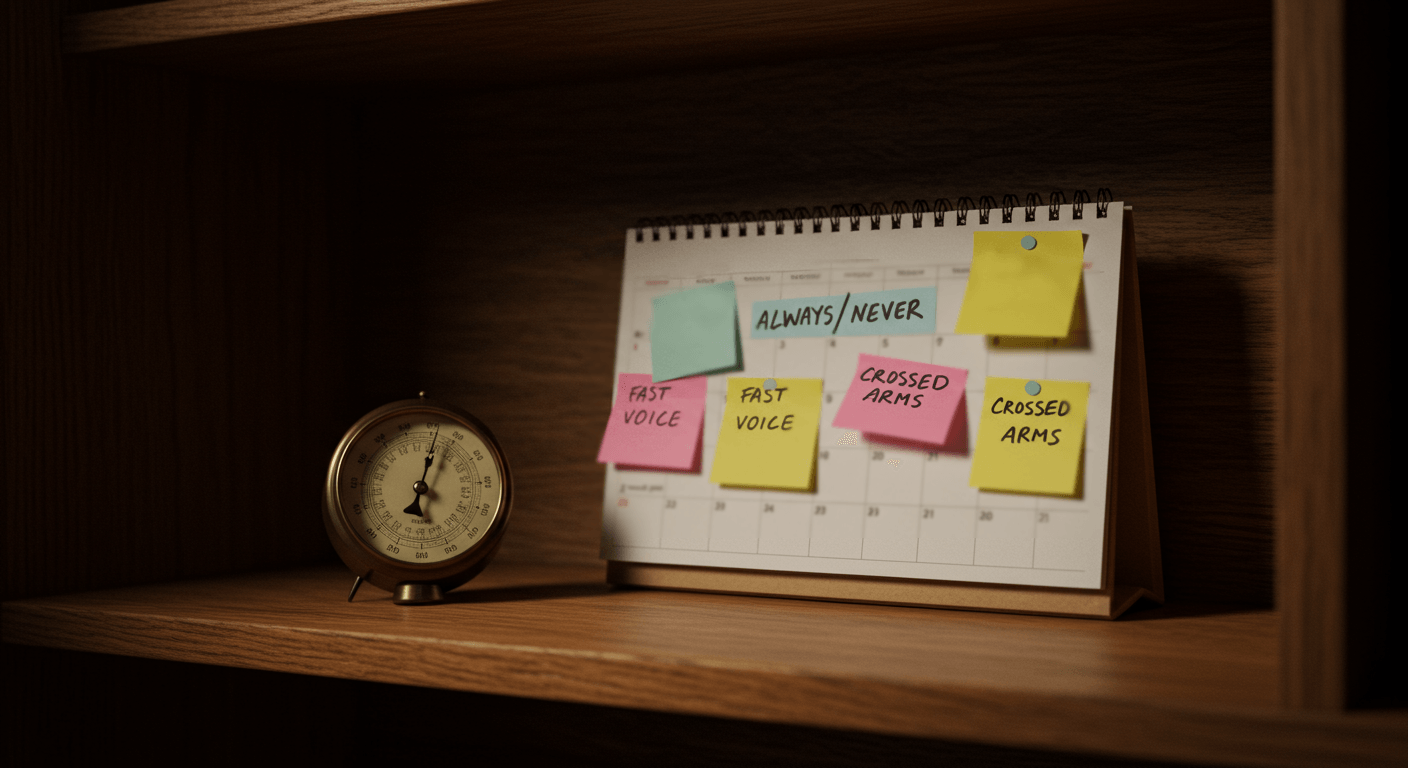
    • Global statements: “You always… You never…” Red flag phrases.
    • Body tells: clenched jaw, crossed arms, tapping foot, shallow breath.
    • Topic hopping: kitchen-sinking past hurts into the current moment.

    Say it out loud: “I’m noticing a storm starting in me.” Naming the pattern turns reflex into choice.


    From Storm to Calm: The Science of De-Escalation

    Science of de-escalation-using breath, words, and structure to move from storm to calm.You don’t need a psychology degree to guide your body from alarm to connection. Three levers help you move From Storm to Calm:

    1. Body (physiology): Long exhales signal safety to the brain. Try 4-in/6-out breathing for one minute.
    2. Words (language): Short sentences lower threat; “I” statements reduce blame.
    3. Structure (guardrails): Turn-taking and time limits keep intensity within safe lanes.

    De-escalation isn’t a trick; it’s a design. The more you practice, the quicker you can return to center when the wind kicks up.


    The Calm Kit: Six Anchors for Intense Moments

    The Calm Kit-timer, tea, and notes as anchors to de-escalate hard conversations.Pack these practical anchors so From Storm to Calm is always within reach.

    1. Anchor your breath
      Exhale longer than you inhale (4 in, 6 out). Do 10 cycles. Your voice will follow your breath.
    2. Anchor your posture
      Uncross arms, drop shoulders, turn your body 10–15 degrees toward your spouse. Strainedposture creates strained tone.
    3. Anchor your pace
      Speak in 10–15-second sentences, then pause. Pacing equals safety.
    4. Anchor your words
      Use plain language and concrete examples. Replace “you never” with “last night I felt… when…”.
    5. Anchor your proximity
      Sit at an angle, not head-on; place a small table between you if that helps. Physical setup reduces perceived threat.
    6. Anchor your process
      Use a timer for turn-taking. Set a stop-time (20–40 minutes) and book a follow-up.


    Scripts for Hot Moments: Words that Cool Without Going Cold

    Cooling phrases-scripts that de-escalate without disconnecting.When your mind blanks or your mouth runs, reach for a few ready-made lines that move you From Storm to Calm:

    • To slow a spiral: “I care about you and this conversation. Can we slow down so I can hear you better-”
    • To reset tone: “I don’t like how I said that. Let me try again.”
    • To clarify meaning: “When you said ‘It’s fine,’ I heard ‘I don’t care.’ Is that what you meant-”
    • To set a pause: “I’m flooded. I need 20 minutes to reset. I’ll be back at 8:30 to finish.”
    • To honor impact: “What I did landed harshly. I’m sorry. Let me restate respectfully.”


    Respect During Conflict: Guardrails that Make Calm Possible

    Respect during conflict-simple setup keeps conversation safe and steady.Guardrails aren’t rules for rules’ sake; they’re what keep love safe while truth is spoken. Borrow from Respect in the Heat of the Moment:

    • No name-calling or character attacks-describe behaviors and impacts.
    • Ban “always/never”-state a specific instance.
    • Turn-taking with a timer-one speaks, one paraphrases, then switch.
    • Repair attempts welcome-“Let me try that again.”
    • Time-outs with a return time-regulate, don’t vanish.

    When respect lives in the process, you can weather big content without breaking.


    Time-Outs That Heal (Not Stonewalling)

    Healthy time-out-clear return time prevents stonewallingA pause can be medicine-or a mask. To keep your break from becoming stonewalling:

    • Set the return time before you step away: “Back at 8:30.”
    • Regulate on purpose: Move, breathe, cool down; don’t ruminate.
    • Return with one revised sentence: Lead with repair.

    If either partner fears “we won’t come back,” put the follow-up in a shared calendar and send a quick confirmation text. Reliability turns the pause into trust.


    From Storm to Calm on Sensitive Topics (Money, Intimacy, Family, Faith)

    Sensitive topics-organized notes help couples navigate emotional chaos calmly.High-stakes topics need extra structure to stay in calm the storm mode:

    • Money: Numbers first, stories second. “The account is $X; we’re $Y over.” Agree on thresholds (e.g., text if > $200).
    • Intimacy: Longings without comparisons. “I miss feeling wanted and relaxed.”
    • Family/in-laws: Present a united message. If you disagree, align in private, then speak as a team.
    • Faith/values: Name the why. “Sunday matters to me because ___. Can we protect that time-”

    If avoidance has been the pattern, reset with Breaking the Cycle of Avoidance in Marriage. And if you need pre-game steadiness, revisit When the Conversation Feels Impossible.


    The 24-Minute Emergency Plan: Move From Storm to Calm Fast

    24-minute emergency plan-structured path from storm to calm in one conversationWhen emotions spike hard, try this 24-minute plan to de-escalate without losing connection.

    • Minutes 0–2: Body reset
      Breathe 4-in/6-out; unclench jaw and hands; uncross arms.
    • Minutes 2–6: Clarify aim
      “My aim is us as a team, not winning. I want to understand and find one next step.”
    • Minutes 6–10: Two-Truths opener
      Impact + goodwill: “When plans change last minute, I feel anxious. I don’t think you’re trying to hurt me.”
    • Minutes 10–16: Turn-taking
      One speaks; one paraphrases. Timer at 3 minutes each; rotate.
    • Minutes 16–20: Tiny bridge
      One visible behavior due within seven days. “Text before we spend over $200.”
    • Minutes 20–24: Land the plane
      Appreciation + follow-up. “Thanks for sticking with me. Sunday at 6 for 10 minutes-”


    When the Conversation Feels Impossible: Prep That Prevents Tempests

    Pre-talk ritual-small preparation steps that create calm in the storm.Preparation is jet fuel for calm. Before big talks, use the 10-minute pre-talk ritual from When the Conversation Feels Impossible:

    1. Breathe (2 min).
    2. Name feelings (not facts).
    3. Choose posture (curious/kind).
    4. Clarify aim (what “better” looks like).
    5. Script your first sentence.
    6. Pick a boundary (flooded = 20-minute break).
    7. Choose a tiny bridge to propose.
    8. Preview repair (“If I snap, I’ll restate”).
    9. Schedule follow-up.
    10. Pray or reflect (1 min).

    Prepping doesn’t make you robotic; it makes you ready to navigate emotional chaos with respect.


    From Storm to Calm in Real Time: Body Tools That Work in 60 Seconds

    Quick body resets-breath, grounding, and cool temperature to calm heated conversations.If you only remember one section, make it this one. These body-first tools flip you into From Storm to Calm mode fast:

    • Paced breathing: 4-in/6-out for 60 seconds.
    • Grounding: Feel the chair support your back; press feet into the floor.
    • Temperature shift: Hold a cold glass to your neck or splash water on wrists.
    • Word window: Limit yourself to 10–15-second sentences; pause.
    • Soft eyes: Drop your gaze slightly; it calms your tone.


    Scripts for Re-Entry After a Pause

    Respectful re-entry-simple phrases that make coming back from a pause easier.Coming back after a break can feel awkward. Use these to glide From Storm to Calm on re-entry:

    • “Thank you for pausing with me. I’m ready to listen first.”
    • “I want to repair how I said that. Here’s what I meant.”
    • “I hear that you felt dismissed. I’m sorry. Can I restate my concern-”
    • “Let’s each offer one tiny step we’ll do this week.”


    After the Storm: Land Soft, Rebuild Strong

    Landing the plane-closing rituals that rebuild connection after conflictWhen the dust settles, move into the repair phase with After the Storm: Rebuilding Connection Once the Emotions Settle. The key is the ending. Your body remembers how the scene ends more than the middle. Close with:

    • One apology that lands (behavior + impact + change).
    • One tiny bridge due within seven days.
    • One appreciation for how your spouse showed up.
    • One follow-up on the calendar.


    The 30-Day Calm Habit: Make De-Escalation Automatic

    30-day calm habit-weekly actions that make de-escalation automatic.Turn From Storm to Calm into your default by practicing on purpose for a month.

    Week 1 – Notice
    Track two early warning signs (tone and speed). Practice 4/6 breathing daily.

    Week 2 – Name
    Use the phrase “I’m noticing a storm starting in me” once per day. Add turn-taking with a timer in one talk.

    Week 3 – Navigate
    Run the 24-minute emergency plan at least once. Add one guardrail from the respect list.

    Week 4 – Nurture
    Schedule a weekly 15-minute reconnection huddle (wins, repair, tiny bridge, calendar). Celebrate small progress.


    Measure What Matters: Proof You’re Moving From Storm to Calm

    Progress dashboard-simple measures that show you’re moving from storm to calm.You’ll feel calmer before you can prove it. Use simple metrics to see progress:

    • Lag time: Issue → conversation goes from weeks to days to hours.
    • Repair speed: Minutes it takes to return to steady tone.
    • Follow-through: Percentage of tiny bridges completed within seven days.
    • Climate shift: Less dread before talks, more relief after.
    • Affection frequency: More consent-based micro-connection.

    If metrics stall, tighten guardrails and re-read Breaking the Cycle of Avoidance in Marriage to keep momentum.


    When the Weather Won’t Change: Invite Wise Help

    Neutral lane-marker-professional support when storms keep repeating.If you keep getting swept into the same storm-shouting, shutting down, or walking out-consider inviting a counselor or wise mentor. Bring your From Storm to Calm tools, your guardrails, and your emergency plan. A neutral lane-marker can make practice safer and change faster.


    Conclusion

    Every storm has a center of calm-find yours and you’ll find each other. When the dust settles, rebuild wisely with After the Storm: Rebuilding Connection Once the Emotions Settle and lock in your ground rules with Respect in the Heat of the Moment. If old patterns keep dragging you back into tempests, address them in Breaking the Cycle of Avoidance in Marriage. From Storm to Calm isn’t about perfect conversations-it’s about steady presence, kind structure, and small, faithful steps that keep love safe while truth is spoken.

  • The Breakthrough You’re Avoiding: Why Hard Conversations Are the Key to Marriage Growth

    The Breakthrough You’re Avoiding: Why Hard Conversations Are the Key to Marriage Growth

    The Breakthrough You’re Avoiding-calm, equal setup for a hard conversation that leads to marriage growth.Every marriage carries one conversation that feels too heavy to touch-yet it’s the very key to deeper trust and closeness. This cornerstone guide shows why avoiding discomfort keeps you stuck and how leaning in-wisely-opens the door to real change. If you’re wondering whether silence is slowly widening the distance, start here, then see how avoidance holds couples back in Why Avoiding Difficult Topics Holds Your Marriage Back and get clear on what “that talk” really looks like in The Next Level of Marriage: Why Every Couple Needs to Have “That Talk”. For practical storm navigation, preview From Storm to Calm: Navigating the Emotional Chaos of Hard Conversations and a mindset reset in Growth Is Messy: How Discomfort Strengthens Your Marriage.


    Why “The Breakthrough You’re Avoiding” Blocks Marriage Growth

    Avoidance delays relief-postponing the breakthrough conversation grows distance over time.Every couple hits places where the stakes feel high-money, intimacy, parenting, time, in-laws, purpose. Your heart says “this matters,” but your stomach says “not now.” In the moment, postponing grants relief. Over months and years, it taxes connection. Avoidance is a short-term anxiety reducer with long-term cost: clarity fades, trust thins, and you slowly start living parallel lives. That is why hard conversations are the gate to marriage growth-they restore clarity, reset trust, and make teamwork real again.

    When you consistently skip The Breakthrough You’re Avoiding, three things happen:

    1. Guesswork replaces truth. Your spouse can’t respond to needs they don’t know.
    2. Resentment replaces warmth. Unspoken fears ferment into stories about each other.
    3. Drift replaces alignment. Without honest check-ins, your daily choices point in different directions.

    If you recognize yourself here, your next read is Why Avoiding Difficult Topics Holds Your Marriage Back. It names the avoidance loop so you can interrupt it with small, brave steps.


    Signs You’re Near The Breakthrough You’re Avoiding (Self-Check)

    Indicator lights-subtle signs that a breakthrough conversation is due.You may be closer than you think. Look for these gentle “indicator lights”:

    • Topic avoidance: You both change the subject within 30 seconds.
    • Logistics-only talk: Schedules dominate; feelings and dreams go untouched.
    • Polite distance: You’re kind but less playful, less curious.
    • Repeat arguments: The same fight in new clothes-content changes, pattern doesn’t.
    • Assumptive telepathy: “I already know what you’ll say,” so you never ask.

    Name it out loud (to yourself first): “This might be The Breakthrough We’re Avoiding.” That sentence transforms reflex into choice.


    The Anatomy of a Hard Conversation (How Breakthroughs Happen)

    Anatomy of a hard conversation-physiology, process, and posture aligned for marriage growth.Breakthroughs aren’t dramatic speeches; they’re structured honesty inside safe guardrails. Think of three layers working together:

    1. Physiology (your body state): Calm bodies make kind sentences.
    2. Process (the structure): Turn-taking, time limits, and one topic at a time.
    3. Posture (the heart): Curiosity over prosecution; “us” over “me versus you.”

    When these line up, hard conversations become building sites, not battlegrounds. If the idea of starting makes your nerves spike, prep your heart with When the Conversation Feels Impossible: Preparing Your Heart Before You Speak. That piece gives you a 10-minute pre-talk ritual you can use tonight.


    Why Hard Conversations Grow a Stronger Marriage (The Case for Discomfort)

    Growth is messy-shared steps through discomfort strengthen the relationship.Muscles strengthen by micro-tears that repair stronger. Marriages strengthen by micro-stretches that repair deeper. You step into the messy middle, you feel the pull, and you return with greater empathy, humility, and trust. Discomfort is not a danger sign; it’s a growth sign-provided respect stays intact. That’s why the sister guide Growth Is Messy reframes awkwardness as evidence you’re building something worth keeping.


    Prepare Your Heart Before You Speak (Respect Under Pressure)

    Pre-talk heart prep-quiet corner and a simple script to keep respect during conflict.You can’t control your spouse’s reaction, but you can regulate your own state. Try this 10-minute primer before you sit down:

    • Breathe 4 in/6 out for a minute.
    • Name feelings (not facts): “I feel anxious + hopeful.”
    • Choose posture: “Curious, not prosecuting.”
    • Clarify aim: “I want a small next step about our evenings.”
    • Script your opener: “I want to understand how evenings are feeling for you and share what’s hard for me.”
    • Set one boundary: “If flooded, 20-minute break; we’ll return at a set time.”

    Full detail and printable prompts live in When the Conversation Feels Impossible.


    From Storm to Calm: Navigate Emotional Chaos in Real Time

    “From Storm to Calm-tiny tools that cool hot moments and keep the talk safe.Even with preparation, big feelings surface. Don’t fear the surge-steer it. Use a pocket set of anchors from From Storm to Calm:

    • Paced breathing: 4 in/6 out; your voice will follow your breath.
    • Word windows: Speak in 10–15 second sentences; pause.
    • Paraphrase pass: “What I heard was… Did I get it-”
    • Time-out with return time: Regulate, don’t vanish.
    • On-the-spot repair: “Same content, softer delivery-let me try again.”

    These anchors return both of you to center so the conversation stays productive.


    Respect in the Heat of the Moment (The Unwritten Rule)

    Respect guardrails-room setup that reinforces dignity while truth is spoken.Respect is the fence that keeps passion from turning into poison. Guardrails to adopt-especially during hard conversations:

    • No name-calling or character attacks. Describe behaviors and impacts.
    • Ban “always/never.” Use a specific instance.
    • Turn-taking with a timer. One speaks; one paraphrases; switch.
    • Repair attempts welcomed. “Can I restate that with more care-”
    • Time-outs with return times. Regulate, then return.

    If you want a full walkthrough, bookmark Respect in the Heat of the Moment. It translates respect into repeatable micro-behaviors.


    “That Talk” Agenda: A Clear Path to the Next Level of Marriage

    That talk agenda-step-by-step structure that turns insight into action.When you’re ready for The Breakthrough You’re Avoiding, structure reduces panic. Adapt this 60-minute flow from The Next Level of Marriage:

    1. Arrival (5 min): Breathe; each person states one-sentence aim.
    2. Two-Truths Openers (10 min): Impact + goodwill.
    3. Turn-Taking (15 min): 3 minutes each; listener paraphrases first.
    4. Ownership (10 min): Name one behavior you can change.
    5. Tiny Bridge (10 min): One visible action due within 7 days.
    6. Land the Plane (10 min): Schedule a 10-minute follow-up; one appreciation each.

    Your goal is not perfection; it’s movement. Tiny bridges compound into big changes.


    The Breakthrough Script Library (Say It Without Burning It Down)

    Pocket phrases-gentle, clear lines that help the breakthrough talk stay respectful.Keep a few lines ready so courage is easier to choose:

    • Opening (aim + goodwill): “I want us to feel like a team about [topic]. I know we’re both trying.”
    • Impact statement: “When [specific event], I feel [emotion] and start to tell myself [story].”
    • Curiosity cue: “What feels heavy about this for you-”
    • Reset line: “I don’t like how I said that. Let me try again.”
    • Boundary: “I’m getting flooded. Can we take 20 minutes and come back at 8:30-”
    • Tiny bridge close: “What’s one small step we’ll both take this week-”


    Use Discomfort to Strengthen Us (Growth Is Messy, On Purpose)

    Reframing discomfort-messy moments are evidence of becoming, not breaking.Discomfort means you’ve left autopilot. That’s good news. Label it as training, not failure. Agree on a shared mantra-“Same team, small steps”-and rehearse the 3S’s of marriage growth:

    • See: Name what’s happening (“Storm rising in me”).
    • Slow: Breathe and shorten sentences.
    • Step: Choose the next tiny bridge.

    For a full reframe that turns awkward into ally, spend time with Growth Is Messy.


    Post-Conversation Repair: After the Storm Comes Reconnection

    After the Storm-repair and tenderness restore safety after a breakthrough conversation.The talk ends; your story continues. The ending teaches your body whether to try again. Use the Four R’s from After the Storm: Rebuilding Connection Once the Emotions Settle:

    1. Recognize the rupture without re-litigating.
    2. Regulate (20–30 minutes if needed) and return at a set time.
    3. Reconcile with an apology that lands (behavior + impact + change).
    4. Rebuild with one tiny bridge and a scheduled check-in.


    Courage Over Comfort: Choose the Hard Thing Kindly

    Courage over comfort-quiet bravery that chooses connection over escape.Courage over comfort doesn’t mean volume. It means honest words with steady respect. Practice micro-courage daily:

    • Text your aim before the talk.
    • Name the tiny bridge you’ll propose.
    • Offer one appreciation after the talk.
    • Put the follow-up on the calendar now.

    When the avoidance reflex is strong, read Courage Over Comfort: Facing the Issues You’d Rather Ignore and let small brave choices accumulate.


    Breaking the Cycle of Avoidance (So Breakthroughs Keep Coming)

    Breaking avoidance-repeatable steps that make brave conversations normal.A single conversation can spark change; a new habit sustains it. To stop backsliding, adopt the 5-Step Reset from Breaking the Cycle of Avoidance in Marriage:

    1. Name the avoided topic.
    2. Contain it (one topic, 20–40 minutes, timer).
    3. Two-Truths opener.
    4. Exchange & reflect.
    5. Tiny bridge due in seven days.

    Rinse and repeat weekly until your body expects relief-not ruin-when hard topics arise.


    Special Topics at the Breakthrough Threshold (Money, Intimacy, Family, Faith)

    Sensitive topics-organized notes help tough talks stay kind, clear, and specific.Some themes carry extra charge. Use fine-tuned structure:

    Money (numbers first):
    “The account is $X; we were $Y over.” Agree on thresholds (text if > $200) and a Sunday 15-minute review.

    Intimacy (longings, not comparisons):
    “I miss feeling wanted and relaxed. Two small rituals I’d love to try this week are …”

    Family/In-laws (united front):
    “We’ll say, ‘We’ll talk and get back to you by tomorrow’-then decide together.”

    Faith/Values (name the why):
    “Sunday morning matters to me because ___. Can we protect that time-”


    The Breakthrough Map: A 60-Day Path to Marriage Growth

    60-day breakthrough map-weekly actions that make marriage growth sustainable.Turn this cornerstone into daily practice with a two-month plan. Small, repeatable steps beat big intentions.

    Weeks 1–2: Notice & Name

    • Identify three avoided topics.
    • Run one 30-minute talk per week using the agenda above.
    • Track a metric: time from issue → first talk.

    Weeks 3–4: Build Structure

    • Adopt two respect guardrails (timer + paraphrase).
    • Create a shared “Agreements” note with owners and due dates.
    • Schedule a 10-minute Sunday follow-up.

    Weeks 5–6: Deepen Courage

    • Use the Two-Truths opener twice weekly.
    • Add one calming ritual (walk, tea, prayer) before talks.
    • Practice one mid-talk repair (“Let me restate more gently”).

    Weeks 7–8: Integrate & Scale

    • Tackle one sensitive topic with the money/intimacy/family/faith structure.
    • Celebrate one win; keep one habit.
    • Book next month’s two talks.


    Metrics That Matter (Proof Your Breakthrough Is Working)

    Progress dashboard-simple measures that show the breakthrough is real.Feelings matter-but data keeps you honest. Review these simple indicators monthly:

    • Lag time: Issue → first talk moves from weeks to days to hours.
    • Repair speed: Minutes to return to steady tone after spikes.
    • Follow-through rate: % of tiny bridges finished within seven days.
    • Climate shift: Less dread before talks; more relief after.
    • Affection frequency: Consent-based micro-connection increases weekly.

    If numbers stall, tighten the container (shorter talks), simplify the bridge (smaller step), and revisit From Storm to Calm for in-the-moment steadiness.


    Frequently Asked Questions About The Breakthrough You’re Avoiding

    FAQ-practical, kind structure makes the breakthrough conversation livable.What if my spouse won’t engage-
    Invite-not indict. Send a short note: “I want us to feel more like a team about [topic]. Could we try a 20-minute talk with a small step at the end-” If no, ask, “What would make this feel safer-” Meanwhile, keep strengthening your side with When the Conversation Feels Impossible.

    What if every talk explodes-
    Upgrade your process before your content. Use turn-taking with a timer, paraphrase before responding, and adopt “time-out with return time.” For scripts that cool heat fast, practice From Storm to Calm.

    What if apologies don’t change anything-
    Apologies without behavioral change create cynicism. Pair “I’m sorry” with one tiny bridge due within seven days and book a follow-up. The full repair blueprint lives in After the Storm.

    Is discomfort a sign we’re wrong for each other-
    Not by itself. Discomfort often means you’re entering new, needed honesty. The difference between harm and growth is respect. Learn the guardrails in Respect in the Heat of the Moment.

    How do we stop backsliding into avoidance-
    Habits beat willpower. Run the weekly 15-minute reconnection huddle (Wins • Repair • Bridge • Calendar) and keep using the reset in Breaking the Cycle of Avoidance in Marriage.


    A Word on Safety and Pace

    Safety first-healthy pace and trusted support come before any conversation agenda.If there is abuse, intimidation, or a history of feeling unsafe, prioritize physical and emotional safety over any conversation plan. Seek trusted, qualified help. Pace is wisdom, not cowardice. You can honor your marriage and your safety at the same time.


    Putting It All Together (A Cornerstone You’ll Reuse)

    Cornerstone interlinking-one hub connecting to practical guides for every phase of the hard conversation.Think of this cornerstone as your interactive manual:

    Spread these links through your own notes or marriage journal; don’t wait for perfection-start the smallest brave step today.


    Conclusion

    Hard conversations aren’t detours-they’re the road to the marriage you both want. When you’re ready to move from insight to skill, prepare your heart with When the Conversation Feels Impossible: Preparing Your Heart Before You Speak, then learn how to land the plane with After the Storm: Rebuilding Connection Once the Emotions Settle. If courage is your gap, go next to Courage Over Comfort: Facing the Issues You’d Rather Ignore, break old patterns in Breaking the Cycle of Avoidance in Marriage, and keep dignity intact with Respect in the Heat of the Moment: The Unwritten Rule of Hard Conversations. The breakthrough you’ve been avoiding is the bridge you’ve been needing-cross it together.

  • Respect in the Heat of the Moment: The Unwritten Rule of Hard Conversations

    Respect in the Heat of the Moment: The Unwritten Rule of Hard Conversations

    You can’t script a hard conversation-but you can set the guardrails. Respect in the Heat of the Moment is the rule that keeps hearts safe while truth is spoken. If you need a full-series overview, visit the cornerstone, The Breakthrough You’re Avoiding, and for in-the-moment stability, see From Storm to Calm. This guide turns respect from a vague value into a repeatable practice you can use when voices rise, tears come, or old defenses try to take over.


    Why Respect in the Heat of the Moment Matters

    Respect in the heat of the moment: calm posture during a hard conversation.When emotions spike, your brain narrows to protect you. You’re more likely to interrupt, defend, generalize, and grab the loudest words you can find. That’s exactly when respect during conflict matters most. It widens the conversation so you can hear what’s actually being said-not just what you’re afraid is being said. Respect doesn’t require agreement; it requires guardrails that protect dignity while you wrestle with what’s true. If you’ve been avoiding sensitive topics because you fear things will blow up, read Why Avoiding Difficult Topics Holds Your Marriage Back to see why delay increases pressure instead of releasing it. For a big-picture plan, start with The Next Level of Marriage: Why Every Couple Needs to Have “That Talk”.


    What Respect Looks Like Under Pressure (Respect Under Pressure)

    Respect under pressure is specific, not sentimental. It shows up as:

    • Plain language, not labels. “When you cancel last minute, I feel unimportant,” instead of “You’re selfish.”
    • Shared airtime. Aim for equal talking time; use a timer if needed.
    • Curiosity over certainty. “Can you say more about that-” disarms defensiveness.
    • Non-negotiable safety. No name-calling, threats, or intimidation.
    • Repair attempts. “Let me start that again,” “I said that harshly-sorry.”

    These micro-behaviors keep respect in heated moments alive even when the conversation is raw. If past talks spiraled, prep first with When the Conversation Feels Impossible: Preparing Your Heart Before You Speak, then keep real-time anchors close by in From Storm to Calm.


    Set the Guardrails Before You Dive In (Respect During Conflict)

    Guardrails and timer tools for respect during conflict.Guardrails are agreements you make when calm so you can rely on them when things get hot. Try these:

    1. Start and stop times. Ninety minutes max; longer talks often create loops.
    2. One issue at a time. If a new issue pops up, list it and park it.
    3. No global statements. Ban “always” and “never.”
    4. Time-outs are allowed. Either partner can pause for 20–30 minutes to regulate.
    5. Repair is required. You both agree to return and finish, and to repair tone if needed.

    If the stakes feel high, map your talk with The Next Level of Marriage and remember to circle back after the conversation using After the Storm so progress sticks.


    A Respect-First Framework You Can Use Tonight

    Conversation framework for respect in hard conversations.Use this five-step structure to keep Respect in the Heat of the Moment even when emotions run high:

    1. Name the aim. “I want to understand how money decisions are stressing you.”
    2. Share impact, not blame. “When expenses change without a heads-up, I feel anxious.”
    3. Ask, then reflect. “What’s your perspective-” Paraphrase before responding.
    4. Own a piece. “I’ve been vague about what I need to feel informed.”
    5. Agree on the next tiny step. “Let’s text each other before spending over $200.”

    This framework prioritizes respect during conflict without watering down truth. If emotions spike, step out for a short regulation break and re-enter with the first step. For language you can borrow, see the scripts below and the preparation tools in When the Conversation Feels Impossible.


    Scripts that Keep Respect During Conflict

    Memorize a few short lines so you can choose connection over escalation:

    • To slow a spiral: “I care about you and this conversation. Can we slow down so I can hear you better-”
    • To reset tone: “I don’t like how I just said that. Let me try again.”
    • To clarify meaning: “When you said ‘whatever,’ I heard ‘I don’t care.’ Is that what you meant-”
    • To take a time-out respectfully: “I’m flooded. I need 20 minutes to reset and then I’ll come back to finish this.”
    • To de-weaponize a hot word: “That word hurts. Can we describe the behavior instead-”
    • To confirm next steps: “So the agreement is we’ll share travel plans by Sunday night. Did I capture that-”

    Practice them out loud when calm. Spoken once, they’re awkward; spoken ten times, they’re muscle memory. For more on the emotional mechanics behind de-escalation, visit From Storm to Calm.


    When You’re Triggered: Fast Resets for Respect in Heated Moments

    Your body announces overload before your mouth does. Notice:

    • Heat in your face or chest
    • Shallow breathing
    • Tunnel vision
    • Urge to talk faster and louder

    Fast resets that preserve respect in heated moments:

    • Exhale twice as long as you inhale for one minute.
    • Grounding: Press your feet into the floor; feel the chair support your back.
    • Temperature shift: Splash cold water or hold a chilled glass to your neck.
    • Write one sentence you want to say; read it instead of improvising.

    If overload is chronic, normalize shorter conversations with scheduled follow-ups. And remember: growth is rarely tidy-see Growth Is Messy: How Discomfort Strengthens Your Marriage for a helpful reframe.


    Respect in Hard Conversations with Power Imbalances

    Sometimes one spouse is more verbal, quicker on their feet, or less reactive. Respect means adjusting the pace so both voices can land. Try:

    • Written prompts before you talk so the slower-to-process partner can prepare.
    • Equal airtime by timer to prevent one-sided debates.
    • Check-ins every ten minutes: “Do you feel heard so far-”
    • Concrete summaries: “Here’s what I believe you’re asking for… did I get it-”

    If past hurt, trauma, or safety concerns are present, consider inviting a trusted counselor to help you practice these skills safely. You’ll still want the same guardrails and repair commitments you see in After the Storm.


    Common Traps That Break Respect-and What to Do Instead

    Even well-intentioned couples slip into patterns that corrode respect during conflict. Watch for:

    • Scorekeeping: Turning the talk into a ledger of who’s done more.
      Do instead: Measure progress by agreements kept, not points won.
    • Kitchen-sinking: Lugging every old offense into the current argument.
      Do instead: Park unrelated issues for another talk.
    • Mind-reading: Assuming motives instead of asking about them.
      Do instead: “The story I’m telling myself is ____. Is that accurate-”
    • Punctuation problems: Good content delivered with a sharp tone.
      Do instead: Repair quickly-“Same content, softer delivery”-then restate.
    • Avoidance disguised as peace: Calling a ceasefire but never circling back.
      Do instead: Put the follow-up date in your calendar and use Breaking the Cycle of Avoidance in Marriage to stop the slow fade.


    Time-Outs That Keep Respect Under Pressure (Respect Under Pressure)

    A time-out is not a shutdown; it’s a strategic pause to protect respect under pressure. Make it work by agreeing to:

    1. Minimum 20 minutes, maximum 48 hours for the follow-up.
    2. No stewing: Move your body, breathe, and do something regulating.
    3. Return with one revised sentence you’ll lead with when you reconvene.

    If either partner fears the other won’t return, set the follow-up time before you separate. Reliability turns time-outs into trust-builders. For post-pause reconnection, lean on After the Storm.


    Repair Is Where Trust Grows (Respectful Conflict Aftermath)

    Repair after rupture-rebuilding connection after the storm.Even with the best intentions, you’ll miss a step, raise your voice, or say the thing you promised not to say. Repair keeps respect in hard conversations alive:

    • Name the offense: “I interrupted you repeatedly.”
    • Own the impact: “It made you feel unimportant.”
    • Offer amends: “I’ll summarize before I respond next time.”
    • Ask for feedback: “Anything else I need to understand-”

    Use a simple format: “What I did… How it impacted you… What I’ll do differently… What do you need next-” Then cement change with a small habit (for example, “I’ll pause three seconds before responding”). Practice clean repair with the guidance in After the Storm.


    Respect for Truth-Not Just for Feelings

    Balancing honesty and respect under pressure.Respect doesn’t mean pretending everything is fine. It means telling the truth in a way your spouse can receive. That often requires:

    • Short sentences and specific examples
    • Requests instead of accusations
    • Boundaries stated calmly: “I’m not willing to be yelled at. I’ll continue when we’re both calm.”

    Respect without truth becomes passivity; truth without respect becomes cruelty. You need both. For courage to speak plainly, see Courage Over Comfort: Facing the Issues You’d Rather Ignore. When your words land gently and clearly, Respect in the Heat of the Moment becomes your normal-not your exception.


    A 30-Day Practice Plan to Make Respect Automatic

    Muscle memory beats willpower. Here’s a simple plan to hard-wire respect in heated moments:

    Week 1 – Language audit (respect during conflict):
    Ban “always/never,” label three personal triggers, and add two repair lines to your vocabulary. Use a notes app to track where you improved and where you slipped.

    Week 2 – Structure (respect under pressure):
    Use the five-step framework in one 30–60 minute talk; set a follow-up date before you finish. If you feel overwhelmed, pause and reset with tools from From Storm to Calm.

    Week 3 – Tone (respect in hard conversations):
    Record (audio) a practice script and listen for speed, volume, and sharpness. Edit and re-record with slower pacing and warmer tone. Ask your spouse which version felt safest to hear.

    Week 4 – Consistency (respectful conflict):
    Do one 20-minute check-in using timers and summarize agreements in writing. Share the summary by text or email so both of you have a copy. If avoidance creeps in, revisit Why Avoiding Difficult Topics Holds Your Marriage Back.


    Respect with Sensitive Topics: Money, Intimacy, In-laws, Faith

    High-stakes topics demand more structure and more respect during conflict:

    • Money: Share numbers, not narratives. “The account is $X; we overspent by $Y.” Agree on thresholds and alerts.
    • Intimacy: Speak to longings and fears without comparisons. “I miss feeling pursued,” not “You never…”
    • In-laws: Define your team. “If we disagree about boundaries, we decide together and present a united front.”
    • Faith/values: Name how beliefs inform behavior. “Sabbath matters to me because ____, so I’m asking for ____.”

    If you’ve delayed these talks because they feel overwhelming, schedule them using The Next Level of Marriage and sustain calm with From Storm to Calm. Then follow with a brief check-in using the five-step framework above.


    How to End a Hard Conversation Without Undoing Progress

    Many couples make it through a tough hour and then wreck the last two minutes. Close well:

    1. Summarize agreements (what, who, when).
    2. Name one appreciation for how your spouse showed up.
    3. Confirm the follow-up date/time (even if everything feels resolved).
    4. Do something connective (short walk, cup of tea, a hug you both consent to).

    The conversation doesn’t have to be perfect to be productive. For structure you can reuse, revisit The Breakthrough You’re Avoiding. If you feel your momentum stalling, nudge yourselves forward with Breaking the Cycle of Avoidance in Marriage.


    Conclusion

    Respect doesn’t mute honesty-it amplifies trust. It slows the moment enough to find the words that heal instead of the words that harm. Keep growing your resilience with Growth Is Messy and practice clean repair with After the Storm. To ensure you don’t slip back into silence, reinforce new habits with Why Avoiding Difficult Topics Holds Your Marriage Back. When you protect Respect in the Heat of the Moment, you don’t just win an argument-you strengthen the marriage you’re building together.

  • After the Storm: Rebuilding Connection Once the Emotions Settle

    After the Storm: Rebuilding Connection Once the Emotions Settle

    The conversation ended-but the story isn’t over. Repair is where trust grows: apologies that land, agreements you honor, and tenderness that says, “We’re still us.” If the dialogue felt intense, stabilize with From Storm to Calm and review your pre-talk prep in When the Conversation Feels Impossible: Preparing Your Heart Before You Speak. This guide is your step-by-step for After the Storm-how to reset, repair, and reconnect so conflict becomes construction, not corrosion.


    After the Storm: Why Repair Matters More Than “Being Right”

    After the Storm-calm, safe space for post-conflict repair.When a hard conversation ends, there’s a fragile moment where both of you ask, “Are we okay-” That moment is where couples either drift apart or draw closer. After the Storm work matters because your nervous system remembers the ending of a scene more than the middle. If the ending is cold or unfinished, your body stores conflict as danger; if the ending is warm and clear, it stores conflict as survivable-and even useful. Repair is how you teach your marriage: we can handle turbulence and land safely together.


    Physiology First: Calming Your Body So Your Words Can Work

    Physiology first-quiet corner and cool water to regulate after conflict.You can’t reconnect with a storm still inside your chest. Before you speak again:

    • Breathe on purpose: Inhale for 4 counts, exhale for 6, ten cycles.
    • Ground your body: Notice the chair beneath you; press your feet into the floor.
    • Temperature reset: Hold a cool glass to your neck or splash cold water on your wrists.
    • Short sentences: When you do speak, keep phrases 10–15 seconds long.

    These regulate your nervous system so your repair attempts actually land. For in-the-moment tools, keep From Storm to Calm open on your phone while you debrief.


    The Four R’s of Repair After the Storm

    After the Storm framework-the Four R’s of repair and reconnection.Think of After the Storm as a simple sequence you can reuse:

    1. Recognize
      Name the rupture without turning it into a trial.
      “We got loud and talked over each other about the budget.”
    2. Regulate
      Take 20–30 minutes apart if needed. Return at a specific time.
      “Let’s meet back at 8:30 so we can finish respectfully.”
    3. Reconcile
      Use an apology that lands (see below), confirm feelings, and restate care.
      “I interrupted and sounded harsh. I’m sorry. You matter more than being right.”
    4. Rebuild
      Agree on one tiny behavioral change with a due date, and schedule a check-in.
      “Text before purchases over $200; Sunday 6 pm check-in.”


    After the Storm Scripts: Words That De-escalate and Reconnect

    After the Storm scripts-simple phrases that help repair landKeep these pocket lines handy so repair doesn’t depend on inspiration:

    • Owning impact: “I raised my voice. That made you feel small. I’m sorry.”
    • Validating feeling: “Given what I said, it makes sense you felt dismissed.”
    • Reopening curiosity: “What did I miss or not hear fully-”
    • Reframing aim: “My aim is us as a team, not winning this point.”
    • Setting a tiny bridge: “Before Friday, let’s both list two expenses to adjust.”
    • Closing with connection: “Thank you for sticking with me. I love you.”


    Apologies That Land vs. Apologies That Inflame

    Apologies that land-gentle touch signaling care and accountability.Not all “sorrys” are created equal. Use this template to make your words count:

    • Name the behavior (not their character).
      “I rolled my eyes and cut you off.”
    • Name the impact (their experience).
      “That made you feel unimportant and unsafe to share.”
    • State a change (your commitment).
      “I’ll pause and summarize before I respond next time.”
    • Invite feedback (their reality).
      “Is there anything else I need to understand-”

    Avoid “I’m sorry you feel that way” or adding a “but.” That turns apology into argument. This is where respect during conflict becomes respect after conflict.


    Rebuilding Connection After Conflict: Agreements That Stick

    Agreements that stick-calendar follow-up for post-conflict connection.Connection isn’t only a feeling-it’s a system. Convert insights into agreements:

    • One behavior change: Small and visible within seven days.
    • Owner + due date: Who does what by when (and how you’ll know).
    • Follow-up on the calendar: 10–15 minutes, already scheduled.
    • Written summary: Text or shared note to capture what you agreed.

    This transforms talk into traction. For agreement language and guardrails, revisit Respect in the Heat of the Moment.


    Tenderness On Purpose: Affection That Reassures Without Papering Over

    Tenderness after conflict-reassuring affection that follows repair.After hard conversations, many couples long for reassurance but worry it will “erase” the issue. You can do both: keep the agreement and offer tenderness.

    • Consent-based touch: “Would a hug feel good right now-”
    • Micro-rituals: Tea on the couch, a short walk, sitting close for a few minutes.
    • Words of assurance: “We’re on the same team. Thank you for staying.”

    Affection is not avoidance when it follows clarity and commitment; it’s the seal that says, “We can disagree and still be us.”


    After the Storm on Hard Topics: Money, Intimacy, In-Laws, Faith

    After the Storm on sensitive topics-structured debrief notes keep progress clear.Post-conflict repair is more delicate with high-stakes themes. Use extra structure:

    • Money: Share numbers first, stories second. Keep a shared note of thresholds (e.g., “text if > $200”).
    • Intimacy: Speak to longing and safety. “I miss feeling wanted and safe to say yes or no.”
    • In-laws: Decide your united script-present one message together.
    • Faith/values: Name the “why.” “Sunday mornings matter to me because _____. Can we protect that-”

    If the conversation was especially intense, stabilize with From Storm to Calm and, next time, consider prepping with When the Conversation Feels Impossible.


    Respect During Conflict Becomes Respect After Conflict

    Respect during and after conflict-house guardrails to protect connection.Repair keeps dignity intact. Re-commit to a few guardrails that carry from conflict into the calm:

    • Summarize before you respond.
    • No character name-calling-ever.
    • Time-outs with a return time.
    • Repair attempts welcome (“Let me try again”).

    House rules aren’t about control; they’re about safety. If you need a refresher, the full guide is in Respect in the Heat of the Moment.


    A 24-Hour “After the Storm” Plan: From Raw to Reconnected

    24-hour After the Storm plan-stepwise repair from regulation to reconnectionWhen emotions are still warm, follow this simple day-after sequence:

    Hour 0–2: Regulation
    Breathe, move, hydrate, journal. No heavy rehashing yet.

    Hour 3–6: Acknowledgment Text
    “Thank you for sticking with me last night. I want us good.”

    Hour 6–12: Repair & Clarify (10–20 minutes)

    • One apology that lands (behavior + impact + change).
    • One tiny bridge this week.
    • Put the follow-up on the calendar.

    Hour 12–24: Affection & Normalcy
    Coffee on the porch, a short walk, shared music-simple touchpoints that say, “We’re okay and moving.”


    The Weekly Reconnection Huddle (15 Minutes)

    Weekly reconnection huddle-simple structure that keeps small changes consistent.Make After the Storm a rhythm, not a rescue:

    1. Wins: One thing your spouse did that helped.
    2. Repair: One thing you’d do differently next time.
    3. Bridge: One action due this week.
    4. Calendar: Confirm next check-in and any high-stakes talks.

    Consistency shrinks the distance between conflict and closeness.


    Metrics That Matter: How You’ll Know You’re Rebuilding

    Reconnection metrics-simple tracker to see After the Storm progress.You’ll feel better before you can prove it-but tracking helps confidence catch up to reality:

    • Lag Time: Issue → first talk moves from weeks to days.
    • Repair Time: Minutes to return to respectful tone.
    • Follow-Through: Tiny bridges completed within seven days.
    • Relief Curve: Less dread before talks; more relief after.
    • Affection Frequency: Small, consent-based touches rise weekly.

    If the metrics stall, revisit Breaking the Cycle of Avoidance in Marriage and tighten your follow-through.


    Common Pitfalls (and Clean Repairs) After the Storm

    Avoiding over-promising-shift to small, clear steps that stick.

    • Pitfall: “Sorry… but.”
      Clean repair: Remove “but.” Add impact and change: “I’m sorry I shut down. It left you alone with the problem. Next time I’ll ask for a 20-minute break and come back.”
    • Pitfall: Over-promising.
      Clean repair: Make the bridge smaller and concrete.
    • Pitfall: Ending without affection.
      Clean repair: Ask for consent; offer a micro-ritual.
    • Pitfall: No follow-up.
      Clean repair: Put a 10-minute check-in on the calendar before you leave the room.


    A 30-Day Reconnection Plan to Make Repair Automatic

    30-day reconnection plan-making After the Storm a repeatable habit.Week 1 – Regulate & Recognize

    • Practice the 4-breath/6-breath pattern daily.
    • Identify three common rupture points (tone, interruptions, avoidance).
    • Agree on two guardrails you’ll honor this week.

    Week 2 – Reconcile with Words That Land

    • Use the apology template twice (even for small bumps).
    • Make one tiny bridge per conflict, due within 7 days.
    • Start a shared “Agreements” note.

    Week 3 – Rebuild with Systems

    • Weekly 15-minute reconnection huddle.
    • Calendar follow-ups at the end of each talk.
    • Track metrics: lag time, repair time, follow-through.

    Week 4 – Reinforce with Tenderness

    • Add one daily, consent-based micro-ritual (hug, tea, walk).
    • One gratitude per day about how your spouse is showing up.
    • Review your month and pick two habits to keep.


    When to Invite Help

    If you’ve tried the steps here and still find repairs collapsing into blame or shutdown, a couples therapist or wise mentor can serve as a neutral lane-marker while you practice. Bring your 4R framework, your guardrails, and the weekly huddle to that space-they’ll accelerate progress.

    Image suggestion: Calm office corner with two equal armchairs facing each other, a small table between them.
    Alt text: “Neutral lane-marker-inviting wise help when After the Storm feels hard to do alone.”


    Conclusion

    Reconnection is a practice, not a one-time promise. Cement new habits with Respect in the Heat of the Moment and broaden your growth mindset in Growth Is Messy: How Discomfort Strengthens Your Marriage. For a next courageous step, revisit the foundation in the cornerstone, The Breakthrough You’re Avoiding. When you treat After the Storm as a rhythm-regulate, repair, rebuild-conflict becomes a way to know each other better, love each other deeper, and live together with steadier peace.