

If you are in a cross cultural Christian marriage, you probably know this feeling:
Everything is fine, you love each other, you are doing your best to follow Jesus.
Then one of three topics comes up:
Where to spend the holidays.
Whether to send money to family.
How to handle something with the kids.
Suddenly the room changes.
Voices get sharper.
Tears sit close to the surface.
The same sentences come out, almost word for word:
- You do not understand my family.
- This is just how my culture does it.
- You are being selfish.
- I always have to be the one to compromise.
 If you trace it back, most of your biggest arguments probably circle around these three areas:
Holidays, money, parenting.
They are the three places culture fights show up again and again.
This article will help you see why holidays, money, and parenting carry so much weight, and how to recognize the culture fights beneath the surface so you can respond with more unity and less panic.
It also fits into your wider journey with other posts in the Cross Cultural Marriage series, like:
- The Holiday War: How to Stop Dreading Family Time
- Money Requests From Family – A Christian Way to Decide
- Parenting Across Cultures: Who Gets a Vote
- Marriage First Doesn’t Mean Family Last
Those posts go deeper into each category. This one zooms out and shows you the pattern: why holidays, money, parenting are the three main places culture fights show up, and how to start responding as a united front instead of as enemies.
Why Holidays, Money, Parenting Culture Fights Hurt So Much
Let us name the pattern clearly: holidays, money, parenting culture fights leave deeper bruises than everyday disagreements.
You might argue about chores, schedules, or hobbies, but when you touch these three areas, your whole body reacts.
Why
Because holidays, money, and parenting are not just logistics. They are loaded with:
- Identity
- Loyalty
- Childhood memories
- Cultural pride
- Family expectations
When culture fights show up around holidays, money, and parenting, you are not only disagreeing about a plan. You are bumping into:
- What love looked like in your family
- What sacrifice meant in your community
- What faithfulness sounded like in your church
So when your spouse questions how your family spends holidays, handles money, or raises kids, your nervous system hears something much bigger:
- They are attacking my parents.
- They are saying my culture is wrong.
- They are asking me to betray my people.
On the other side, your spouse is thinking:
- I do not feel chosen.
- Our marriage is not a team.
- I keep losing to your family or your culture.
Culture fights show up most strongly where your deepest loyalties live. That is why these three areas feel so intense.
Once you see that, you can stop saying, “We are just bad at communication,” and start admitting, “We have never learned how to handle holidays, money, parenting culture fights together.”
The Three Places Culture Fights Show Up Most
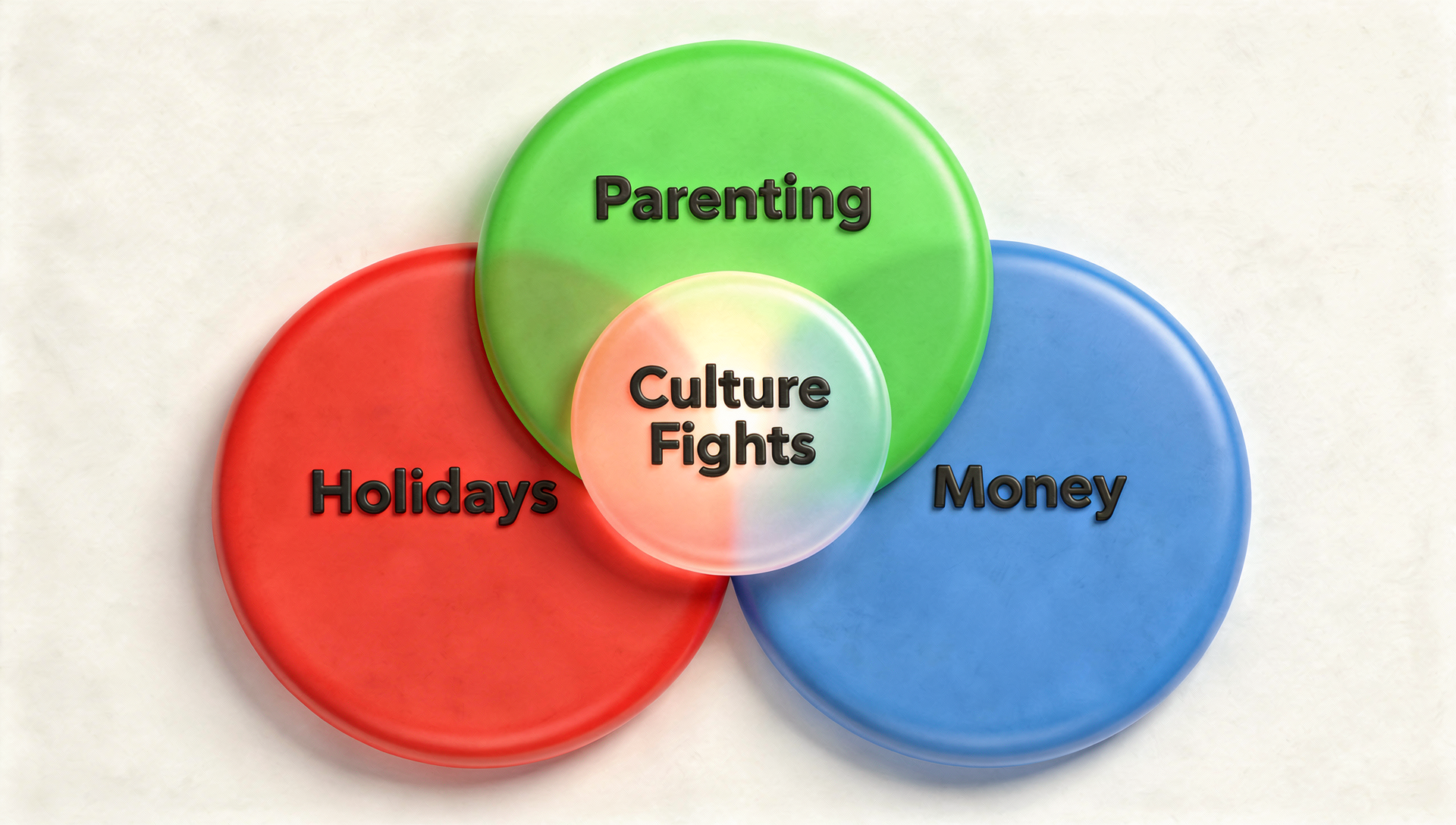 There are many places culture can create friction in a marriage.
But for most cross cultural Christian couples, the biggest and most frequent culture fights show up here:
- Holidays and family events
- Money requests and financial expectations
- Parenting decisions and child raising
If you look back over your last year of arguments, chances are these three categories hold the heaviest ones.
They also tend to overlap.
- A holiday trip that costs more than you planned.
- A parenting decision influenced by grandparents.
- A money request that shows up right before a big family event.
So it can feel chaotic and personal.
This is why your marriage needs a clear framework like the one we talk about in The United Front: The Missing Skill in Cross-Cultural Christian Marriage. Without a united front, every culture fight around holidays, money, or parenting becomes another wedge between you.
Let us look at each area more closely.
Holidays: Where Culture Fights Show Up On The Calendar
 Holidays are supposed to be restful and joyful.
Yet for many cross-cultural couples, they are exhausting and full of tension.
Common holiday questions:
- Which side do we visit first
- How long do we stay with each family
- Who pays for travel and hosting
- What traditions do we include or leave out
- Who gets invited to stay in our home
On the outside, it looks like you are arguing about plane tickets and dates. Inside, culture fights show up as:
- I feel guilty if we do not follow my family’s pattern
- I feel disrespected when your family always gets more time
- I feel like our marriage does not get a say
- I feel like the kids are being dragged instead of cared for
You might hear phrases like:
- In our culture, we always go to the husband’s side first.
- My parents expect us to be there every year.
- They will say you changed after you got married.
- You know how much they sacrificed for us.
Holidays carry the memory of your whole childhood. They represent connection, sacrifice, joy, and sometimes pain.
So when you try to change the pattern, it can feel like you are rewriting history.
This is why we devoted a whole article to The Holiday War: How to Stop Dreading Family Time. That guide walks you step by step through planning holidays with a united front.
When you remember that holidays are one of the key places culture fights show up, you can stop being surprised by the intensity. Instead, you can say:
- Of course this feels big. This is about identity and loyalty, not just travel plans.
From there, you can start asking better questions:
- What do we want our children to remember about holidays
- How can we honor both families without letting them run our calendar
- Where can we say yes freely, and where do we need a loving no
Money: Where Culture Fights Show Up In Your Wallet
 If holidays reveal culture on the calendar, money reveals culture in your wallet.
In many tight knit or cross cultural families, money is not just math. It is:
- Gratitude
- Honor
- Responsibility
- Proof that you remember where you came from
So when money requests come from family, you are not just deciding about numbers. You are deciding:
- Do I honor my parents and relatives the way they expect
- Do I live out the generosity my culture taught me
- Do I prove my love and loyalty
Your spouse might experience the same moment very differently:
- Are our bills going to be paid
- Do I have a voice in what we give
- Do I come second to your family’s needs
This is exactly what we unpack in Money Requests From Family – A Christian Way to Decide. Culture fights show up here as conflicting assumptions:
From one side:
- Of course we help. That is what family does.
- They were there for us when we had nothing.
- Saying no feels cruel and ungrateful.
From the other side:
- We cannot say yes just because we feel guilty.
- Our kids and our marriage also need protection.
- We need a plan we both agree on.
When you do not name these holidays, money, parenting culture fights, you end up having the same late night arguments again and again.
You are not just fighting about whether to send money. You are fighting about:
- Who gets to decide
- Whether your marriage is a team
- Which culture sets the rules for generosity
The goal is not to become stingy and cold. The goal is to move your giving from panic and pressure to prayerful, united decisions.
That is why creating a giving plan together is one of the central steps in handling money culture fights in a healthier way. It lets you say to family:
- We love you, and this is what we are able to do.
Instead of:
- I promised them something, now we have to figure it out.
Parenting: Where Culture Fights Show Up In Your Living Room
 If holidays touch your calendar and money touches your wallet, parenting touches your heart.
Parenting may be the most intense place that holidays, money, parenting culture fights show up.
Why
Because now it is not only about how you were raised. It is about how you are raising the next generation.
Common conflict areas in parenting:
- Discipline style
- Language use at home
- School and church choices
- How much grandparents should influence decisions
- Gender roles and responsibilities for kids
Each culture brings deep convictions:
- Children should be obedient and respectful to elders.
- Children should be encouraged to ask questions.
- Children should be fluent in the heritage language.
- Children should be fluent in the main local language.
When you and your spouse grew up in different systems, those convictions can collide.
One partner might say:
- In my culture, a child would never speak to elders like that.
The other might say:
- In my culture, it would be normal for a child to share their feelings.
Add grandparents and extended family, and the culture fights show up even more strongly.
You may hear:
- You are too soft.
- You are too strict.
- You are raising them to forget their roots.
- You are raising them in fear, not freedom.
This is why we created Parenting Across Cultures: Who Gets a Vote. It helps you sort out:
- Who gets input
- Who makes final decisions
- How to honor elders without giving them parental authority
The key is to remember that culture fights show up in parenting because you both care deeply.
You are not enemies here. You are two people who want to give your children the best of both worlds without the worst of either.
How Holidays, Money, Parenting Culture Fights Feed Each Other
One of the reasons these three areas feel so overwhelming is that they rarely stay separate.
A money request arrives right before a holiday trip.
Grandparents criticize your parenting when they visit for Christmas.
Travel decisions impact school routines and kids’ stability.
Soon, holidays, money, parenting culture fights blend into one big knot.
You might hear or think things like:
- Your family always gets more holiday time and more money, and they still criticize how we raise our kids.
- I am always the one trying to keep the peace between you and my parents.
- Our kids see us stressed every time grandparents visit or a money request comes.
It becomes tempting to think:
- Maybe cross cultural marriage is just too hard.
But the real problem is not that you come from different cultures. It is that you do not yet have shared agreements and skills for the places culture fights show up.
This is why the bigger series exists:
- Cross Cultural Couples Keep Fighting: The Real Reason You Cannot Get Past the Same Arguments shows you the repeating pattern.
- The United Front: The Missing Skill in Cross-Cultural Christian Marriage gives you the core skill.
- Then posts like The Holiday War: How to Stop Dreading Family Time, Money Requests From Family – A Christian Way to Decide, and Parenting Across Cultures: Who Gets a Vote apply that skill in each specific area.
You are not just collecting tips. You are learning how to face the three main places culture fights show up with a shared mindset and language.
Building A United Front Around Holidays, Money, Parenting Culture Fights
So what does it look like to actually respond differently when culture fights show up in holidays, money, and parenting
Here is a simple process you can use in each area.
1. Name the culture fight, not just the logistics
Instead of saying:
- You always side with your family.
Try:
- I think there is a culture fight showing up here around holidays, money, parenting. Can we slow down and talk about what this represents for each of us
Naming the pattern takes some of the shame and blame out of the room.
2. Share your meanings, not just your opinions
Each of you can answer:
- When I think about this holiday plan, what does it mean to me
- When I think about this money request, what does it prove or threaten inside
- When I think about this parenting decision, what am I afraid of losing
You will probably hear about:
- Respect
- Belonging
- Fear of gossip
- Fear of rejection
- Desire to honor God and family
Suddenly the culture fights around holidays, money, and parenting are not just about winning a point. They are about understanding each other’s hearts.
3. Decide your united front before talking to anyone else
Ask:
- What do we agree on as a couple
- Where can we compromise
- Where do we need to hold a firm line
Then, present decisions to others as a team, not as individuals.
This is what we practice in The United Front Conversation: Exactly What to Say. It gives you phrases that sound like:
- We have decided together
- In our home, we are choosing
Not:
- My wife does not want that.
- My husband will not allow that.
4. Accept that not everyone will understand
Even when you handle holidays, money, and parenting culture fights with grace, some people will still be upset.
That does not mean you betrayed your culture. It means you are growing.
You can still say:
- We love you.
- We respect you.
- This is the decision we are making as a couple.
You are choosing to believe that protecting your marriage will, in the long run, bless both sides of your family more than endless resentment and secret anger ever could.
How This Post Fits Your Cross Cultural Marriage Journey
You do not need one more vague piece of advice. You need a map.
Think of the series like this:
- Cross Cultural Couples Keep Fighting: The Real Reason You Cannot Get Past the Same Arguments helps you see the pattern of repeating fights.
- Marriage First Doesn’t Mean Family Last resets your loyalty order.
- The United Front: The Missing Skill in Cross-Cultural Christian Marriage gives you the core skill.
- The Holiday War: How to Stop Dreading Family Time, Money Requests From Family – A Christian Way to Decide, and Parenting Across Cultures: Who Gets a Vote then help you apply that united front in the three main places culture fights show up.
This particular article is your high level lens. It reminds you that when you catch yourselves spiraling around holidays, money, and parenting, you are not crazy and you are not alone.
You are simply standing in the three main arenas where culture fights show up in almost every cross cultural Christian marriage.
The good news is that with awareness, language, and a united front, those same arenas can become places where you and your spouse grow closer, deepen trust, and create a new kind of family culture for your children.
You do not have to dread holidays.
You do not have to panic about money requests.
You do not have to feel pulled apart over parenting.
You can learn to face all three together.
Because holidays, money, parenting are not just where culture fights show up.
They can also become the places where God slowly builds a new story of unity in your home.