Honor Your Parents Without Betraying Your Spouse
By Pesa Shayo ·
If you grew up in a culture where honoring parents is sacred, even reading the words Honor Your Parents Without Betraying Your Spouse can make your chest tighten.
Because very quietly, this is the fear you live with:
If I honor my parents
My spouse will feel second.
If I protect my spouse
My parents will feel disrespected.
So you bounce between two worlds.
With your parents you try to be the good son or daughter.
With your spouse you try to be the loyal husband or wife.
And when those worlds collide, you are the one who feels ripped in half.

If you do not learn how to honor your parents without betraying your spouse, you will eventually lose trust with one of them.
Either your parents will feel abandoned.
Or your spouse will feel like they never really became your first human priority.
This guide will show you a sane, Christ centered way through, especially as a cross cultural couple. It connects with the rest of our United Front series, including:
- The Loyalty Ladder: God, Spouse, Kids, Then Family
- Stop Letting In Laws Drive Your Marriage
- How To Set Boundaries Without Being “Disrespectful”
- When Your Spouse Feels Second To Your Family
- What to Do When Family Criticizes Your Spouse
- The United Front Conversation: Exactly What to Say
Think of those as the toolbox. This article is the specific project where you finally use the tools.
Why Honor Your Parents Without Betraying Your Spouse Feels Impossible

The command to honor your father and mother is not a suggestion. It is one of the Ten Commandments. For many of us, it was drilled into our hearts since childhood.
Add culture and it gets even more intense.
You grew up hearing:
- “Family is everything.”
- “Children must always obey parents.”
- “You never say no to elders.”
Then you got married.
Now there is another covenant in the mix, and Scripture says:
- Leave and cleave
- Two become one flesh
- What God joined together, let no one separate
There is no verse that says:
- “Honor your father and mother, unless your spouse is offended”
So your brain tries to find a way to honor parents and protect your marriage. Most of us land in one of two unhealthy places.
Option 1: You sacrifice your spouse on the altar of honor
You keep parents happy and spiritual sounding. You say:
- “This is my culture.”
- “This is honor.”
- “God will reward my sacrifice.”
Meanwhile your spouse hears:
- “You come after them.”
- “I will not protect you from their comments.”
- “If I have to choose, I will choose them.”
This is the pain we unpack in When Your Spouse Feels Second To Your Family.
Option 2: You cut off your parents to prove loyalty to your spouse
You get tired of the pressure, and you swing to the other extreme.
You barely visit.
You ignore calls.
You avoid every hard conversation with them.
Your spouse feels safer, at least for a while. But eventually you notice:
- You feel guilty and ashamed.
- You miss your parents and your culture.
- You are carrying anger instead of healthy distance.
This does not feel like a Jesus response either.
To honor your parents without betraying your spouse, you need a third way. Something that is neither blind obedience nor total cut off.
What The Bible Actually Says About Honor And Loyalty
If you grew up in a strong family culture, you probably heard a lot of verses about honor. The problem is that many families quote half the story.
To truly honor your parents without betraying your spouse, you need the whole picture.
Honor is commanded, but obey is not forever
Children are commanded to obey their parents. Adult sons and daughters are commanded to honor.
Honor means:
- You treat parents with respect.
- You care about their wellbeing.
- You do not speak to them with contempt.
Honor does not mean:
- You always do what they say about your marriage.
- You let them pick your priorities.
- You allow them to divide you and your spouse.
The shift from obedience to honor is one of the keys that The Loyalty Ladder: God, Spouse, Kids, Then Family explains. Without that ladder, loyalty gets scrambled.
Leave and cleave is not a western idea, it is a biblical one
Some cultures say:
- “This is western thinking. In our culture, you never leave your parents.”
The problem is that leave and cleave is not from a western book. It is from Scripture.
To cleave means:
- Your spouse is now your primary human bond.
- Decisions about your home now belong to the two of you before God.
- No one else gets to sit in that first human seat.
You still honor parents. You no longer give them the steering wheel of your marriage.
Honor is not silence in the face of sin or harm
Sometimes “honor” is used to hide:
- Emotional abuse
- Control
- Disrespect toward your spouse or kids
In those moments, honoring your parents without betraying your spouse means you tell the truth with respect.
You might say:
- “I love you and I am grateful for you. I am not okay with the way you speak to my spouse. This needs to change.”
That is not dishonor. That is stewardship of your marriage.
For help spotting the difference between real honor and manipulation, go back to “Respect” vs Control: How to Tell the Difference.
The Loyalty Ladder And How To Honor Your Parents Without Betraying Your Spouse
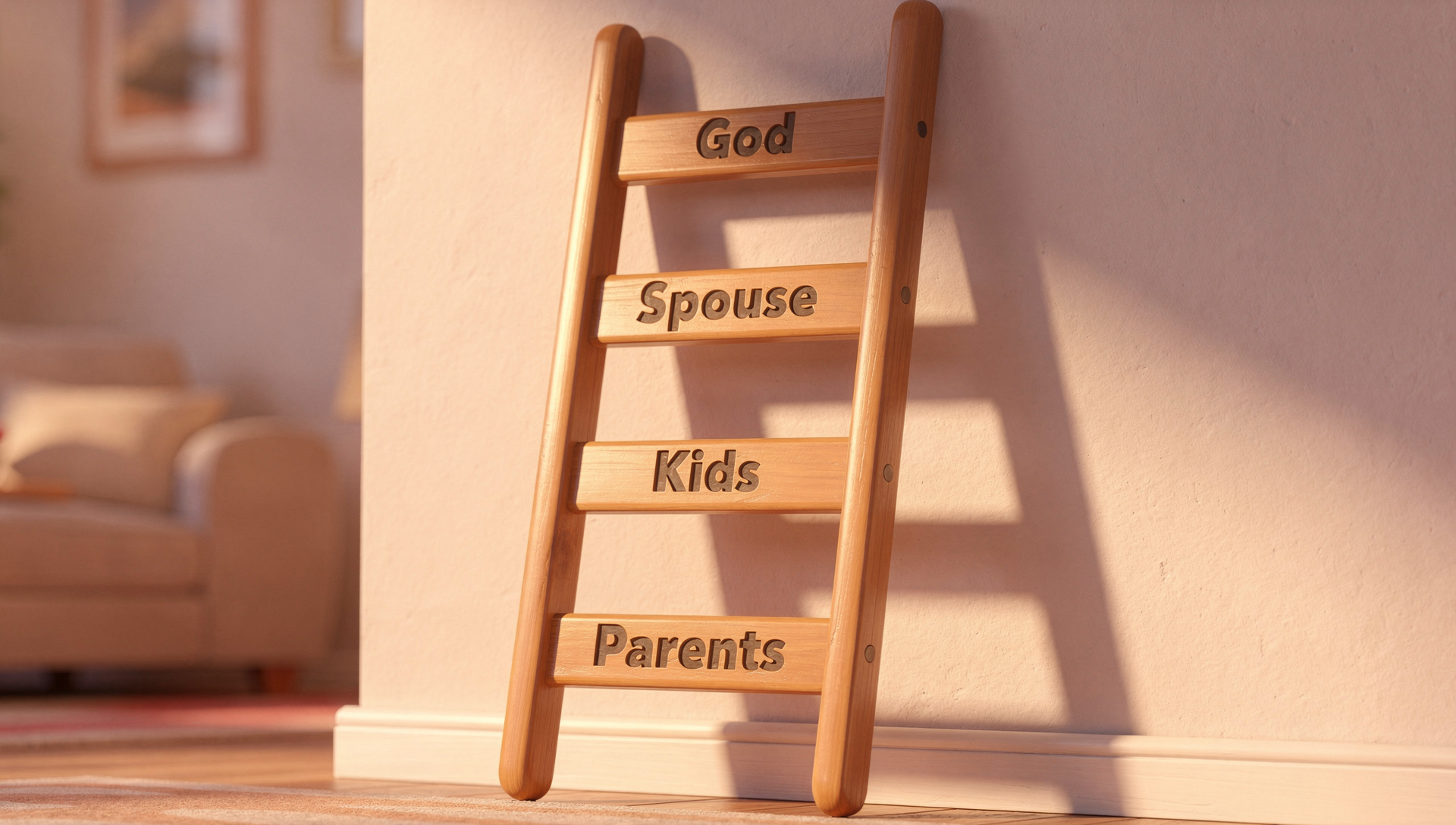
If you want a picture that stays in your mind, use the loyalty ladder.
From top to bottom:
- God
- Spouse
- Kids
- Parents and extended family
This is not American culture. This is a simple way to describe biblical patterns.
Here is what it means in practice for someone trying to honor parents without betraying your spouse.
- God’s voice comes first. If God wants peace and unity in your marriage, you do not sacrifice that just to avoid uncomfortable conversations with parents.
- Your spouse is your first human covenant. You do not promise loyalty at the altar then give a different loyalty at the family table.
- Your kids are looking to you for emotional safety. They need parents who protect the atmosphere of the home.
- Parents are honored in a strong fourth place. Not forgotten, not despised, not ignored, but also not allowed to move up above your spouse.
When you feel torn, ask:
- “What choice keeps this ladder in the right order”
The answer may be uncomfortable. It will also be freeing.
Three Ways You Might Be Betraying Your Spouse Without Realizing It
This part stings, but it is important.
Sometimes you feel loyal to everyone. Meanwhile your spouse feels betrayed and you cannot see why.
If you want to honor your parents without betraying your spouse, you need to understand how betrayal can sneak in.
1. You let parents or in-laws freely criticize your spouse
Maybe you stay quiet.
Maybe you laugh awkwardly.
Maybe you even join in.
You tell yourself:
- “They are just venting.”
- “They do not mean it.”
- “I do not want to start drama.”
Your spouse hears something else.
They hear:
- “I will not defend you.”
- “My parents’ peace matters more than your dignity.”
This is why we wrote What to Do When Family Criticizes Your Spouse. Silence in those moments feels like betrayal, even if you feel stuck.
2. You process every conflict with your parents before you process with your spouse
When something goes wrong in your marriage, who do you tell first
If the answer is always your parents, you are tying them to every weakness and struggle in your relationship.
Over time they collect:
- Every failure
- Every sin
- Every frustration
You may forgive and repair. They often do not.
To honor your parents without betraying your spouse, you must stop making your parents the main processing place for your marriage.
3. You make big decisions with parents, then present them to your spouse as a done deal
This might be about moving, money, visits, kids, or church.
When you say:
- “I already told my parents we would do this.”
- “My father expects this, so it is decided.”
You have removed your spouse’s voice and power.
You did not just honor your parents. You gave them your spouse’s seat at the table.
If this is you, do not drown in shame. But do be honest. To honor your parents without betraying your spouse, you have to change this pattern.
How To Honor Your Parents Without Betraying Your Spouse: Internal Shifts
 Before we talk scripts, you need a heart reset. Otherwise the words will fall flat.
1. Decide what kind of son or daughter you want to be now
You are not a child anymore.
You are an adult son or daughter who is also a husband or wife.
Ask yourself:
- “What does a godly adult child look like in this season”
Maybe it means:
- You call more often to check on them, even while holding boundaries.
- You show up in practical ways they actually need.
- You listen to their worries without letting them control your home.
Honoring parents without betraying your spouse means you upgrade your definition of honor.
2. Grieve the version of honor your parents may want from you
Some parents will only feel honored if:
- You obey them like a child
- You let them overrule your spouse
- You keep their secrets or dysfunction
You cannot give them that and keep your covenant at the same time.
It is okay to grieve that.
You might think:
- “I wish I could honor them in exactly the way they want and still be loyal to my spouse. I cannot. I have to choose God’s version of honor instead.”
This grief is real. Ignoring it does not make it go away.
3. See your spouse as part of how you honor your parents
Here is a secret that changes everything:
The way you treat your spouse is part of how you honor your parents.
Why
Because it is evidence of the kind of adult they raised.
When you protect your marriage covenant:
- You are living in wisdom
- You are breaking cycles of dysfunction
- You are creating a healthy model for the next generation
Even if your parents do not see it yet, honoring your parents without betraying your spouse means you treat your spouse as the gift God trusted you with, not as someone your parents can freely wound.
Scripts To Honor Your Parents Without Betraying Your Spouse
Now let us get practical. These are examples you can adapt, using the same rhythm as The United Front Conversation: Exactly What to Say.
When you need to set a new boundary
- “Mom and Dad, I love you and I am grateful for everything you have done for me. I also need to be honest that some of the comments about my spouse have been hurtful. I want to honor you without betraying my spouse. That means I will not participate in conversations that put them down.”
When they question your decisions as a couple
- “I hear that you would handle this differently. We appreciate your perspective. We have prayed and decided together as a couple. To honor you without betraying my spouse, I am going to stand with the decision we made.”
When they pressure you to choose them over your spouse
- “I understand this feels like I am choosing my spouse instead of you. I am choosing to follow the order God gave us. I will always love you and care about you, but I will not betray my spouse in order to make anyone feel better, even you.”
You may never say that last sentence aloud in exactly those words, but you need to say it in your own heart.
When you need to stop oversharing about your spouse
- “I realize I have shared too much about our marriage problems with you. I am sorry. I want to honor you without betraying my spouse, so from now on I am going to be more careful with what I share. If we need help, we will seek wise counsel together.”
These phrases are not magic. They are training wheels to help you walk out a new pattern.
Applying Honor Your Parents Without Betraying Your Spouse In Real Situations

Let us run this through the most common pressure points.
Holidays and visits
You can say:
- “We love family holidays and we value our time with you. We have decided that some years we will celebrate in our home as a couple. That is part of how we honor this marriage God gave us. We are learning to honor you without betraying each other, and that means our plans will not always match what you prefer.”
This connects directly with what you learned in The Holiday War: How to Stop Dreading Family Time.
Money requests
You can say:
- “We care about what you are facing and we want to help when we can. As a couple, we have a giving plan that allows us to be generous and still pay our responsibilities. To honor you without betraying my spouse and our children, we will stay within that plan. Sometimes that means we will say no.”
This flows with Money Requests From Family – A Christian Way to Decide.
Parenting and discipline
You can say:
- “We value your experience raising children and we are grateful for the things you did that shaped us. We are also responsible before God for how we raise our own kids. To honor you without betraying my spouse, we will not allow certain discipline methods in our home. We hope you can enjoy the children as grandparents while we lead as parents.”
That directly applies what you read in Parenting Across Cultures: Who Gets a Vote.
When extended family criticizes your spouse directly
You can say:
- “I know you might think you are helping by pointing out my spouse’s flaws. I am committed to working on our marriage directly with them. To honor you without betraying my spouse, I will not have more conversations where we tear them down.”
That is a lived expression of What to Do When Family Criticizes Your Spouse.
How To Repair With Your Spouse If You Have Chosen Parents Before
You might be reading this and thinking:
- “I have already betrayed my spouse. Many times.”
If that is you, here is the good news.
Repentance and repair are still possible.
Here is how to start.
1. Name it clearly
Sit with your spouse and say something like:
- “I see that I have often put my parents ahead of you, especially in these ways. I realize that when I did that, you felt betrayed. I am sorry. I want to learn how to honor my parents without betraying you.”
Be specific if you can:
- Times you stayed silent
- Times you shared too much
- Times you made decisions with parents then informed your spouse later
2. Invite their honest perspective
Ask:
- “How has my relationship with my parents or in-laws made you feel unsafe or second in our marriage”
Listen without defending your parents.
Listen without explaining away your choices.
This conversation will connect with what you already saw in When Your Spouse Feels Second To Your Family.
3. Share what you will do differently
Do not just say “sorry.” Say “here is what changes now.”
For example:
- “From now on, if someone in my family criticizes you, I will speak up.”
- “I will not decide visits and money with my parents before talking to you.”
- “If my parents ask for something that affects us, my answer will always be ‘I need to talk with my spouse first.’”
4. Give them permission to gently call you out
Tell them:
- “If you see me slipping back into old patterns, I want you to tell me. You can say ‘This feels like you are choosing them over me’ and I will listen and adjust.”
That is what real change looks like in someone who wants to honor parents without betraying your spouse.
How This Fits The United Front Journey
This post is part of a bigger journey where you move from feeling split between parents and spouse to feeling grounded, clear, and united.
You have already seen:
- Why cross cultural couples keep repeating the same arguments in Cross Cultural Couples Keep Fighting.
- How to set boundaries with elders without erupting in How To Set Boundaries Without Being “Disrespectful”.
- How to reorder your loyalties in The Loyalty Ladder: God, Spouse, Kids, Then Family.
- How to stop letting in-laws steer in Stop Letting In Laws Drive Your Marriage.
- How to use exact wording in The United Front Conversation: Exactly What to Say.
This article sits right in the center.
It answers the question:
- “Can I really honor my parents without betraying my spouse”
Yes. You can.
It will not always feel comfortable.
Some people will not understand at first.
But you can live in a way that:
- Treats parents with real respect
- Loves your culture
- Protects your spouse
- Keeps God at the top of the ladder
That is what healthy, grown, cross cultural Christian loyalty looks like.
And over time, as they watch you love your spouse well and still show up for them in the right ways, some parents will see that you did not become less honorable.
You became more whole.